
How to Troubleshoot Flickering Lights Safely

Why Flickering Lights in Michigan Homes Deserve a Closer Look
Flickering lights, what causes them, and when to call an electrician in Michigan are questions every homeowner in Metro Detroit should know the answers to — because the difference between a loose bulb and a fire hazard can look exactly the same from across the room.
Here's a quick breakdown to address your concern right now:
Common causes of flickering lights:
- Loose or improperly seated light bulb
- Incompatible bulb and dimmer switch combination
- Voltage drop when a large appliance (AC, microwave) starts up
- Faulty or worn-out light switch
- Overloaded circuit
- Loose or damaged wiring connections
- Problems at the main electrical panel or service entrance
- Utility-side issues from your provider (DTE Energy, Consumers Energy)
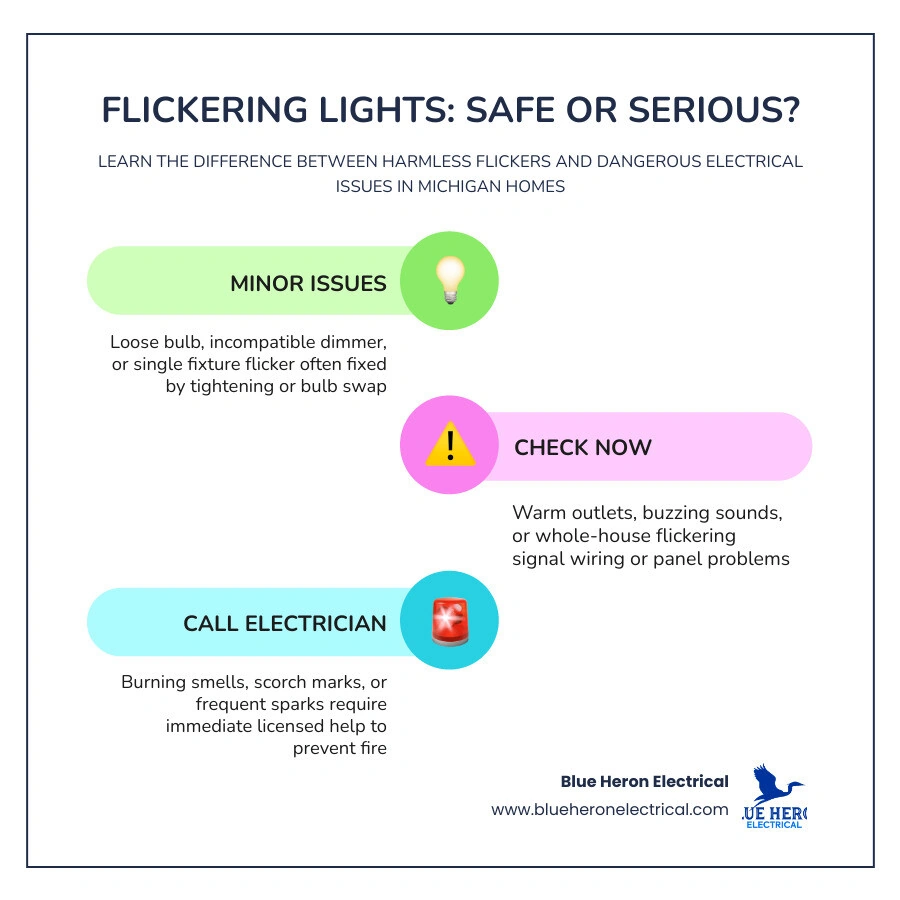
When to call a licensed electrician — do not wait if you notice:
- Flickering that affects multiple rooms or the entire house
- A burning smell near outlets, switches, or your panel
- Switch plates or outlet covers that feel warm to the touch
- Buzzing or humming sounds coming from walls or your panel
- Visible scorch marks or sparks anywhere in the home
- Flickering that is frequent, worsening, or has no obvious cause
For most Michigan homeowners, occasional flickering tied to a single fixture is a minor nuisance. But in older Metro Detroit homes — many of which still carry aluminum wiring, knob-and-tube systems, or undersized 100-amp panels — flickering lights can be an early warning sign of something far more serious. Electrical malfunction is responsible for roughly 7.7% of residential fires in the U.S., accounting for approximately 26,100 house fires every year. That's not a statistic worth ignoring.
In the sections below, Blue Heron Electrical walks you through how to read the signs, what's safe to check yourself, and exactly when it's time to pick up the phone.
Flickering Lights: What Causes Them and When to Call an Electrician in Michigan
To understand why your lights are blinking like an amateur Morse code operator, it helps to understand how electricity moves through your home. Think of your electrical system as a plumbing network, but instead of water, it carries current. When something restricts or disrupts that flow, you get voltage fluctuations. In lighting, these fluctuations manifest as visible flickers or sudden dims.

Let's look at the most common culprits behind this phenomenon:
Loose or Faulty Bulbs
Sometimes, the solution is so simple it's almost embarrassing. If a single light bulb is flickering, it may simply be loose in its socket. Over time, the subtle vibrations of your home (from foot traffic, washing machines, or seasonal temperature changes) can cause a bulb to back out of its connection just enough to disrupt the electrical contact.
Dimmer Switch Incompatibility
This is one of the most frequent calls we get in the Metro Detroit area. Many older homes have traditional dimmer switches designed strictly for incandescent bulbs. When you swap those out for modern, energy-efficient LED bulbs, they often begin to flicker rapidly. Traditional dimmers work by quickly cutting the power to the bulb dozens of times per second. While incandescent filaments hold heat and don't show this rapid cycling, LEDs respond instantly, resulting in a strobe-like flicker.
Voltage Drops from Large Appliances
Have you ever noticed your lights dim for a brief second when your central air conditioning compressor kicks on during a humid July afternoon in Troy or Sterling Heights? This happens because large motors draw up to three to five times their normal running current for a brief second during startup. If your lights dim momentarily and then return to normal, it is usually a harmless voltage drop. However, if they continue to flicker or dim deeply for several seconds, your system is struggling to supply the necessary power.
Understanding these basic triggers is the first step toward keeping your home safe. If you want to dive deeper into why ignoring these signs can lead to major safety risks, take a moment to read about Why Flickering Lights Should Never Be Ignored.
Simple Bulb and Switch Issues vs. Serious Electrical Faults
How do you know when to grab a screwdriver and when to grab your phone? A structured decision-making process can keep you safe and save you unnecessary stress.
To isolate the issue, start with these simple DIY troubleshooting steps:
- Turn off the power first: Before touching any bulb or fixture, turn off the light switch. If you are inspecting a socket, it is always safest to shut off the corresponding breaker at your main panel.
- Tighten the bulb: Once the bulb has cooled down, verify that it is screwed firmly into the socket.
- Swap the bulb: If a bulb continues to flicker, replace it with a brand-new one of the correct wattage. If the flickering stops, you simply had a failing bulb.
- Check the switch: Gently wiggle the light switch toggle. If the light flickers as you touch or move the switch, the internal contacts of the switch itself are worn out and arcing.
If the issue persists after swapping the bulb and verifying switch stability, you are likely dealing with a loose connection deeper in the circuit. Loose wire nuts inside a junction box, backstabbed wiring connections behind an outlet, or corroded terminals can cause high-resistance points. These points generate heat, which can deteriorate surrounding insulation and spark a fire.
If you suspect your outlets or wall switches are failing, you can learn more about identifying these dangers in our guide on Common Outlet Problems and What They Mean for Your Electrical System.
Flickering Lights: What Causes Them and When to Call an Electrician in Michigan for Older Homes
Metro Detroit is rich with historic charm, but with historic charm comes historic wiring. If your home in Royal Oak, Birmingham, or Rochester Hills was built several decades ago, its electrical system was never designed to handle the massive power demands of modern life. In 2026, our homes are packed with high-draw appliances, electric vehicle chargers, smart devices, and advanced HVAC systems.
Older homes present several unique electrical challenges:
Aluminum Wiring (Common from 1965 to 1973)
During a copper shortage in the late 1960s and early 1970s, many homes were built using aluminum branch circuit wiring. Aluminum expands and contracts at a much higher rate than copper when heated by electrical current. This "thermal creep" causes connections at outlets, switches, and light fixtures to loosen over time. Furthermore, aluminum oxidizes quickly, creating a high-resistance layer that leads to severe arcing and flickering. If your home has aluminum wiring, it requires specialized CO/ALR-rated devices and anti-oxidant joint compound at all connection points to prevent fire hazards.
Knob-and-Tube Wiring (Common before 1950)
Found in many of our historic neighborhoods, knob-and-tube wiring consists of single insulated conductors run through porcelain insulating tubes and supported by porcelain knobs. This system lacks a safety ground wire, relies on rubber insulation that becomes brittle with age, and is easily damaged by modern home renovations or DIY insulation additions.
Undersized 100-Amp Panels
While a 100-amp electrical panel was more than enough for a household in the mid-20th century, it is easily overloaded today. When your panel is pushed to its absolute limit, voltage drops occur across your entire home, causing widespread light flickering.
If you suspect your older home’s electrical system is struggling to keep pace, read our comprehensive guide on When to Upgrade Wiring in an Older Home and What to Expect to understand your options.
Diagnosing the Scope: Single Room vs. Whole-House Flickering
When diagnosing flickering lights, the most important clue is scope. Where is the flickering happening, and what triggers it?
Flickering Confined to a Single Room or Circuit
If the flickering is isolated to one room, a single light fixture, or a specific group of outlets, the issue is local. This typically points to:
- A loose wire nut inside a local junction box.
- A faulty wall switch controlling that specific room's lights.
- An overloaded branch circuit where high-draw appliances (like a vacuum cleaner or space heater) are sharing a circuit with your lights.
Flickering Throughout the Entire House
If every light in your home is flickering simultaneously, you are dealing with a systemic issue that originates at your main electrical panel, your main service entrance, or from the utility company. This is a high-priority situation that requires professional attention. Whole-house flickering is frequently caused by:
- A loose or deteriorating main neutral connection: If the main neutral wire coming from the utility pole or transformer is loose or corroded, it can cause extreme voltage imbalances. Some lights in your home may dim significantly, while others on the opposite phase may suddenly grow dangerously bright. This can destroy sensitive electronics and pose an immediate fire hazard.
- Main panel bus bar degradation: Corroded or loose main breakers can cause intermittent contact, leading to whole-house power fluctuations.
If you live in Royal Oak or the surrounding areas and notice these systemic warning signs, you should immediately check out our professional Electrical Panel Services in Royal Oak MI to ensure your system is safe and stable.
Flickering Lights: What Causes Them and When to Call an Electrician in Michigan After Storms
Michigan weather is notoriously unpredictable. From heavy winter ice storms to high-velocity summer winds, our climate puts incredible stress on the outdoor utility infrastructure.
If your lights begin to flicker wildly during or immediately after a major storm, the cause is almost always external:
- Wind-Induced Flickering: High winds can sway overhead utility lines, causing tree branches to make intermittent contact with the wires. This creates brief, repeated short circuits that cause voltage sags in nearby homes.
- Deteriorated Service Drop Connections: The overhead service wires connecting your home's weatherhead to the utility pole are subject to constant physical strain. Ice accumulation and wind can loosen these connections at the mast or the meter base.
- Utility Grid Strain: Major storms can damage transformers, blow substation fuses, or disrupt the local grid, causing unstable voltage delivery to your entire neighborhood.
If the flickering is happening across your entire neighborhood, contact your utility provider (DTE Energy or Consumers Energy) first to report the issue. However, if your neighbors have perfectly stable power and your home is the only one flickering after a storm, a physical connection on your property may have been damaged.
In these situations, do not touch any outdoor lines. Instead, contact a licensed professional immediately. Our team at Blue Heron Electrical is ready to assist with our 24/7 Emergency Electrician services to safely restore your home's power.
Warning Signs of a Serious Fire Hazard
While some flickering is harmless, other scenarios are direct warning signs of an active fire hazard. Electrical arcing — where current jumps across a gap in a damaged or loose connection — can easily exceed temperatures of 10,000 degrees Fahrenheit. This intense heat can ignite wood framing, drywall paper, and wire insulation within seconds.
If your flickering lights are accompanied by any of the following warning signs, cut power at the main breaker immediately and call an emergency electrician:
- A distinct burning smell: A fishy, plastic-like, or metallic burning odor near outlets, switches, or the electrical panel indicates that wire insulation is actively melting.
- Warm switch plates or outlets: No electrical device on your wall should ever feel hot to the touch. If a switch plate is warm, it means arcing is occurring behind the drywall.
- Buzzing, sizzling, or cracking sounds: If you hear a faint sizzling or popping sound coming from your walls or your electrical panel when the lights flicker, you are hearing the sound of electricity arcing across a loose connection.
- Visible sparks or scorch marks: If you see sparks when plugging in a device or notice dark discoloration around your outlet slots or switch plates, the system is actively failing.
Your electrical panel is the heart of your home's safety system. If it is outdated, damaged, or unable to handle modern power demands, it can fail to trip when these hazards occur. Learn how to evaluate your system by reading about the Signs Your Electrical Panel Is No Longer Safe for Modern Power Needs.
If you already know your panel is outdated, we can help you upgrade to a modern, code-compliant system through our Electrical Panel Upgrades in Royal Oak MI.
How to Prevent Flickering and Protect Your Home's Electrical System
Preventative maintenance is the best way to keep your home safe, protect your expensive electronics, and eliminate annoying flickers before they start.
Here is a comparison of how you can protect your home's appliances and lighting systems from voltage fluctuations:
| Feature | Point-of-Use Surge Protectors | Whole-Home Surge Protection |
|---|---|---|
| Installation Area | Plugs directly into individual wall outlets. | Installed directly inside your main electrical panel. |
| Scope of Protection | Protects only the devices plugged into that specific strip. | Protects every outlet, light fixture, and appliance in the home. |
| Source of Surges Managed | Primarily protects against small, localized internal surges. | Defends against massive external surges (lightning, utility switching). |
| Lifespan & Maintenance | Needs replacement every 2–3 years as internal components degrade. | Long-lasting commercial-grade protection with status indicators. |
Beyond surge protection, here are three essential steps to keep your electrical system in peak condition:
- Distribute Electrical Loads: Avoid plugging multiple high-draw appliances (like space heaters, microwaves, or hair dryers) into the same circuit.
- Install Dedicated Circuits: High-draw equipment like sump pumps, hot tubs, and EV chargers should always run on their own dedicated circuits to prevent voltage sags on your lighting circuits.
- Schedule Routine Inspections: Having a licensed electrician inspect your panel connections, torque your breakers to manufacturer specifications, and check your grounding system every few years can catch loose connections before they cause flickering or fires.
If you are wondering whether your home is adequately protected against Michigan's frequent summer storms and winter grid strains, read our guide on How to Tell If Your Home Needs Whole House Surge Protection.
Ready to secure your home? Our team offers expert installations for Whole Home Surge Protection Troy MI.
Frequently Asked Questions About Flickering Lights
Why do my lights flicker when the air conditioner turns on?
When your central air conditioning compressor starts up, it requires a massive, temporary surge of electrical current (often 30 to 50 amps) to get the motor spinning. This sudden draw causes a brief voltage drop across your home's electrical system, which makes your lights dim for a split second.
While a very brief, minor dimming is normal, prolonged or severe flickering means your electrical panel is struggling to distribute the load. The best solution is to have an electrician install a dedicated circuit for your HVAC system or install a soft-start kit on your AC compressor. If you suspect your breakers are struggling, explore our professional Circuit Breaker Services in Royal Oak MI.
Can a bad circuit breaker cause lights to flicker?
Yes. If a circuit breaker is worn out, damaged, or has a loose connection where it clips onto the main electrical panel's copper bus bar, it will create intermittent electrical contact. This poor connection restricts current flow and causes the lights on that specific circuit to flicker.
Over time, this loose connection generates intense heat that can damage the surrounding breakers and the panel itself. If you suspect a breaker is failing, do not attempt to replace it yourself. Contact us for professional diagnostics and Electrical Panel Repair Troy MI.
Is it normal for LED lights to flicker on a dimmer switch?
It is very common, but it is not "normal" or healthy for the bulbs. This issue almost always stems from a compatibility mismatch. Older dimmer switches control light levels by slicing the electrical current. Because LEDs operate on low-voltage direct current (DC) managed by an internal electronic driver, these rapid interruptions cause the driver to cycle on and off, resulting in a rapid flicker. To resolve this, you must replace the old switch with a modern dimmer rated specifically for LED lighting, and ensure the LED bulbs themselves are labeled as "dimmable."
Conclusion
At Blue Heron Electrical, we believe your home should be your safe haven, not a source of worry. While a flickering light can sometimes be resolved with a simple twist of a new light bulb, it is often a quiet warning sign from your electrical system that something deeper needs attention.
Our team of highly trained, fully licensed electricians serves communities across Metro Detroit and Oakland County — including Royal Oak, Troy, Rochester Hills, Sterling Heights, and Birmingham. We are committed to providing dependable, code-compliant workmanship, clear communication, and a relentless focus on your family's safety and long-term reliability.
Don't leave your home's safety to chance. If you are experiencing persistent flickering lights, warm switches, or suspect your older electrical panel is no longer up to the task, let us help.
- Ready to speak with an expert? Contact our friendly team today.
- Want to schedule an inspection? Schedule Professional Electrical Services in Metro Detroit to restore safety, comfort, and peace of mind to your home.
Customer Testimonials

Service Areas