

How to Rewire a Home in Michigan Without Permit Issues
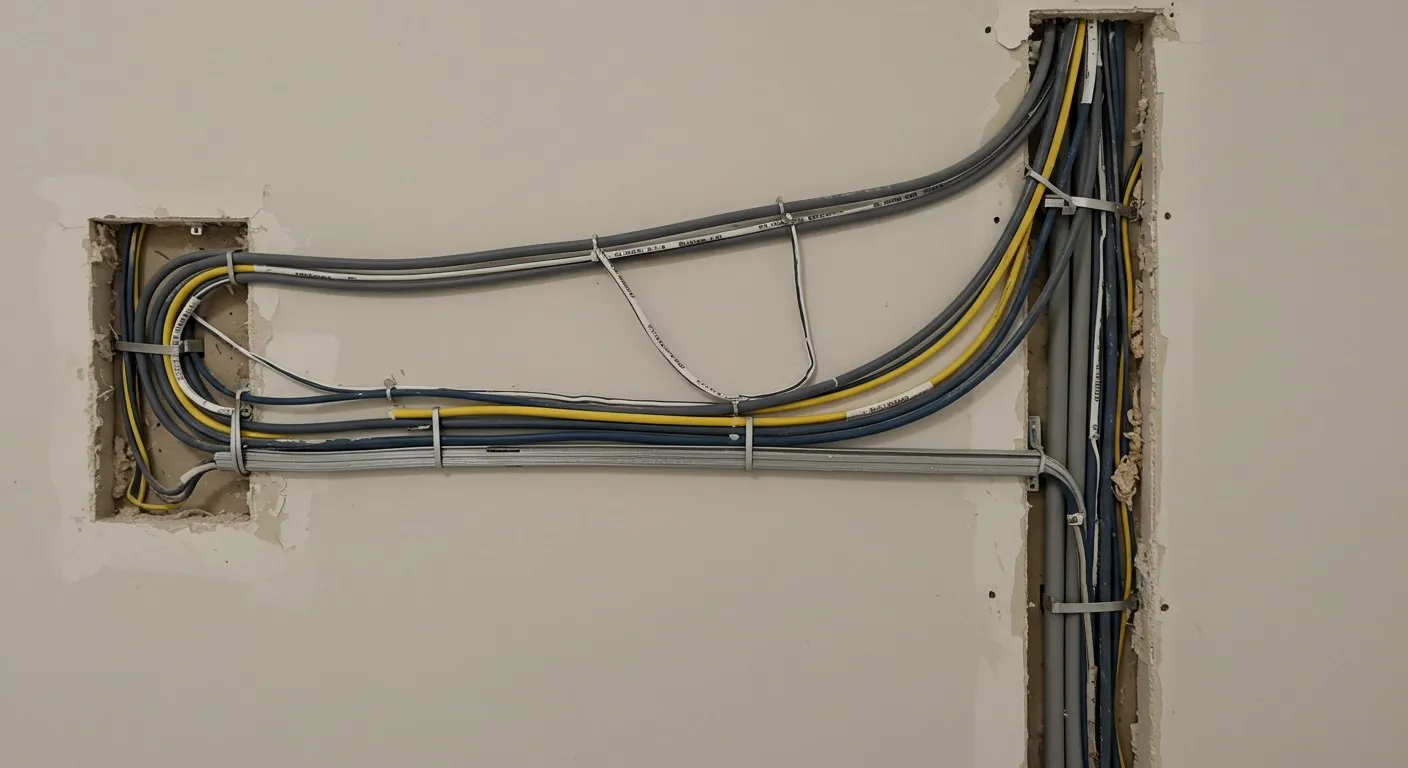
Does Rewiring a Home in Michigan Require a Permit? Here's the Short Answer
Does rewiring a home require a permit in Michigan? Yes — and there are no real exceptions for major electrical work. Michigan state law is clear: you cannot equip a building with electrical wiring or make any alteration, addition, or change to an electrical system without first obtaining a permit. This applies to full home rewires, panel replacements, new circuit additions, and most other significant electrical work.
Quick Answer: When Is an Electrical Permit Required in Michigan?
| Type of Work | Permit Required? |
|---|---|
| Full home rewiring | Yes |
| Adding new circuits | Yes |
| Electrical panel replacement or upgrade | Yes |
| Installing new outlets or switches | Yes |
| Any work that opens walls to access wiring | Yes |
| Replacing a light bulb or lamp | No |
| Connecting a portable appliance to an existing outlet | No |
| Minor maintenance and repairs | No |
For Metro Detroit homeowners dealing with outdated panels, flickering lights, or aging wiring, the permitting process can feel like one more hurdle. But permits exist for a straightforward reason — they protect you, your family, and your home's value. Skipping a permit on a rewiring project can create serious problems down the road, from insurance denials to complications when selling your home.
This guide walks you through exactly what Michigan requires, who can pull a permit, and how the inspection process works — so your project goes smoothly from start to finish.
Does Rewiring a Home Require a Permit in Michigan?
To understand why does rewiring a home require a permit in michigan, we have to look at how the state regulates construction. Under the Michigan Residential Code and rules set by the Department of Licensing and Regulatory Affairs (LARA) Bureau of Construction Codes, electrical safety is strictly enforced. The state's primary legal framework comes from the Stille-DeRossett-Hale Single State Construction Code Act (Act 230 of 1972). This act mandates that before any electrical conductors or equipment are installed, altered, changed, or added to, a proper permit must be issued by the enforcing agency.
Whether you are performing a complete overhaul or upgrading specific parts of your home's electrical system, you will need to ensure a permit is pulled. This is especially true for projects involving our Residential Electrical services, where safety and code compliance are the top priorities.
To help clear up any confusion, here is a detailed breakdown of what requires a permit versus what is generally exempt under Michigan administrative rules:
| Permit Required | Exempt from Permits |
|---|---|
| Replacing a main electrical service panel | Replacing a burnt-out light bulb or lamp |
| Running new electrical wires through walls | Connecting approved portable appliances to existing receptacles |
| Adding new dedicated circuits (e.g., for an EV charger or hot tub) | Replacing an existing, broken wall switch or outlet (like-for-like) |
| Replacing knob-and-tube or aluminum wiring | Testing or temporary systems used in laboratory environments |
| Installing new hardwired light fixtures where none existed | Reinstalling a plug-in appliance |
What electrical work can be done without a permit in Michigan?
While the law is strict, Michigan does allow for minor repairs and routine maintenance without requiring you to file paperwork or pay fees. According to Michigan Administrative Code R 408.30560, "minor repair work" is exempt from permit requirements.
But what exactly counts as minor? The rule defines this as the replacement of lamps or the connection of approved portable electrical equipment to approved, permanently installed receptacles. In other words, if you are simply plugging in a new microwave, swapping out a light bulb, or changing a broken outlet cover, you do not need to notify the local building department.
However, as soon as you modify the physical wiring, run new cables behind drywall, or change the capacity of your electrical system, you have crossed the line into permit-required territory.
What happens if you rewire a house without a permit in Michigan?
It is always tempting to skip the permitting process to save time, but doing so can result in serious legal, financial, and safety consequences:
- Home Sales Hurdles: When you eventually sell your home in Metro Detroit, the buyer's home inspector will look closely at the electrical system. If they find brand-new wiring but no record of a permit or inspection with the local municipality, the sale can grind to a halt. You may be forced to obtain retroactive permits before the title can transfer.
- Retroactive Permit Pain: To issue an "after-the-fact" or retroactive permit, local building inspectors will require proof that the work was done to code. This often means hiring a licensed contractor to inspect the work, which may involve tearing open finished drywall so the inspector can view the rough-in wiring.
- Insurance Denials: If an unpermitted electrical installation causes a fire or significant property damage, your homeowner's insurance policy may contain clauses that allow the insurer to deny your claim entirely.
- Local Penalties: Municipalities can issue "Stop Work" orders, assess double permit fees as penalties, or even issue citations for code violations.
Understanding the Michigan Electrical Code and Older Homes
Michigan's electrical regulations are not arbitrary; they are based on the National Electrical Code (NEC). The state adopts the NEC on a regular cycle, incorporating specific state-level technical amendments (known as Part 8 amendments) to form the Michigan Electrical Code.
For homeowners living in historic or older properties throughout Metro Detroit, these code updates have a major impact. If you own a home built before 1980 in areas like Troy, Birmingham, or Royal Oak, your electrical system likely reflects the codes of the era in which it was built. While older systems are generally "grandfathered" in—meaning you aren't legally required to upgrade them just because the code changed—the moment you begin a major renovation or rewiring project, you must bring the modified areas up to the modern standards of the current Michigan Electrical Code.
Many of these older properties still contain outdated, hazardous wiring methods. If you are dealing with active legacy systems, it is highly recommended to read about When to Upgrade Wiring in an Older Home and What to Expect to understand the scope of bringing an older system into the modern era. Additionally, homes featuring vintage systems should seek specialized Knob and Tube Rewiring Troy MI solutions to eliminate fire hazards.
Why Does Rewiring a Home Require a Permit in Michigan for Older Properties?
Older homes present unique safety hazards that modern codes are specifically designed to address. This is why municipalities pay extra attention to permits for older properties:
- Knob-and-Tube Wiring: Common in homes built before 1940, knob-and-tube systems lack a grounding conductor. Over time, the porcelain knobs can crack, and the rubberized cloth insulation can crumble, leaving bare wires exposed to wooden framing.
- Aluminum Branch-Circuit Wiring: Widely installed between 1965 and 1973, aluminum wiring is prone to oxidation and expansion/contraction at connection points, which can loosen connections and create severe fire hazards.
- Ungrounded Circuits: Pre-1968 homes often feature two-prong outlets without an equipment grounding conductor, leaving modern electronics vulnerable to surges and increasing the risk of electrical shock.
- Modern AFCI and GFCI Protection: Under the current code, any modified or newly installed circuits must feature Arc-Fault Circuit Interrupter (AFCI) protection to prevent electrical fires and Ground-Fault Circuit Interrupter (GFCI) protection in wet areas (kitchens, bathrooms, basements, and outdoors) to prevent shocks.
When we perform a whole-house rewire on an older property, we don't just replace old copper; we completely redesign the system to incorporate these modern safety standards, ensuring your home is fully protected.
Who Can Legally Pull an Electrical Permit in Michigan?
In the State of Michigan, electrical permits cannot be issued to just anyone. To ensure safety, the state restricts permit applications to two specific groups:
- Licensed Electrical Contractors: A contractor licensed by the State Electrical Administrative Board or a qualifying municipality.
- Qualifying Homeowners: An owner-occupant of a single-family home.
Under the homeowner permit exemption, you are allowed to pull an electrical permit and perform the work yourself only if you own and occupy (or are about to occupy) the single-family home, and the work is limited to that home and its accompanying outbuildings (like a detached garage).
While the law technically allows you to pull a permit for DIY rewiring, doing so is rarely a good idea. Rewiring a home involves handling high-voltage energy, complex load calculations, and intricate routing. A single mistake can lead to a fire or severe shock. For a safe, stress-free upgrade, it is always best to trust a professional team to handle your Whole House Rewiring Troy MI needs.

How Does Rewiring a Home Require a Permit in Michigan When Hiring a Contractor?
When you hire an electrical contractor to perform your home rewiring, they must hold a valid license. In Michigan, the contractor must employ a Master Electrician to oversee all installations.
When you work with a professional team:
- We Handle the Paperwork: We submit the permit application, complete with our state contractor license number, business details, and detailed plans of the work to be performed.
- We Coordinate with Inspectors: We schedule and attend all required inspections, ensuring that any questions the municipal inspector has are answered directly by our experienced crew.
- We Take on Liability: By pulling the permit under our company name, we assume full legal responsibility for ensuring the work complies with the Michigan Electrical Code. If an inspector requests a correction, we resolve it at no extra hassle to you.
Hiring an insured, licensed contractor for projects like Whole House Rewiring Birmingham MI guarantees that your home remains safe and fully compliant with local municipal enforcement.
The Step-by-Step Michigan Electrical Permit and Inspection Process
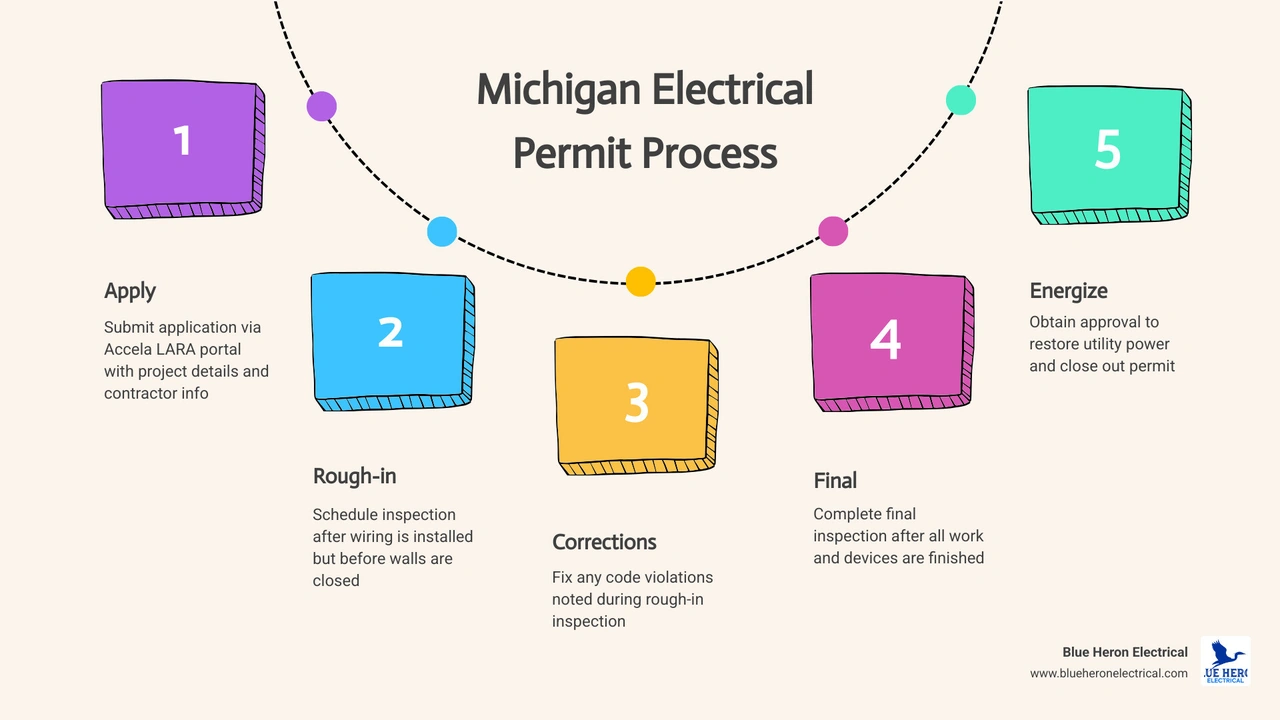
The permitting and inspection process in Michigan is highly structured, moving through several phases to verify safety at every turn. If your municipality falls under state-level jurisdiction, the permit can be obtained online through the Accela LARA portal (https://aca-prod.accela.com/lara/). If your city or township manages its own building department, the application is submitted directly to them.
Here is what the step-by-step process looks like during a typical whole-house rewiring project:
- Permit Application: The contractor (or homeowner) submits the application with the required fee, detailing the number of circuits, fixtures, and panel upgrades planned.
- Rough-In Inspection: This is scheduled after all the new cables have been run through the studs, boxes are installed, and the grounding system is established—but before any insulation or drywall is put up. The inspector checks that the wires are properly supported, routed, and sized for their prospective loads.
- Trim-Out / Final Inspection: Once the walls are closed, painted, and all light fixtures, outlets, switches, and the main panel cover are installed, the final inspection is scheduled. The inspector tests the circuits to verify proper grounding, polarity, and that AFCI/GFCI devices trip correctly.
- Certificate of Approval and Utility Energization: After passing the final inspection, the local building department issues a certificate of electrical approval. If the power was disconnected for a panel upgrade, this approval is sent directly to the utility provider (such as DTE Energy) so they can safely re-energize the service.
For homeowners in Royal Oak, securing professional Whole House Rewiring Royal Oak MI services ensures this multi-step inspection process is managed flawlessly by experts.
Local Jurisdictional Variations in Metro Detroit
While the Michigan Electrical Code serves as the baseline, Act 230 of 1972 allows local cities, villages, and townships to establish their own local enforcing agencies. This means that permit fees, processing times, and local administrative rules can vary depending on where you live.
For example, performing a whole-house rewire in Bloomfield might involve slightly different local forms and inspection scheduling protocols than a similar project in Sterling Heights. Because we regularly work across Oakland County and the broader Metro Detroit area, our team is highly familiar with these local variations. Whether you need Whole House Rewiring Bloomfield MI or Whole House Rewiring Sterling Heights MI, we know exactly how to navigate your local building department's specific requirements.
Is a permit required for an electrical panel upgrade in Michigan?
Yes, absolutely. An electrical panel upgrade is one of the most critical projects requiring a permit in Michigan. The main electrical panel is the heart of your home's electrical system, regulating the flow of electricity from the utility grid into your individual household circuits.
Upgrading a panel usually involves replacing the old enclosure, installing new breakers, upgrading the service entrance cables on the exterior of your home, and establishing a new grounding electrode system (such as driving ground rods into the earth). Because this work involves high-voltage utility lines and directly impacts your home's fire safety, it must be permitted and inspected. For residents in Troy, our team specializes in safe, fully permitted Electrical Panel Upgrades Troy MI to keep your home's power supply running reliably.
Conclusion
When it comes to the question, "does rewiring a home require a permit in Michigan?" the answer is a resounding yes. From simple circuit additions to whole-house rewires and panel upgrades, obtaining a permit is a legal necessity that protects your family, your property, and your financial investment.
At Blue Heron Electrical, we pride ourselves on delivering dependable, code-compliant electrical work to homeowners across Metro Detroit and Oakland County. We take the stress out of home renovations by handling the entire permitting and inspection process from start to finish. Our team ensures that every wire, outlet, and panel we install meets or exceeds the highest local safety standards.
If you are planning an electrical project or suspect your older home is due for a system upgrade, contact us today to explore our comprehensive Electrical Services. Ready to bring your home's electrical system up to modern standards? Let's discuss your project and schedule a professional consultation for Whole House Rewiring Troy MI today.
Customer Testimonials

Service Areas