
Tripping AC Breakers During Michigan Heatwaves: Repair vs. Replacement
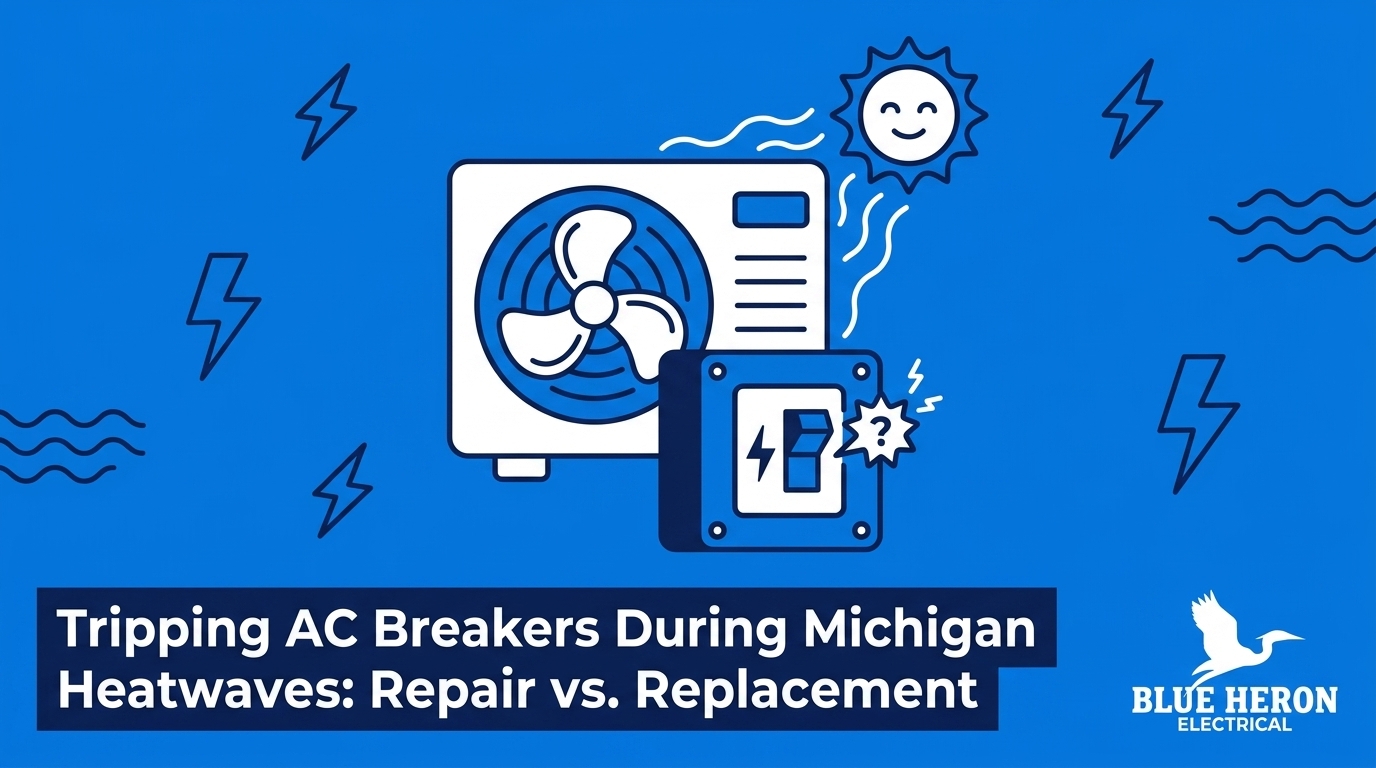
Is Your AC Breaker Tripping Under the Weight of Summer Heat?
Are you dealing with an air conditioner that suddenly shuts down right when your home needs cooling the most? If you are facing tripping AC breakers during Michigan heatwaves, repair vs. replacement is likely the first decision on your mind. You are not alone. Extreme July heatwaves force air conditioning units to run continuously, stripping away the normal overnight cooldown cycles that electrical panels rely on to shed built-up heat. When your breaker trips under this heavy load, it leaves you sitting in a hot house, wondering if the fix is a simple adjustment or a major panel upgrade.
If you need professional guidance right away, explore our electrical panels resources or schedule circuit breaker services in Sterling Heights to restore your home's cooling safely.
The core dilemma: Homeowners must distinguish between a nuisance trip caused by a minor issue and dangerous thermal degradation that requires a completely new breaker. A breaker that trips is doing its job by protecting your home from an electrical fire. However, high-draw appliances like central air conditioners put immense strain on aging infrastructure. Because of the serious risks involved with high-voltage systems, diagnosing a tripping breaker should never be a do-it-yourself project. Understanding the difference between a repairable connection and a failing component is the first step toward getting your cooling system back online safely.
The Physics of Continuous High-Amperage Draw on Older Panels
To understand why your breaker is struggling, it helps to know how these devices operate under stress. Circuit breakers are not just simple on-and-off switches. They are sensitive thermal-magnetic safety devices designed to monitor the exact amount of electrical current flowing to your air conditioner. When that current exceeds safe limits, or when the internal temperature of the panel gets too high, the breaker automatically cuts the power.
Here is exactly how continuous high-amperage draw impacts your electrical panel:
1. The Bimetallic Strip Heats Up: Inside your breaker sits a small piece of metal called a bimetallic strip. As electricity flows through it to your AC, this strip naturally warms up. If the current pulls too much power, the strip bends far enough to physically trip the switch and break the circuit.
2. The Three-Hour Continuous Load Rule: The National Electrical Code (NEC) defines a "continuous load" as any maximum electrical draw that lasts for three hours or more. During a hot afternoon in Sterling Heights MI, your AC easily runs for over three hours at a time. Older panels were often not designed to handle modern continuous loads without generating excess internal heat.
3. The Cumulative Stress Effect: Every time that bimetallic strip heats up and cools down, it experiences microscopic physical stress. Over many years of heavy summer use, this constant expansion and contraction takes a toll on the metal's structural integrity.
Why Overnight Cooldowns Matter
Under normal weather conditions, your air conditioner cycles on and off throughout the day. More importantly, it powers down frequently during the cooler evening hours. This downtime allows the internal components of your electrical panel to dissipate the heat they absorbed during the afternoon.
However, when high humidity and extreme temperatures roll in, your AC is forced to keep cycling late into the night. Without that critical overnight cooldown period, the ambient temperature inside the panel continues to rise. This compounding thermal stress pushes aging breakers past their safe operating limits, causing them to trip even if the air conditioner itself is functioning perfectly.
Nuisance Trips vs. Thermal Degradation: Understanding the Difference
When a professional electrician inspects your panel, they are looking to draw a clear line between a mechanical connection issue and irreversible material fatigue. Knowing the difference dictates whether you need a quick repair or a full replacement.
The Problem: Your AC breaker trips repeatedly during July heatwaves, but your HVAC technician has already confirmed that the air conditioning unit is clean, fully charged, and operating normally.
The Cause: Nuisance Trips (Repairable)
A nuisance trip happens when the breaker functions correctly, but a minor physical issue simulates an electrical overload. The most common culprit is a loose lug—the screw terminal that holds the wire in place. Electricity generates heat when it jumps across a loose connection. This localized heat warms up the breaker's bimetallic strip, tricking it into thinking the AC is pulling too much power. Minor wire seating issues can also cause these frustrating, yet easily repairable, nuisance trips.
The Cause: Thermal Degradation (Requires Replacement)
Thermal degradation occurs when the bimetallic strip inside the breaker physically weakens over time. Years of heavy AC usage, constant heat exposure, and repeated tripping permanently alter the metal. A weakened breaker loses its original calibration. This lowers its trip threshold, meaning a 30-amp breaker might start tripping at just 20 amps. Once this metal fatigue sets in, the breaker can no longer reliably hold the normal electrical load of your air conditioner.
The Solution: A licensed electrician will use specialized tools, such as thermal imaging cameras and multimeters, to measure the exact temperature and voltage at the connection points. If the issue is a loose wire generating localized heat, they can repair it. If the internal mechanics are compromised, the breaker must be replaced.
When a Simple Breaker Repair is Enough
Not every tripping breaker requires a trip to the supply house for new parts. In specific scenarios, an electrician can safely repair your existing setup and restore reliable power to your cooling system. This usually involves addressing the physical connections rather than the breaker mechanism itself.
Here is what a professional repair process looks like when the breaker is still in good condition:
• Torquing the lugs to manufacturer specifications: Loose connections at the breaker terminal generate excess heat. As wires heat up and cool down during normal operation, they expand and contract. Over time, this micro-movement loosens the terminal screws. An electrician will use a calibrated torque screwdriver to tighten these connections precisely to the manufacturer's required specifications.
• Reseating the electrical wires: Sometimes, the wire carrying power to your AC is not seated deeply enough into the breaker terminal. This reduces the surface area for the electricity to flow through, creating resistance and heat. A professional will safely remove the wire, inspect it for damage, and reseat it properly.
• Cleaning non-compromised bus bars: The bus bar is the metal strip inside your panel that the breaker snaps onto. If slight oxidation has formed, it can cause a poor connection. As long as the metal is not pitted or burned, an electrician can clean the contact points to ensure a solid, heat-free connection.
If you want to understand more about how these connection issues impact your entire home, read our guide on how an overloaded panel causes electrical problems. Properly maintaining these connections in older Sterling Heights MI homes is the best way to prevent a minor nuisance trip from turning into a major electrical failure.
Red Flags That Demand Immediate Circuit Breaker Replacement
While some issues can be tightened and cleaned, others pose a severe fire hazard. If your breaker has suffered permanent damage, attempting to repair it is dangerous. You need a definitive way to know when the component is beyond saving.
If you notice any of the following symptoms during July heatwaves, your breaker requires full replacement:
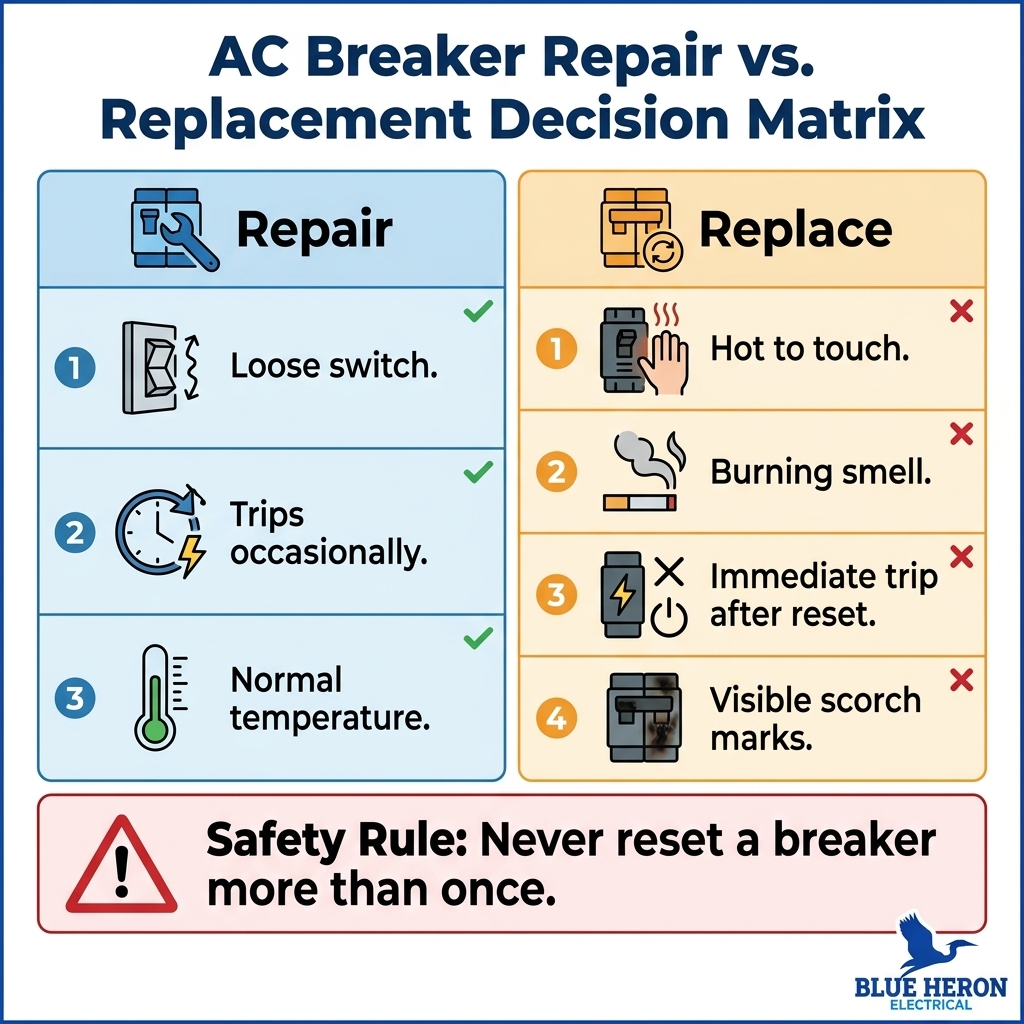
• The breaker feels hot to the touch: It is normal for a breaker to feel slightly warm while the AC is running heavily. However, if the plastic casing is uncomfortably hot to the touch, the internal components are failing and generating dangerous levels of resistance.
• A burning plastic smell: This is an absolute emergency. A burning smell or visible scorch marks around the panel means the electrical insulation is actively melting. The breaker is no longer containing the heat.
• Immediate tripping after a reset: If you reset the breaker and it instantly snaps back to the "off" position with a loud pop, you have a hard fault or severe degradation. The breaker is violently rejecting the electrical load to prevent a fire.
• A loose or spongy switch mechanism: When you flip a healthy breaker, it should click firmly into the "ON" position. If the switch feels loose, wobbly, or spongy, the internal spring mechanism has physically broken down.
If you experience a burning smell or a breaker that is hot to the touch, do not wait for normal business hours. You need immediate licensed diagnostics to prevent a panel fire. Take advantage of our 24/7 emergency electrician availability—we are ready day or night to secure your panel and replace dangerous components.
The Hidden Danger of the 'Just One More Reset' Habit
When the house is growing warmer by the minute, it is incredibly tempting to walk down to the basement and simply flip the breaker back on. Many homeowners fall into the habit of resetting a tripping breaker multiple times a day just to keep the cool air flowing. This is one of the most dangerous things you can do to your electrical system.
Resetting a breaker does not fix the underlying heat buildup. When a breaker trips, it is telling you that the circuit is overloaded or physically too hot to operate safely. By immediately flipping it back on, you are forcing a compromised system to carry a massive electrical load while it is already overheated.
Continuing to force power through a weakened breaker can lead to arc faults. An arc fault happens when electricity jumps through the air between loose or degraded connection points. This creates intense, concentrated heat that can easily ignite the surrounding wire insulation or the plastic breaker casing, leading to a devastating panel fire.
To keep your home safe, especially in older Sterling Heights MI properties, establish a strict rule: If an AC breaker trips twice in a row, leave it off and call a professional. The temporary comfort of "just one more reset" is never worth the risk of an electrical fire.
Side-by-Side Comparison: Breaker Repair vs. Replacement
Weighing your options during July heatwaves requires looking at the symptoms, the long-term reliability, and the overall safety of your electrical panel. Use this comparison to understand what your electrician is looking for when they evaluate your system.
• Common Symptoms — Breaker Repair (Tightening/Cleaning): Occasional nuisance trips; breaker feels slightly warm but not hot; switch feels firm. — Breaker Replacement (New Unit): Trips immediately; hot to the touch; burning smell; spongy or loose switch mechanism.
• Long-Term Reliability — Breaker Repair (Tightening/Cleaning): Highly reliable if the issue was simply a loose lug caused by natural thermal expansion. — Breaker Replacement (New Unit): Restores factory-level reliability with a fresh, fully calibrated bimetallic strip.
• Safety Implications — Breaker Repair (Tightening/Cleaning): Safe for newer panels where the breaker itself has not suffered thermal degradation. — Breaker Replacement (New Unit): Essential for older homes running modern central air systems to prevent arc faults and electrical fires.
If your panel is showing signs of serious wear, do not take chances with your home's safety. Reach out for professional circuit breaker services in Royal Oak and surrounding areas to get a definitive, safety-focused assessment.
Frequently Asked Questions
How do I know if my circuit breaker is bad or if it's the AC?
The most reliable way to tell is by checking the temperature and physical condition of the breaker. If the AC runs fine for hours but the breaker panel feels excessively hot or smells like burning plastic, the breaker is likely failing. A professional electrician can test the amp draw to confirm if the AC is pulling too much power or if the breaker is tripping prematurely.
Why does my AC breaker feel hot to the touch?
A breaker feels hot to the touch when there is excessive electrical resistance inside the panel. This is usually caused by a loose wire connection generating friction, or by internal thermal degradation of the breaker's components. While slightly warm is normal during heavy use, uncomfortably hot plastic is a major fire hazard that requires immediate professional attention.
Is it safe to keep resetting a tripped AC breaker?
No, it is never safe to repeatedly reset a tripped breaker. Resetting the switch forces electricity back into a circuit that is already overheated or overloaded. Doing this multiple times can cause the internal metal components to fail entirely, leading to dangerous arc faults, melted wires, or a panel fire.
Can a circuit breaker get weak and trip more easily over time?
Yes, circuit breakers can experience physical fatigue over years of heavy use. The internal bimetallic strip that controls the tripping mechanism weakens from constant heating and cooling. Once this thermal degradation occurs, the breaker loses its calibration and will trip at a much lower electrical load than it was originally designed to handle.
Should I replace a breaker that keeps tripping immediately?
A breaker that trips instantly after being reset almost always needs professional replacement or serious electrical repair. An immediate trip indicates a "hard fault," meaning there is a direct short circuit or the breaker's internal spring mechanism has completely broken. Leave the breaker turned off and call a licensed electrician immediately.
How long does an AC circuit breaker typically last in older homes?
Most circuit breakers are designed to last between 30 and 40 years under normal conditions. However, breakers dedicated to heavy, continuous loads like central air conditioning often wear out faster due to the constant thermal stress. In older homes, these breakers may need replacement much sooner to keep up with modern cooling demands.
Keeping Your Home Safe and Cool
Dealing with a tripping AC breaker is stressful, but understanding the signs of thermal wear versus a loose connection puts you in control of your home's safety. By following clear, safety-first criteria, you can stop guessing and take the right action. If your system is struggling to keep up, reach out to our licensed team for a definitive assessment, ensuring your family stays cool and protected all summer long.
Customer Testimonials

Service Areas