
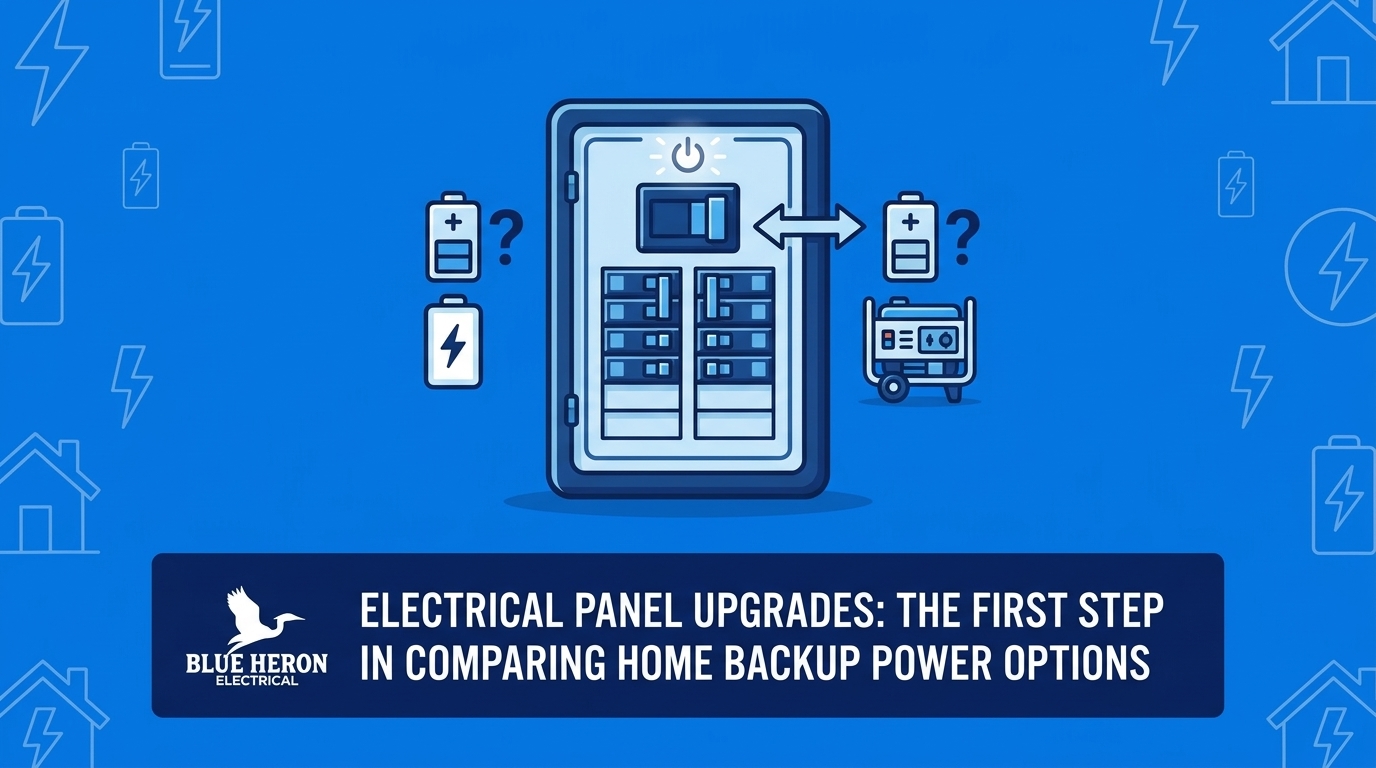
Electrical Panel Upgrades: The First Step in Comparing Home Backup Power Options
Preparing for Winter: The Backup Power Dilemma
With October pre-winter preparation already underway, looking at options comparisons for homeowners is the most critical step you can take to protect your family from freezing temperatures. At Blue Heron Electrical, our team frequently sees how Michigan's severe winter weather and ice storms create prolonged power outages, leaving families in the dark for days. The immediate dilemma usually comes down to deciding between a whole-home standby generator and a battery backup system. However, before comparing specific units, we always advise that your home's foundational electrical infrastructure must be evaluated to see what it can actually handle. A seamless transition into emergency power relies entirely on how well your current panel capacity dictates backup viability. To start this process, ensuring your Electrical Panels are up to date is an absolute necessity.
Analyzing Heavy Winter Heating Loads During an Outage
The core problem with winter power outages is that your home's energy demands are uniquely high due to continuous heating needs. When the grid goes down in the middle of a freeze, you are not just trying to keep the lights on and the refrigerator running. You are actively fighting against plummeting indoor temperatures. In our years of field experience, the cause of many backup system failures is a simple underestimation of these heavy winter heating loads. If a system is undersized, the immense power draw of heating appliances will rapidly deplete inadequate backup systems during multi-day outages.
Our team recently worked with a homeowner in Sterling Heights MI who had purchased an older house needing significant electrical modernization before winter. During our assessment, it became clear that their existing breaker panel could not safely support the heavy loads of modern heating and backup equipment. We provided them with several upgrade options to prioritize the work, and installed a new panel efficiently to ensure their home could handle the winter energy demands safely.
The Hidden Power Draw of Gas Furnaces
The misconception: We frequently hear from homeowners who assume that because they have a natural gas furnace, they do not need much electricity to heat their home during an outage.
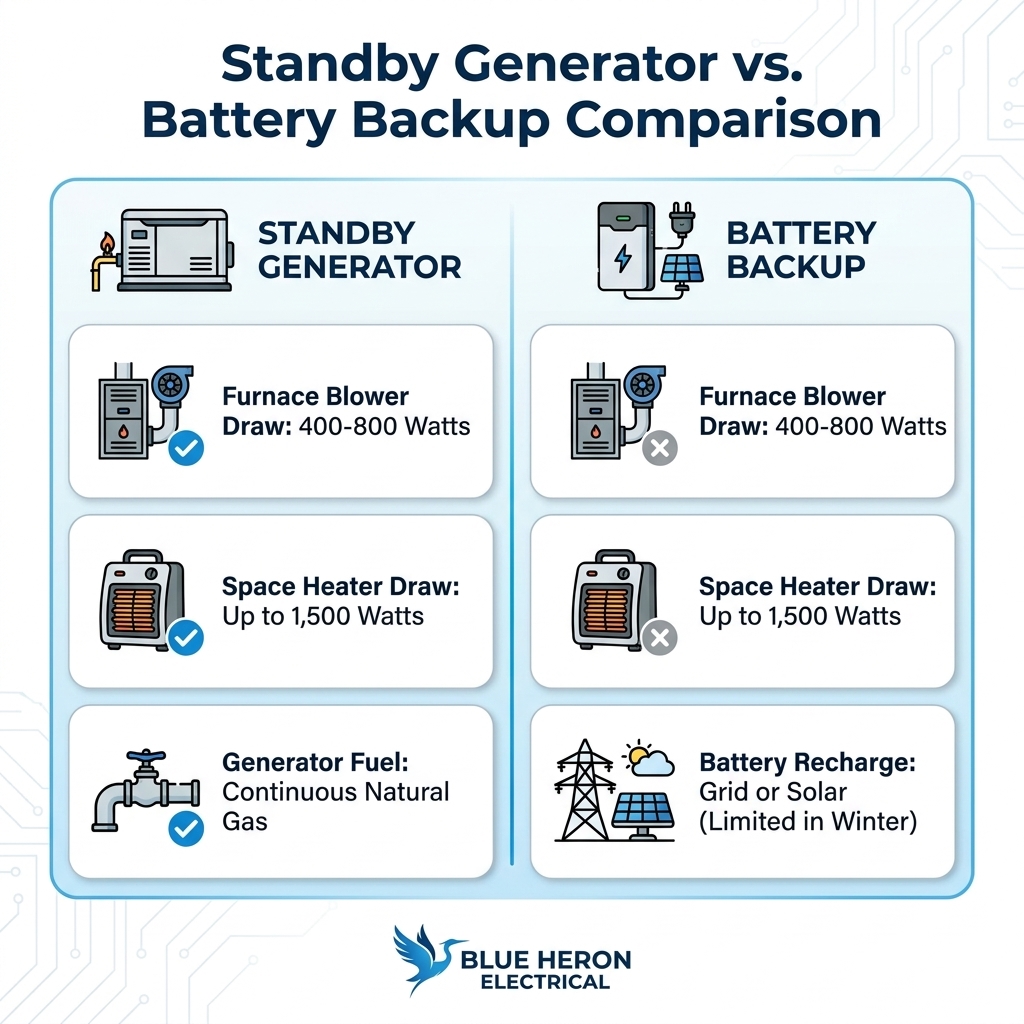
The reality: Even though natural gas provides the actual heat, your furnace relies on significant electrical power to function. The system requires electricity to run the inducer motor, the electronic control board, the igniter, and most importantly, the main blower motor that pushes the warm air through your ductwork. Furnace blower motors typically draw between 400 to 800 watts continuously while running. Calculating this wattage is critical before selecting a backup power source, as a system that cannot handle this continuous draw will leave your gas furnace completely useless.
Supplemental Heating and Overloads
When the main heating system struggles or fails, the immediate reaction is often to plug in electric space heaters. As electricians, we warn against this because it creates a massive strain on any electrical system. Standard electric space heaters draw up to 1,500 watts each. If you plug in just two space heaters in different rooms, you are immediately demanding 3,000 watts of continuous power. Relying on space heaters during an outage can quickly overload a limited backup system, tripping breakers or draining batteries in a matter of hours. Having enough electrical capacity at the panel level to run multiple heating sources safely is the only way to prevent a cold-weather emergency from escalating.
Standby Generators vs. Battery Backups for Cold Climates
When researching a generator vs battery backup michigan residents must account for the specific challenges of our climate. In our experience serving the Sterling Heights area, generic national advice often ignores the reality of multi-day ice storms. A direct comparison reveals significant differences in how these systems handle freezing conditions, heavy loads, and prolonged grid failures.
• Power Duration — Whole-Home Standby Generator: Continuous, limited only by the local natural gas supply. — Home Battery Backup System: Limited to the battery's stored capacity until recharged.
• Winter Recharging — Whole-Home Standby Generator: Not applicable; runs on direct fuel lines. — Home Battery Backup System: Highly restricted if relying on snow-covered solar panels.
• Heavy Heating Loads — Whole-Home Standby Generator: Easily handles furnace blowers and space heaters simultaneously. — Home Battery Backup System: Rapidly depleted by high-wattage heating appliances.
• Maintenance Needs — Whole-Home Standby Generator: Requires regular oil changes and mechanical tune-ups. — Home Battery Backup System: Virtually maintenance-free solid-state technology.
For heavy winter heating loads during prolonged outages, our technicians generally see standby generators perform better because they do not rely on the grid or the sun to keep running. However, integrating either system requires a robust electrical foundation. Whether you choose a generator or a battery, professional Residential Electrical services are required to ensure the system communicates safely with your home's main panel.
Fuel Reliability in Freezing Conditions
Direct-line natural gas provides uninterrupted fuel for standby generators, meaning the unit can run for days or even weeks without you ever needing to refuel it manually. Contrast this with the challenges of grid-charging or solar-charging batteries in the dead of winter. If the grid is down for three days and your roof's solar panels are buried under two inches of ice and snow, a battery backup system has no reliable way to recharge once its initial storage is depleted.
Why Older Homes Struggle to Support Modern Backup Systems
Older homes were simply not built to handle the amperage required by modern backup systems and automatic transfer switches. Decades ago, a 60-amp or 100-amp service was considered plenty for a standard household. Today, integrating a high-capacity generator or a whole-home battery system into an outdated electrical box is a recipe for overloaded circuits, melted wires, and significant fire risks.
One local homeowner experienced this firsthand during a fall pre-winter inspection. Their home still had an outdated Pushmatic fuse panel that desperately needed upgrading, and the entire house lacked proper grounding. Our crew successfully swapped out the old fuse panel for a brand-new, modern breaker panel, and fully grounded the home. This replacement was completed quickly, providing the necessary foundation for any future heavy electrical loads.
As the local authority comprehensively evaluating older Metro Detroit electrical panels, the Blue Heron Electrical team consistently finds hidden problem areas in aging infrastructure. Outdated panels often lack the physical space for new breakers and lack the safety mechanisms required to isolate backup power from the main utility grid. Your backup system is only as reliable as the panel it connects to. If the panel fails, the most expensive generator in the world cannot keep your heat running.
When an Electrical Panel Upgrade is Mandatory for Backup Power
During a past severe winter storm, our emergency dispatch received a call when high winds and ice ripped the electrical service box completely off a local home. Responding after-hours in freezing temperatures, one of our technicians assessed the severe damage, safely hooked up a generator directly to the furnace to keep the house warm overnight, and then fully replaced the mangled service box through the freezing rain the next day. This emergency highlights exactly why a resilient, modern electrical panel is a mandatory prerequisite for safely managing backup power.
There are several technical and safety reasons why an upgrade is often required before a backup system can be installed. Updating the panel prevents dangerous overloads, ensures a seamless power transition, and is a standard, manageable part of the installation process.
1. Physical capacity assessment: The existing panel must be evaluated to see if it has open slots and sufficient total amperage to support new connections.
2. Transfer switch integration: Space must be made to wire in the automatic transfer switch, which acts as the brain of the backup system.
3. Load shedding configuration: Circuits must be organized so that non-essential loads drop off when running on limited backup power.
4. Code compliance verification: The entire setup must be brought up to current safety standards and inspected.
Integrating Automatic Transfer Switches
An automatic transfer switch (ATS) detects when grid power fails and instantly switches your home's electrical load over to the backup system. It also prevents "backfeeding," which is when your generator sends electricity back out onto the utility lines, potentially injuring line workers. Our installers note that old panels often lack the physical space or the internal safety mechanisms to house or connect to these modern switches safely.
Meeting Modern Safety Codes
Adhering to current electrical codes is non-negotiable when adding any secondary power source to a home. Local municipalities have strict regulations regarding how generators and batteries interface with the grid. Fortunately, professional electricians handle all the permitting and compliance seamlessly. If you are curious about the regulatory side of this process, you can learn more about Panel Upgrade Permit Requirements in Michigan.
Navigating Installation Timelines and Generic Tax Incentives
Because October pre-winter preparation is the busiest time of year for electrical upgrades at Blue Heron Electrical, we strongly advise beginning the assessment and installation process well before peak winter weather hits. Sourcing equipment, securing permits, and scheduling the physical installation takes time. Early planning ensures your home is fully protected before the first major freeze arrives in Sterling Heights.
When planning your project, it is also worth exploring potential financial benefits. Federal tax credits may apply to qualifying home battery backup installations, helping to offset the initial investment. Because these programs change frequently, we always encourage homeowners to verify current incentive programs and eligibility requirements with their utility provider or a qualified tax professional. Taking advantage of these generic tax incentives can make upgrading your electrical panel and backup system much more manageable.
Frequently Asked Questions About Backup Power and Panel Upgrades
Which is better for winter outages: a whole house generator or battery backup?
A whole-house standby generator is generally better for prolonged winter outages because it runs on a continuous natural gas supply. Battery backups are excellent for short-term outages, but they struggle to recharge when winter storms cover solar panels in snow. Heavy heating loads will deplete a battery much faster than a continuous-fuel generator.
Can a battery backup run a gas furnace blower?
Yes, a properly sized battery backup can run a gas furnace blower motor. The blower typically draws between 400 and 800 watts, which a robust battery system can handle. However, running the blower continuously will drain the battery's stored capacity over time, limiting how many days it can operate without a recharge.
How long does a home battery backup last during a multi-day winter outage?
A home battery backup typically lasts one to two days during a winter outage, depending heavily on how much power you consume. If you are running a furnace blower and electric space heaters, that duration will drop significantly. Without a reliable way to recharge via solar panels or the grid, the battery will eventually deplete.
Do I need an electrical panel upgrade for a standby generator?
You often need an electrical panel upgrade if your current panel is outdated, full, or lacks the capacity to safely integrate an automatic transfer switch. Older 100-amp panels frequently cannot handle the complex wiring and safety requirements of a modern standby generator. A professional assessment will determine if your specific panel requires an upgrade.
How do I know if my older home's electrical panel is outdated?
Your panel is likely outdated if it uses fuses instead of breakers, is made by defunct brands like Pushmatic or Federal Pacific, or constantly trips when running modern appliances. Flickering lights and a lack of open breaker slots are also strong indicators. A licensed electrician can quickly evaluate the panel to tell you if it meets modern safety codes.
What is an automatic transfer switch and why do I need one?
An automatic transfer switch is a device that safely disconnects your home from the utility grid and connects it to your backup power source the moment an outage occurs. You need one to automate the power transition and to prevent your generator from sending electricity back onto the public power lines, which is a major safety hazard.
Take the Next Step in Your Winter Preparation: Options Comparisons for Homeowners
Choosing between a standby generator and a battery backup system always starts with knowing exactly what your home's current electrical infrastructure can support. By evaluating your panel first, you ensure that whichever system you choose will operate safely and reliably when the ice storms hit. At Blue Heron Electrical, we encourage you to explore your options with a professional evaluation before the freezing weather settles in. Learn more about how professional Panel Changes can provide the safe, heavy-duty foundation required to support your future backup power system.
Customer Testimonials

Service Areas