
How to Check Michigan Panel Upgrade Permit Requirements
Does a Panel Upgrade Require an Inspection and Permit in Michigan? Here's What Homeowners Need to Know
Does a panel upgrade require an inspection and permit in michigan? Yes — and there are no exceptions for service panel work.
Here's the short answer:
| Requirement | Required for Panel Upgrades in Michigan? |
|---|---|
| Electrical permit | Yes, always |
| Inspection (rough-in and final) | Yes, always |
| Licensed electrical contractor | Yes — homeowners cannot self-perform panel work |
| Permit before work begins | Yes — permits must be obtained prior to starting |
Michigan's Construction Code Act (Public Act 230 of 1972) is clear: no one may alter, replace, or upgrade electrical equipment in a building without first obtaining a permit from the appropriate enforcing agency. That includes your electrical panel — whether you're replacing a worn-out 100-amp box or upgrading to a 200-amp service to handle an EV charger or heat pump.
For homeowners and small business operators in Metro Detroit, this matters a lot. Skipping the permit process doesn't just put you at legal risk — it can void your insurance, create problems when selling your home, and leave your electrical system without the safety verification that an inspection provides.
This guide walks you through exactly what Michigan requires, who can do the work, and how the permit and inspection process works from start to finish.
Does a Panel Upgrade Require an Inspection and Permit in Michigan?
To understand why Michigan enforces such strict rules around electrical permits, we have to look at state law. In Michigan, the regulatory framework is governed by Public Act 230 of 1972, also known as the Michigan Construction Code Act. Under this act, the Bureau of Construction Codes—which operates under the Department of Licensing and Regulatory Affairs (LARA)—administers the state electrical code.
Currently, in 2026, Michigan enforces a statewide uniform code based on the National Electrical Code (NEC) with specific Michigan-specific amendments. The law states that you cannot equip a building with electrical conductors or equipment, or make any alteration, change, or addition to existing electrical equipment, without first receiving a permit.
Because an electrical panel is the central nervous system of your home’s power distribution, modifying it is considered a major structural alteration. If your panel is outdated, overloaded, or showing signs of deterioration, you are likely due for an upgrade. To help you identify if your system is at risk, you can read about the Signs Your Electrical Panel Is No Longer Safe for Modern Power Needs to determine if it is time to contact a professional.
Understanding Why Michigan Mandates Permits for Service Upgrades
An electrical panel upgrade is not a simple DIY project like swapping out a light fixture or replacing a single outlet. A true panel upgrade touches several critical, high-risk components of your home's electrical infrastructure:
- The Service Entrance: The heavy-duty cables that bring electricity from the utility lines into your home.
- The Main Breaker: The primary safety switch that controls all power entering the property.
- The Grounding Electrode System: The safety system that directs stray electricity safely into the earth.
- Bonding Systems: Ensuring metal pipes and structural components are electrically bonded to prevent shock hazards.
Because these systems handle high voltage directly from the grid, a mistake can lead to catastrophic failure, electrocution, or severe property damage. This is why LARA and local municipal building departments require a formal permitting process. For more details on what these systems entail, check out our dedicated page on Electrical Panels.
Why Does a Panel Upgrade Require an Inspection and Permit in Michigan?
The permitting and inspection process is designed as a safety shield for you and your family. When we perform Panel Changes, the permit ensures that the proposed design is reviewed for safety, and the inspection verifies that the physical installation adheres strictly to code.
Without this oversight, homeowners are exposed to significant safety hazards, including electrical fires and shock risks. Furthermore, because a panel upgrade requires disconnecting and reconnecting to the electrical grid, local utility providers like DTE Energy or Consumers Energy will not legally restore power to a home without proof of a successful municipal inspection. The permit and inspection process guarantees that code compliance is maintained, protecting both the homeowner and the utility grid.
Who Can Legally Pull Permits and Perform Panel Upgrades in Michigan?
In Michigan, the rules regarding who can pull an electrical permit and perform the actual physical work are very strict. To obtain an electrical permit, the applicant must be a licensed electrical contractor or specialty contractor licensed by the state or an authorized municipality.
While Michigan law does feature a "homeowner exemption" that allows qualifying individuals to pull permits for work on their own single-family dwellings (provided they own and occupy, or will occupy, the home), this exemption generally does not apply to service panel upgrades. Because a service panel upgrade involves high-voltage utility connections, main service entrance conductors, and complex grounding systems, local enforcing agencies in Metro Detroit almost universally require a licensed electrical contractor to pull the permit and execute the work.
If you live in Oakland County, our team provides certified, fully insured Electrical Panel Services in Royal Oak MI to ensure your project is completed legally and safely.
The Risks of DIY Panel Upgrades and Unlicensed Work
Attempting to upgrade your own electrical panel or hiring an unlicensed "handyman" to do it under the table is incredibly risky. First and foremost, there is the immediate, life-threatening high-voltage danger. Unlike standard branch circuits, the main incoming service lines inside a panel remain "hot" and energized even when the main breaker is shut off. One wrong move can result in fatal electrocution.
Beyond the physical danger, performing unpermitted or unlicensed work carries severe administrative and financial consequences:
- Insurance Voiding: If an unpermitted electrical panel causes a fire, your homeowner’s insurance carrier has the legal right to deny your claim entirely.
- Title Defects: When you eventually try to sell your home, home inspectors and buyers will look at the electrical panel. Unpermitted work creates a title defect and can stall or ruin a real estate transaction.
- Municipal Fines: Local building departments can issue costly fines, order a complete "stop work" directive, and even disconnect your power until a licensed contractor corrects the work and pulls retroactive permits.
To protect your investment and ensure compliance, always work with a licensed professional. We offer dependable Electrical Panel Services in Birmingham MI to keep your home safe and fully up to code.
The Step-by-Step Process for Michigan Electrical Permits and Inspections
Navigating the administrative side of a panel upgrade can seem daunting, but when you work with a professional team, we handle the heavy lifting.
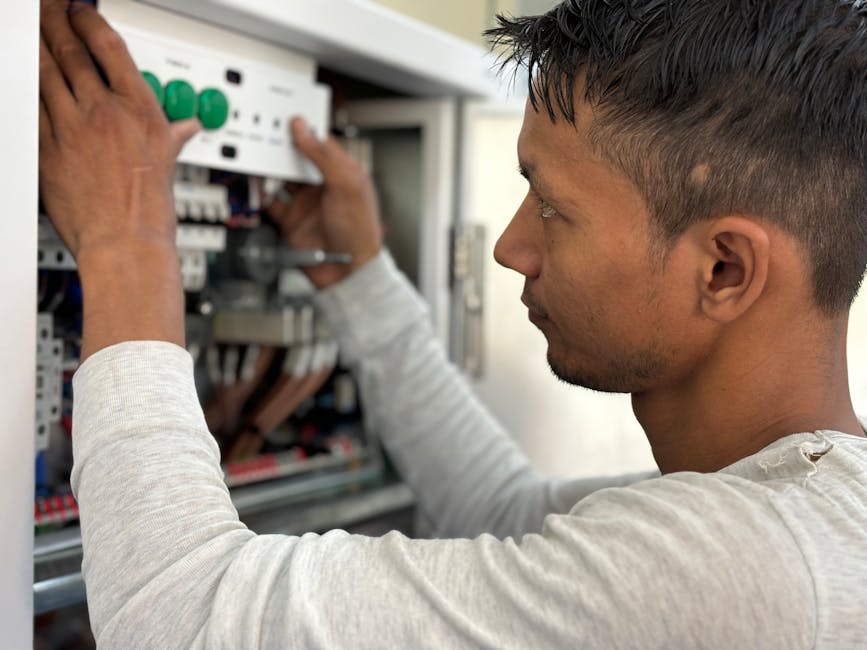
Depending on where you live in Metro Detroit, your permit will be processed either directly by the state through the LARA portal or by your local municipal building department. The state maintains a regularly updated Statewide Jurisdiction List that outlines which local enforcing agency (LEA) has authority over your specific address.
Here is a quick look at how the permitting authority is divided:
| Permitting Authority | Who Handles It? | When Does It Apply? |
|---|---|---|
| State-Level (LARA) | Bureau of Construction Codes (Building Trades Section) | Applies to townships and municipalities without their own local electrical inspectors. |
| Local Municipal Enforcing Agency (LEA) | Local Building Department (e.g., Troy, Royal Oak, Southfield) | Applies to cities and townships with dedicated local building and electrical inspectors. |
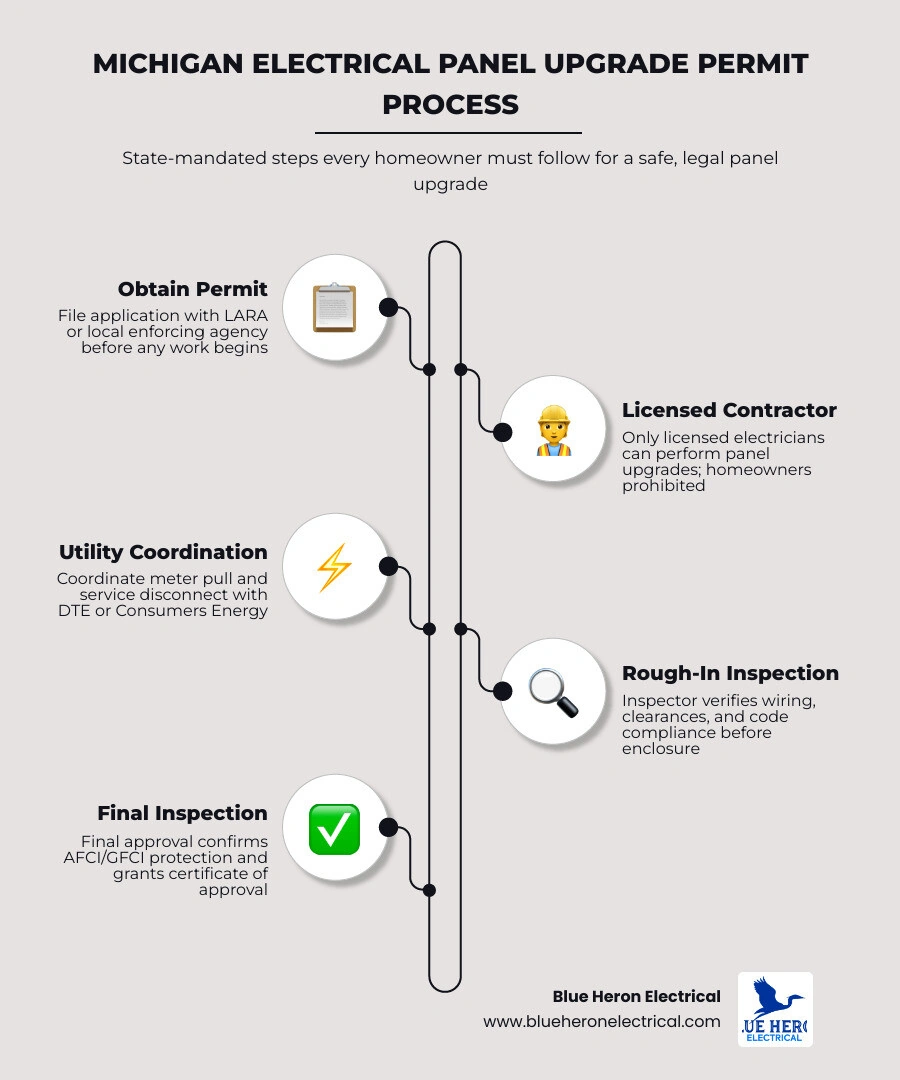
Regardless of who holds jurisdiction, the upgrade process follows three critical steps.
Step 1: Filing the Permit Application
Before any tools touch your wall, a detailed permit application must be submitted to the appropriate enforcing agency. This application must include:
- The contractor's license details and credentials.
- Detailed load calculations (per NEC Article 220) to prove the new panel can handle the home's electrical demands.
- Specific equipment specifications (such as the manufacturer, model, and rating of the new panel and breakers).
If there are any technical questions or unique jurisdictional requirements, the applicant coordinates directly with the Building Trades Section (which can be reached at 517-241-9313 or bccpermits@michigan.gov). For homeowners in neighboring communities, we manage this entire planning phase, offering comprehensive Electrical Panel Services in Bloomfield MI.
Step 2: Coordinating with the Utility Company
A panel upgrade cannot happen in a vacuum; it requires close coordination with your electrical utility provider, which is typically DTE Energy in our Metro Detroit service areas.
Once the permit is approved by the local building department, we schedule a coordinated "disconnect/reconnect" window. On the day of the upgrade, the utility company must perform a meter pull or service disconnect to safely cut power from the grid to your home. Only then can we safely remove the old panel and install the new system.
If you are planning an upgrade in the Oakland County area, we can streamline this coordination through our specialized Electrical Panel Upgrades in Royal Oak MI.
Step 3: Passing the Rough-In and Final Inspections
Once the new panel, breakers, grounding rods, and service entrance conductors are physically installed, the local electrical inspector must review the work.
The inspector will verify several key code requirements:
- Working Clearances: Under NEC 110.26, there must be a clear working space around the panel that is at least 30 inches wide, 36 inches deep, and 6.5 feet high. The panel cannot be installed in clothes closets, bathrooms, or over stairs.
- Grounding and Bonding: The inspector will check for proper connections to your grounding electrodes (usually two ground rods driven into the earth or a connection to a metal water pipe).
- AFCI and GFCI Protection: Modern codes require Arc-Fault Circuit Interrupter (AFCI) and Ground-Fault Circuit Interrupter (GFCI) protection on many residential branch circuits. The inspector will ensure these safety breakers are installed correctly.
Once the inspector signs off, they issue a certificate of approval and notify the utility company that it is safe to permanently restore power. If you are in the Troy area, our team is highly experienced in navigating these local inspection checkmarks. We provide seamless Electrical Panel Upgrades Troy MI designed to pass inspection on the very first visit.
Exceptions, Replacements, and Local Jurisdictional Rules
Many homeowners ask us if there are any shortcuts or exceptions when it comes to replacing a panel rather than upgrading its capacity.
While minor repairs—such as swapping out a single broken circuit breaker or replacing a light switch—do not require a permit in Michigan, replacing an entire panel always requires a permit and inspection, even if you are not increasing the amperage.
Does a Panel Upgrade Require an Inspection and Permit in Michigan for Like-for-Like Replacements?
Yes. Even if you are swapping an old, failing 100-amp panel for a brand-new 100-amp panel (a "like-for-like" replacement), you must pull a permit. This is because the process still involves disconnecting the main service entrance, disturbing the grounding system, and transferring all of your home's active circuits to a new bus bar.
This rule is especially critical if you are replacing historically hazardous, obsolete panels. Brands like Federal Pacific Electric (FPE) Stab-Lok and Zinsco panels have well-documented histories of breaker failures, which frequently lead to electrical fires. Because these panels pose an active threat, insurance companies often demand their immediate replacement.
If you need a reliable installation or swap in the Troy area, we can help. We provide code-compliant Electrical Panel Installation Troy MI to safely modernize your system. And if you are dealing with minor issues or need an assessment first, we also offer expert Electrical Panel Repair Troy MI to keep your current setup running safely.
Frequently Asked Questions About Michigan Panel Upgrades
What happens if I upgrade my electrical panel without a permit in Michigan?
If you proceed with unpermitted panel work, you are opening yourself up to significant legal and financial liability. If local municipal code enforcement discovers the unpermitted work, they can issue heavy fines, place a "stop-work" order on your home, and even instruct the utility company to disconnect your power due to safety concerns.
Furthermore, you will face disclosure issues when you try to sell your home, as buyers and inspectors will easily spot unpermitted modifications. Most importantly, your insurance company can deny any future claims related to electrical fires if the work was not permitted and inspected.
Can a homeowner pull an electrical permit for a panel upgrade in Michigan?
No, not for a main service panel upgrade. While Michigan's homeowner exemption allows individuals to pull permits for minor electrical work on their own primary, single-family residences, this exemption does not extend to service panel upgrades. Because this project involves high-voltage utility connections, service entrance cables, and complex grounding systems, the state and local municipalities require a licensed electrical contractor to pull the permit and perform the work.
How long does the electrical inspection process take after a panel upgrade?
The physical installation of a panel upgrade usually takes a single day, during which your power will be temporarily turned off. Once the work is complete, the inspection is typically scheduled for the same day or the following business day. The inspector's visit itself takes about 15 to 30 minutes. Once the inspector approves the work and issues the certificate of approval, they notify the utility company (such as DTE Energy), which will then schedule their crew to permanently reconnect and seal your meter.
Conclusion
Upgrading your electrical panel is one of the most important investments you can make in your home's safety, value, and future readiness. Whether you are prepping for an electric vehicle, installing a modern heat pump, or simply replacing an obsolete and dangerous legacy panel, keeping the project legal and code-compliant is essential.
At Blue Heron Electrical, we serve homeowners and businesses across Metro Detroit and Oakland County with dependable, code-compliant installations. We handle every phase of your project—from calculating your electrical load and filing the initial LARA or municipal permits, to coordinating with DTE Energy and passing the final inspection.
If you are ready to ensure your home's power supply is safe, reliable, and fully up to code, visit our Electrical Panels page to learn more and schedule your professional assessment today!
Customer Testimonials

Service Areas