
Why Does My Circuit Breaker Keep Tripping? Diagnosing Overloads in Older Homes
When the First Fall Chill Causes a Sudden Power Loss
Your space heater is running, the room is finally starting to warm up, and suddenly—click. The lights go out, the heater dies, and you are left in the dark. That strange silence that follows a sudden power loss is incredibly frustrating, especially when you are just trying to stay comfortable. Relying on local service expertise and area tips is the best way to navigate these sudden outages safely. At Blue Heron Electrical, our team sees this exact scenario play out in homes across Sterling Heights during the first October cold snaps, as residents pull auxiliary heating units out of storage and plug them into whichever outlet is closest.
When you are standing in a dark room, you face an immediate decision point: is it safe to simply walk down to the basement and flip the switch back to the "on" position, or is it time to call a professional? Many homeowners treat a tripping breaker as a nuisance, but it is actually a vital safety mechanism working exactly as intended. That click is the sound of your electrical panel preventing a potential fire. If your home's system is repeatedly cutting power, it is trying to tell you that the demand is exceeding the safe capacity of your wiring. Understanding why this happens is the first step toward a permanent, safe solution.
Before you force that switch back into place for the third time today, it is important to address the root cause. Whether you are considering comprehensive electrical panel upgrades or simply need targeted circuit breaker services in Sterling Heights, knowing what is happening behind your walls can keep your property safe as the temperatures drop.
The Top Three Reasons Your Circuit Breaker Keeps Tripping
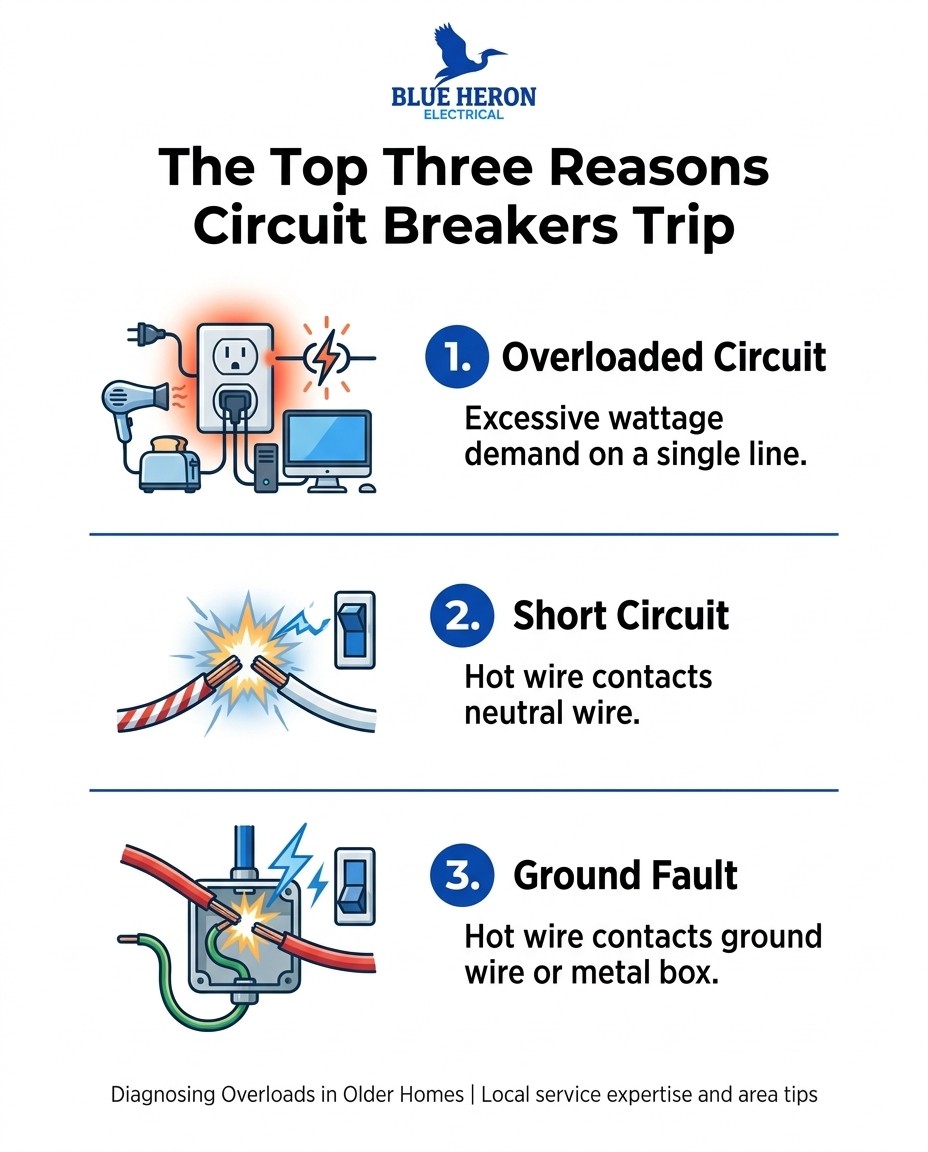
To diagnose why your home keeps losing power in specific rooms, you first need to understand what causes a breaker to activate. Your electrical panel is designed to monitor the flow of electricity (current) traveling through the wires. When that flow becomes unstable or dangerous, the breaker interrupts the circuit. Here are the top three reasons our electricians see this safety feature trigger:
• Overloaded Circuits: This is the most common culprit in residential homes. An overload happens when the total wattage of all plugged-in and active devices exceeds the breaker's rated capacity, causing the internal components to heat up and trip the switch.
• Short Circuits: A significantly more dangerous issue, a short circuit occurs when a "hot" wire accidentally touches a "neutral" wire. This creates an immediate, massive surge in electrical current that bypasses the normal resistance of your appliances.
• Ground Fault Surges: Similar to a short circuit, a ground fault happens when a hot wire touches a ground wire or the metal side of a grounded electrical box, creating a severe shock hazard.
Overloaded Circuits
An electrical overload is essentially a traffic jam inside your home's wiring. Every circuit has a strict limit on how much electrical current it can safely carry. When you plug in multiple heat-generating appliances—such as space heaters, hair dryers, or heavy motor-driven devices like vacuum cleaners—you are asking the wires to deliver more energy than they are physically capable of handling. The breaker senses this excessive demand and shuts off the power before the wires can overheat and melt their protective insulation.
Short Circuits and Ground Faults
Unlike a simple overload, short circuits and ground faults indicate a physical wiring issue or a failing appliance that requires immediate professional attention. These events do not happen because you plugged in too many devices; they happen because electricity is escaping its intended path. If you reset a breaker and it immediately trips again with a loud pop or visible spark, you are likely dealing with a short or a ground fault. These present severe fire and shock hazards and must not be ignored or repeatedly tested by the homeowner.
Why Auxiliary Heating Overwhelms Standard Room Circuits
Michigan is known for its extreme seasonal temperature shifts. In our years of servicing local electrical systems, we've noticed that homes here often transition directly from running heavy, continuous air conditioning loads in the late summer straight into heavy auxiliary heating demands in the fall. This rapid shift places immense, prolonged strain on older electrical systems. The biggest offender during this transition is the portable space heater.
To understand why space heaters cause so many power outages, we have to look at the math behind standard 15-amp bedroom circuits. According to safe electrical practices, a circuit should only carry a continuous load of 80% of its maximum capacity. For a standard 15-amp, 120-volt circuit, the absolute maximum capacity is 1,800 watts. However, the safe continuous load limit is only 1,440 watts.
A typical portable space heater running on its "high" setting draws a full 1,500 watts of power. By itself, the heater is already exceeding the safe continuous limit of the entire room's wiring. When you add normal lighting, a television, a computer, or even a phone charger to that same circuit, you easily push the load over the edge, causing the breaker to trip.
• Portable Space Heater (High) — Estimated Wattage Draw: 1,500 Watts — Impact on a 15-Amp Circuit: Consumes 100%+ of safe continuous capacity
• Gaming Desktop Computer — Estimated Wattage Draw: 400 - 600 Watts — Impact on a 15-Amp Circuit: High draw; dangerous to pair with heating
• Large LED Television — Estimated Wattage Draw: 100 - 150 Watts — Impact on a 15-Amp Circuit: Moderate draw; easily pushes a loaded circuit over
• Standard LED Room Lighting — Estimated Wattage Draw: 40 - 60 Watts — Impact on a 15-Amp Circuit: Low draw; minimal impact on its own
If you find that your heating habits are constantly plunging your bedroom or home office into darkness, it is a clear sign that the infrastructure cannot support your needs. Reaching out for professional circuit breaker repair and evaluation is the safest way to determine if your panel is functioning correctly or if your daily habits are simply demanding too much from a single wire.
The Hidden Danger of Continuously Resetting a Breaker
One dangerous pattern our electricians at Blue Heron Electrical see often is homeowners treating their electrical panel like a simple reset button for their appliances. When the power goes out, they march to the basement, push the lever firmly to the "off" position, and then snap it back to "on." While doing this once to resolve a known overload (like running a vacuum and a space heater simultaneously) is standard procedure, making a habit of it is incredibly dangerous.
The problem: Resetting a breaker repeatedly degrades its internal mechanical components. Inside that small plastic switch are precise springs, contacts, and bimetallic strips designed to separate under extreme heat. Every time the breaker trips under a heavy load, a tiny arc of electricity occurs inside the casing, slowly pitting and burning the metal contacts.
The cause: When a homeowner bypasses the safety trip by continually forcing the breaker back on without fixing the root cause, the breaker eventually loses its ability to trip at the correct temperature. Worse, the contacts can actually weld themselves shut due to the repeated electrical arcing.
The solution: Stop resetting a breaker that trips instantly or trips multiple times a week. If a breaker fails to trip when an overload occurs, the wires inside your walls become the new weak point. They will heat up, melt their surrounding insulation, and ignite the wooden studs nearby, creating a massive fire hazard. Additionally, you should be on the lookout for signs that the breaker itself has already gone bad. A burning plastic smell near the panel, visible scorch marks around the switch, or a switch that feels spongy and won't stay reset even with nothing plugged in are critical warning signs. If you are also noticing other electrical anomalies in the house, investigating the causes of flickering lights alongside your tripping breaker can help a professional diagnose systemic panel issues.
Safe Homeowner Diagnostics: What You Can Check
While electrical panels are strictly off-limits for DIY repairs, there are safe, practical steps you can take to identify the source of an overload before calling a professional. By isolating the devices on the affected circuit, you can provide valuable information to your electrician and potentially solve simple capacity issues on your own.
1. Turn off and unplug all devices: Walk through the rooms affected by the power loss. Turn off every lamp, television, and computer. Most importantly, physically unplug everything from the wall outlets. A device can sometimes draw a small amount of current or cause a short even when switched off.
2. Reset the breaker safely: Once the circuit is completely free of any load, go to your electrical panel. Stand to the side (never directly in front of the panel), look away, and firmly push the tripped breaker fully to the "off" position until it clicks, then firmly push it to the "on" position.
3. Monitor for an immediate trip: If the breaker trips immediately with nothing plugged into the walls, you likely have a short circuit in the wall wiring or a failed breaker. Do not attempt to reset it again. Call a professional.
4. Test devices one by one: If the breaker stays on, return to the rooms and plug your devices in one at a time. Turn each device on and wait a few minutes before moving to the next. If plugging in a specific appliance (like an older space heater) immediately kills the power, that specific device is either shorting out or drawing too much wattage.
A critical safety warning: Never, under any circumstances, remove the dead front cover of your electrical panel to inspect the wires underneath. Explicitly avoid trying to tighten loose lugs, swap breakers, or "upgrade" a 15-amp breaker to a 20-amp breaker to stop the tripping. Putting a larger breaker on smaller wires guarantees a fire. All internal panel diagnostics require a licensed professional.
Addressing Electrical Demands in Aging Homes
When upgrading panels in older Sterling Heights residential neighborhoods, our crews frequently encounter wiring systems built decades before modern, high-wattage appliances became standard in every room. When these homes were constructed, a typical bedroom only needed to support a clock radio, a single lamp, and perhaps a small television. Today, those same wires are being asked to power gaming computers, multiple chargers, smart home devices, and 1500-watt space heaters simultaneously.
The infrastructure simply hasn't kept pace with our daily energy consumption. Because of this, it is crucial to rely on a thorough diagnostic approach to ensure older homes are brought up to modern safety codes safely. Blue Heron Electrical's thorough diagnostic approach ensures that we aren't just putting a band-aid on a symptom, but actually evaluating the health of your home's entire electrical nervous system. If your aging panel is constantly struggling to keep up, you might find yourself needing a 24/7 emergency electrician in the middle of a freezing winter night when the system finally gives out.
When to Consider a Dedicated Circuit
If you find that auxiliary heating is absolutely required every winter to keep certain rooms comfortable, relying on standard shared bedroom circuits is a gamble. The most effective, code-compliant solution we recommend is having a professional install a dedicated circuit.
• Ensures safe operation: A dedicated circuit is a single wire pulled directly from the panel to a specific outlet, meant to serve only one heavy-draw appliance. This ensures your heater has all the amperage it needs without starving other devices.
• Protects essential safety devices: Overloading shared circuits doesn't just turn off your TV; it can also kill power to hardwired smoke detectors and essential security lighting on that same line.
• Future-proofs the room: Adding a dedicated 20-amp circuit for a window AC unit in the summer or a space heater in the winter adds permanent capacity to the room, ending the cycle of tripped breakers for good.
Frequently Asked Questions About Tripping Breakers
Is it dangerous if a circuit breaker keeps tripping?
Yes, a breaker that keeps tripping is a clear warning sign of a dangerous electrical condition. It usually indicates that the circuit is overloaded, or that there is a short circuit somewhere in the wiring. Continually resetting it forces electricity through compromised wires, which can cause them to overheat, melt their insulation, and start an electrical fire inside your walls.
How do I know if my circuit breaker is bad?
A bad circuit breaker often presents physical warning signs before it fails completely. You might notice a burning plastic smell coming from the panel, visible scorch marks around the switch, or a breaker that feels loose and won't stay in the "on" position even when nothing is plugged into the circuit. If a breaker trips constantly under a very light electrical load, its internal mechanisms have likely worn out.
What to do if a breaker trips and won't reset?
If a breaker won't reset, immediately stop trying to force it. First, unplug every device on that specific circuit to rule out an appliance short. If the breaker still immediately springs back to the tripped position or feels completely loose when you try to reset it, leave it off. This indicates a dead short in the wall wiring or a physically broken breaker switch that requires a licensed electrician to replace.
Can a tripping breaker cause a fire?
The tripping action itself prevents fires by cutting off the power. However, the underlying issue causing the trip—such as overheated wires, a failing appliance, or a short circuit—is a severe fire hazard. The real danger occurs when a homeowner repeatedly resets the breaker, which wears down the safety mechanism until it eventually fails to trip, allowing the wires to overheat and ignite.
Why does my circuit breaker trip with nothing plugged in?
If a breaker trips with absolutely nothing plugged into the wall outlets, you are likely dealing with a short circuit in the home's hidden wiring or a ground fault inside an electrical box. It could also mean that the breaker itself is defective and needs to be replaced. Because this rules out appliance overloads, it is a serious issue that requires professional diagnostic equipment to trace safely.
Secure Your Home's Electrical Safety Before Winter Hits
A tripping breaker is never just a minor inconvenience; it is your home's first line of defense actively warning you of an electrical hazard. Whether you are dealing with undersized wiring in an older home, a failing panel, or simply the heavy demands of early-season space heaters, ignoring the problem will only lead to more dangerous conditions as the temperatures drop.
Before the harsh winter weather makes auxiliary heating mandatory, take the time to have your system evaluated. Having a licensed professional inspect your panel, trace your circuit loads, and install dedicated lines if necessary ensures that your home remains warm, well-lit, and completely safe all season long.
Customer Testimonials

Service Areas