
How to Safely Shut Off Power in Your Michigan Home
Why Knowing How to Safely Shut Off Power in Your Michigan Home Before Calling an Electrician Could Save Your Life
Knowing how to safely shut off power in your Michigan home before calling an electrician is one of the most important things you can do to protect yourself, your family, and your property during an electrical emergency.
Quick Answer: How to Safely Shut Off Power in Your Michigan Home
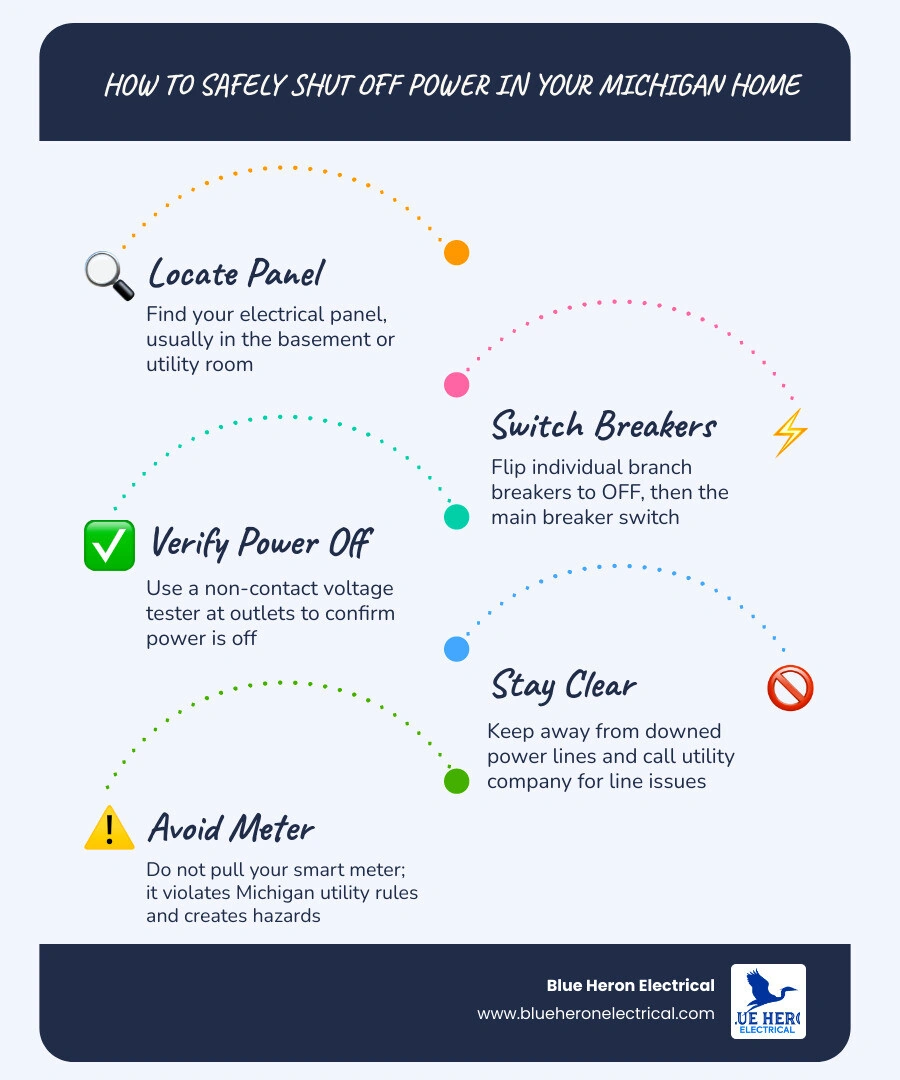
- Find your electrical panel - usually in the basement or utility room
- Switch off individual circuit breakers - flip each one to the OFF position
- Flip the main breaker - the large switch at the top or bottom of the panel
- Verify power is off - use a non-contact voltage tester at nearby outlets
- Stay away from downed lines - call your utility company, not 911, for downed power lines
- Do not touch the meter - pulling a smart meter in Michigan can violate utility rules and create serious safety hazards
For Metro Detroit homeowners, electrical emergencies don't wait for a convenient time. Storms knock out power. Panels overheat. Flickering lights signal something worse underneath. And when something goes wrong, you need to act fast — and safely — before help arrives.
Many homeowners assume a quick call to the utility company is enough. But relying on a remote smart meter disconnect, or worse, pulling the meter yourself, can leave you exposed to real danger. Knowing how your home's electrical system actually works — and how to shut it down the right way — puts you in control when it matters most.
Why You Need to Know Your Home's Emergency Shutoffs

When a home emergency strikes, seconds count. Whether it’s a burst pipe spraying water near an outlet, a strange sulfur smell indicating a gas leak, or a buzzing, hot-to-the-touch breaker box, knowing how to isolate your utilities is your first line of defense.
Many homeowners don't think about these shutoffs until they are standing in ankle-deep water or watching sparks fly. True emergency preparedness means knowing the location and operation of three critical points:
- The Main Electrical Breaker: Cuts off all electrical current entering your home.
- The Main Water Shutoff Valve: Stops water flow to prevent catastrophic flooding.
- The Main Gas Valve: Shuts off the gas supply to eliminate fire and carbon monoxide hazards.
If a plumbing leak occurs near your appliances, turning off the water is only half the battle. If water contacts live electrical wiring, it can energize the standing water, creating a lethal shock hazard. In this scenario, you must shut off the power at your Electrical Panels before you even think about stepping into that water to reach the plumbing valve.
How to Safely Shut Off Power in Your Michigan Home Before Calling an Electrician
Shutting off the electricity in your home is a straightforward process, but it requires a careful, methodical approach to avoid arc flashes or accidental shocks. Before you touch your electrical panel, make sure you have the right tools and are taking basic safety precautions.
Safety Gear and Preparation
- Personal Protective Equipment (PPE): Wear safety glasses and thick, dry rubber-soled shoes. Ensure your hands are completely dry, and you are not standing on a damp or wet floor. If the area around the panel is wet, do not touch it—contact a professional immediately.
- The "One-Hand" Rule: When flipping breakers, use only one hand while keeping your other hand at your side or in your pocket. This prevents your body from forming a complete electrical path to the ground in the rare event of a panel malfunction.
- Stand to the Side: Never stand directly in front of the panel when switching the main breaker. Stand to the side and turn your head away to protect your eyes from potential sparks.
If you are dealing with tricky circuits or suspect your breakers are failing, our team offers professional Circuit Breaker Services in Troy MI to ensure your system responds reliably when you need it most.
Step 1: Locate Your Electrical Panel
The first step is finding where the power enters your home. In most Metro Detroit homes—whether you live in a classic bungalow in Royal Oak or a newer estate in Rochester Hills—the electrical panel is located in one of three places:
- The Basement: Typically on an outer wall, near where the utility lines enter the foundation.
- The Utility Room or Laundry Room: Hidden behind a small metal cabinet door.
- The Garage: Mounted on the wall, often near the interior entry door.
If you have an older home and still rely on a fuse box rather than a modern breaker panel, it is highly recommended to look into an upgrade. You can learn more about local options by visiting our page on Electrical Panel Services in Royal Oak MI.
Step 2: How to Safely Shut Off Power in Your Michigan Home Before Calling an Electrician at the Breaker Level
Once you have located your panel, do not just grab the big main switch and yank it down. Doing so while your home is pulling a heavy electrical load (like your AC, dryer, and refrigerator running simultaneously) can cause a small electrical arc inside the switch, wearing out the contacts prematurely.
Instead, follow this safe, step-by-step shutdown sequence:
- Turn off individual branch breakers first: Go down the rows of switches and flip every single individual breaker to the "OFF" position. This safely sheds the electrical load in small, manageable increments.
- Switch off the main breaker: Once all the individual circuits are off, locate the large main breaker (usually a double-width switch at the very top or bottom of the panel, labeled "Main" and rated for 100 to 200 amps). Firmly flip this switch to the "OFF" position.
Following this sequence protects your household electronics from sudden power surges and preserves the mechanical integrity of your panel. If you reside in Macomb County, you can find local maintenance support through our Electrical Panel Services in Sterling Heights MI.
Step 3: Verify the Power is Off
Never assume a circuit is dead just because a switch is flipped. Breakers can fail mechanically, remaining energized internally even when the plastic toggle points to "OFF."
To verify the power is completely disconnected:
- Use a non-contact voltage tester: This inexpensive, pen-shaped tool lights up and beeps when placed near live wires or inserted into an outlet slot.
- Test the tester first: Always test the device on a known live outlet (like a lamp socket or appliance plug that is currently working) to confirm the tester's batteries are functioning.
- Test the dead zone: Place the tester near the wires or outlets in the area where you intend to work. If it remains silent and dark, the power is safely isolated.
If you notice that some outlets still seem to have a current or are behaving strangely, it could point to deeper wiring issues. Read up on Common Outlet Problems and What They Mean for Your Electrical System to help diagnose these warning signs.
The Truth About Smart Meters: Remote Disconnects vs. Physical Pulling
With the widespread installation of digital smart meters across Michigan by major utilities like DTE Energy and Consumers Energy, the way power is managed has shifted. Many smart meters now feature a built-in "remote disconnect" switch, allowing the utility company to shut off or restore power wirelessly from their central office.
However, this convenience has created a dangerous misunderstanding among some homeowners and DIY enthusiasts who believe a remote shutoff is a substitute for physical electrical isolation.
Why Electricians Avoid Relying on Remote Smart Meter Disconnects
Professional electricians operate under strict safety standards, including Lockout/Tagout (LOTO) protocols. A core rule of electrical safety is establishing a visible air gap—a physical separation of conductors that you can see with your own eyes, which cannot be closed without your direct physical intervention.
- Wireless Signal Vulnerabilities: A remote disconnect relies on a software command sent over a cellular or mesh network. If a signal glitch, software bug, or network delay occurs, the system might report that the power is off when the physical contacts inside the meter are actually still closed and live.
- Lack of Personal Control: When working downstream from a wireless switch, you have no way to lock it out. A utility operator could accidentally send a remote command to re-energize the meter while you or an electrician are actively touching the wires.
Because of these life-threatening risks, relying on a smart meter's remote disconnect for safety-critical work is highly discouraged. For more insights into panel safety, check out the Signs Your Electrical Panel Is No Longer Safe for Modern Power Needs.
Legal and Practical Risks of Pulling a Smart Meter in Michigan
Some homeowners think, "If I can't trust the remote disconnect, I'll just pull the glass meter out of the socket myself."
Do not do this. Physically pulling an electric meter is incredibly dangerous and illegal for unlicensed individuals in Michigan.
- Arc Flash Explosion Hazard: If you pull a meter while the home is drawing a significant electrical load, a massive electrical arc can form between the meter jaws and the socket. This can result in an instant explosion, causing severe burns, blindness, or death.
- Tampering Fines and Legal Issues: The electric meter belongs to the utility company (DTE or Consumers Energy), not the homeowner. Pulling the meter breaks the security seal. Smart meters instantly send a "last gasp" radio distress signal to the utility when disconnected. This alerts the company to an unauthorized removal, which can lead to hefty fines, immediate service termination, and potential legal charges for utility tampering.
If your service entry or meter socket requires attention, you need a professional upgrade. We provide code-compliant Electrical Panel Upgrades in Royal Oak MI to handle these high-voltage components safely.
How to Safely Shut Off Power in Your Michigan Home Before Calling an Electrician to Prevent Accidental Re-energization
If you are waiting for an electrician to arrive to perform repairs, you must ensure that no one else in your home accidentally turns the power back on while work is in progress.
- Use Breaker Lockout Devices: These are small, inexpensive plastic clips that clamp onto the toggle switch of a breaker and allow you to secure it with a padlock.
- Apply Warning Tags: If you don't have a physical lockout device, tape a highly visible note over the panel door that reads: "DANGER: DO NOT TURN ON. ELECTRICAL WORK IN PROGRESS."
- Keep the Key: If you use a padlock to lock the panel door or a specific breaker, keep the key in your pocket. Do not leave it near the panel where someone else could find it.
For homeowners in Oakland County, our team can guide you through securing your system safely. Explore our Electrical Panel Services in Bloomfield MI for personalized assistance.
Michigan Utility Policies: Cold Weather Protections and Emergency Protocols
Michigan winters are legendary for their harsh temperatures, making power loss a matter of survival rather than mere inconvenience. Because of this, the Michigan Public Service Commission (MPSC) enforces strict rules regarding utility disconnections.
Michigan is one of 42 states with established cold weather disconnection protection policies. Under these rules:
- Regulated utilities cannot shut off service to low-income households or qualifying seniors during the heating season (typically November 1 through April 15).
- Vulnerable populations, particularly those with critical medical conditions where a loss of service would be immediately life-threatening, can obtain medical emergency certifications. This certification can postpone a utility shutoff for up to 21 days per occurrence, helping vulnerable residents stay safe while resolving electrical or billing emergencies.
When a major winter storm or summer thunderstorm strikes Metro Detroit, it is vital to know who to call. Many residents mistakenly dial 911 for simple power outages, which clogs emergency phone lines meant for life-or-death situations.
| Situation | Who to Call | Action to Take |
|---|---|---|
| Downed Power Line | 911 First, then Utility | Stay at least 25 feet away. Treat all downed lines as live and highly dangerous. |
| Suspected Gas Leak | 911 First, then Utility | Evacuate the home immediately. Do not flip any light switches or use phones inside. |
| Simple Power Outage | Utility Company | Check your main breaker panel first. If it's not a tripped breaker, report the outage to DTE or Consumers Energy. |
| Sparking Panel/Electrical Fire | 911 Immediately | Evacuate the house. Do not attempt to throw water on an electrical fire. |
If you experience an urgent, non-utility hazard inside your home—such as a smoking outlet or a buzzing breaker panel—you need a professional on the scene fast. Our 24/7 Emergency Electrician team is always ready to respond to hazardous situations across Metro Detroit.
Best Practices for Managing Outages and Electrical Emergencies
Whether you are dealing with a planned shutdown to let an electrician work or an unexpected storm-related outage, keeping your home safe and comfortable requires a bit of preparation.
- Emergency Lighting: Keep high-quality LED flashlights and extra batteries in easily accessible spots on every floor of your home. Avoid using candles, which present a serious fire hazard if knocked over or left unattended.
- Protect Sensitive Electronics: Power surges often occur when the utility grid is re-energized after an outage. Unplug computers, televisions, and high-end appliances during an outage, or invest in whole-house protection. You can determine if your home is vulnerable by reading How to Tell If Your Home Needs Whole House Surge Protection.
- Food Safety: Keep your refrigerator and freezer doors closed as much as possible. A full freezer will keep food frozen for about 36 to 48 hours if left unopened; a half-full freezer will keep food safe for about 24 hours.
- Avoid Generator Backfeeding: If you use a portable generator, never plug it directly into a standard wall outlet. This is known as "backfeeding," and it sends high-voltage electricity backward through your home's electrical lines into the neighborhood grid, which can easily electrocute utility line workers trying to restore power. Always use a professionally installed manual transfer switch.
Frequently Asked Questions About Michigan Home Electrical Safety
What should I do if my lights are flickering before I shut off the power?
Flickering or dimming lights are often a sign of a loose neutral wire, overloaded circuits, or a failing electrical panel. If the flickering is localized to one room, it may be a minor circuit issue. However, if lights are flickering throughout the entire house, it could indicate a serious supply issue from the utility or a loose connection in your main panel. You should turn off the power at the main breaker and contact a licensed professional immediately. For a deeper dive into this issue, read Why Flickering Lights Should Never Be Ignored.
Can I pull my own electric meter in Michigan to cut all power?
No. As discussed, pulling your own meter is highly dangerous due to arc flash hazards and is illegal under Michigan utility regulations. Only authorized utility personnel or licensed electricians with specific permits are permitted to cut the security seal and pull a meter. If you need to cut all power to your home, use the main breaker switch inside your panel. If you need assistance with your service entrance, we recommend seeking professional Electrical Panel Services in Birmingham MI.
How do I protect my appliances from power surges when the electricity comes back on?
The most reliable way to protect your appliances is by installing a whole-home surge protective device (SPD) directly inside your main electrical panel. This device intercepts high-voltage surges from the utility grid before they can reach your interior wiring. To secure your home, check out our options for Whole Home Surge Protection in Troy MI.
Conclusion
Taking control of your home's electrical safety doesn't have to be intimidating. By understanding how to safely shut off power in your Michigan home before calling an electrician, you protect your household and lay the groundwork for a smooth, safe repair process.
At Blue Heron Electrical, we are dedicated to providing dependable, code-compliant residential and commercial electrical services across Metro Detroit and Oakland County. Whether you are in Birmingham, Royal Oak, Sterling Heights, or Rochester, our focus is always on safety, clear communication, and long-term reliability.
When you need professional help to resolve an issue or upgrade your system, contact us to schedule our top-tier Electrical Services. Keep your home safe, keep your power reliable, and leave the heavy lifting to us!
Customer Testimonials

Service Areas