
Why Snow Accumulation Trips Exterior GFCIs: The Problem with Standard Flap Covers

The Frustration of Flickering Holiday Lights: A Pre-Winter Reality Check
Before the first major freeze hits, there is one frustrating seasonal issue you need to anticipate: figuring out why your outdoor gfci trips in snow right when you need it most. Every year, as November pre-winter prep begins, our team at Blue Heron Electrical sees homeowners spend hours meticulously stringing up holiday lights, setting up yard displays, or plugging in essential winter equipment like engine block heaters. Everything works perfectly during the crisp, dry autumn afternoon. But the moment the first heavy snowfall arrives, the power cuts out.
You trudge out into the cold, reset the outlet, and go back inside—only for the lights to go dark again twenty minutes later. This constant cycle of resetting the breaker is more than just a nuisance; it is a clear signal that your exterior electrical system is actively fighting against the elements. The core decision you face is whether you want to spend the entire winter constantly resetting a tripped Ground Fault Circuit Interrupter (GFCI) or if it is time to upgrade the physical outlet cover to a truly winter-ready solution.
Addressing this vulnerability requires more than just hoping the snow stops falling. It requires understanding the mechanical limitations of your current setup and bringing in professional residential electrical services to install weather-defending upgrades safely. By tackling this issue early, you can keep your seasonal displays brightly lit and your essential winter equipment running without interruption.
Why Snow Accumulation Triggers Your Exterior GFCI
To stop the constant power interruptions, you first need to understand exactly what is happening behind that plastic cover. A GFCI is not like a standard indoor outlet. It is a highly sensitive safety device designed specifically to monitor the flow of electrical current entering and leaving the receptacle. When it trips during a snowstorm, the outlet is not necessarily broken; in most cases, it is doing exactly what it was engineered to do.
With summer temperatures, outdoor outlets face occasional vertical rain, but winter brings a completely different set of challenges. In our years of servicing local homes, we've seen firsthand how heavy, horizontal blowing snow and freezing rain in the Sterling Heights MI and Macomb County areas easily bypass standard defenses, packing moisture directly against the face of your electrical fixtures.
The Role of the Ground Fault Circuit Interrupter
A Ground Fault Circuit Interrupter is designed to protect you from severe electrical shocks. It constantly measures the current flowing along the hot wire and the neutral wire. If the GFCI detects an imbalance as small as 4 or 5 milliamps—meaning some of the electrical current is leaking out of its intended path and heading toward the ground—it cuts the power in a fraction of a second.
Why wet locations demand this protection: Water is an excellent conductor of electricity. In outdoor environments, the risk of water interacting with live electrical components is incredibly high. Building codes require GFCIs in wet locations specifically because the presence of moisture exponentially increases the risk of a dangerous ground fault. When the outlet detects that moisture has compromised the electrical path, it shuts down to prevent the current from traveling through you, your equipment, or the wet ground.
How Moisture Bridging Occurs
The specific reason snow causes so many problems relates to a process called moisture bridging. When you plug in a cord for your holiday lights, the electrical draw creates a very slight, almost imperceptible amount of heat at the connection point. This is completely normal.
However, when blowing snow accumulates on the face of the outlet, that slight heat causes the snow to melt. The resulting water seeps into the microscopic gaps between the plug prongs and the outlet contacts. This water creates an unintended, conductive bridge between the hot, neutral, or ground terminals. The moment the electrical current uses that water bridge to escape its intended path, the GFCI detects the leak and instantly trips the circuit. The outlet is successfully preventing a short circuit or a fire, but the underlying problem is that the physical cover allowed the snow to reach the active components in the first place.
The Hidden Vulnerability of Standard Flap Covers
If you look at the exterior outlets on most older homes, you will likely see a standard flap cover. These are typically metal or plastic plates with one or two spring-loaded doors that snap shut over the receptacle. While these covers are incredibly common, they harbor a critical design flaw that makes them practically useless during harsh winter weather.
These standard defenses fail because they were engineered for a completely different set of weather conditions. Understanding this mechanical failure is essential for any November pre-winter prep checklist.
Vertical Deflection vs. Horizontal Blowing Snow
Standard flap covers are primarily designed to deflect vertical precipitation. Think of a gentle spring rain or a summer thunderstorm where the water falls straight down from the sky. The closed flap acts like an umbrella, allowing the water to roll off the front without penetrating the electrical contacts.
Winter weather, however, rarely falls straight down. Harsh, blowing winter precipitation moves horizontally. High winds drive fine snow crystals sideways, upward, and into every available crevice. A basic flap offers zero protection against horizontal snow, which easily circumvents the edges of the flat plate and packs tightly against the outlet face.
The 'Propped Open' Problem During Active Use
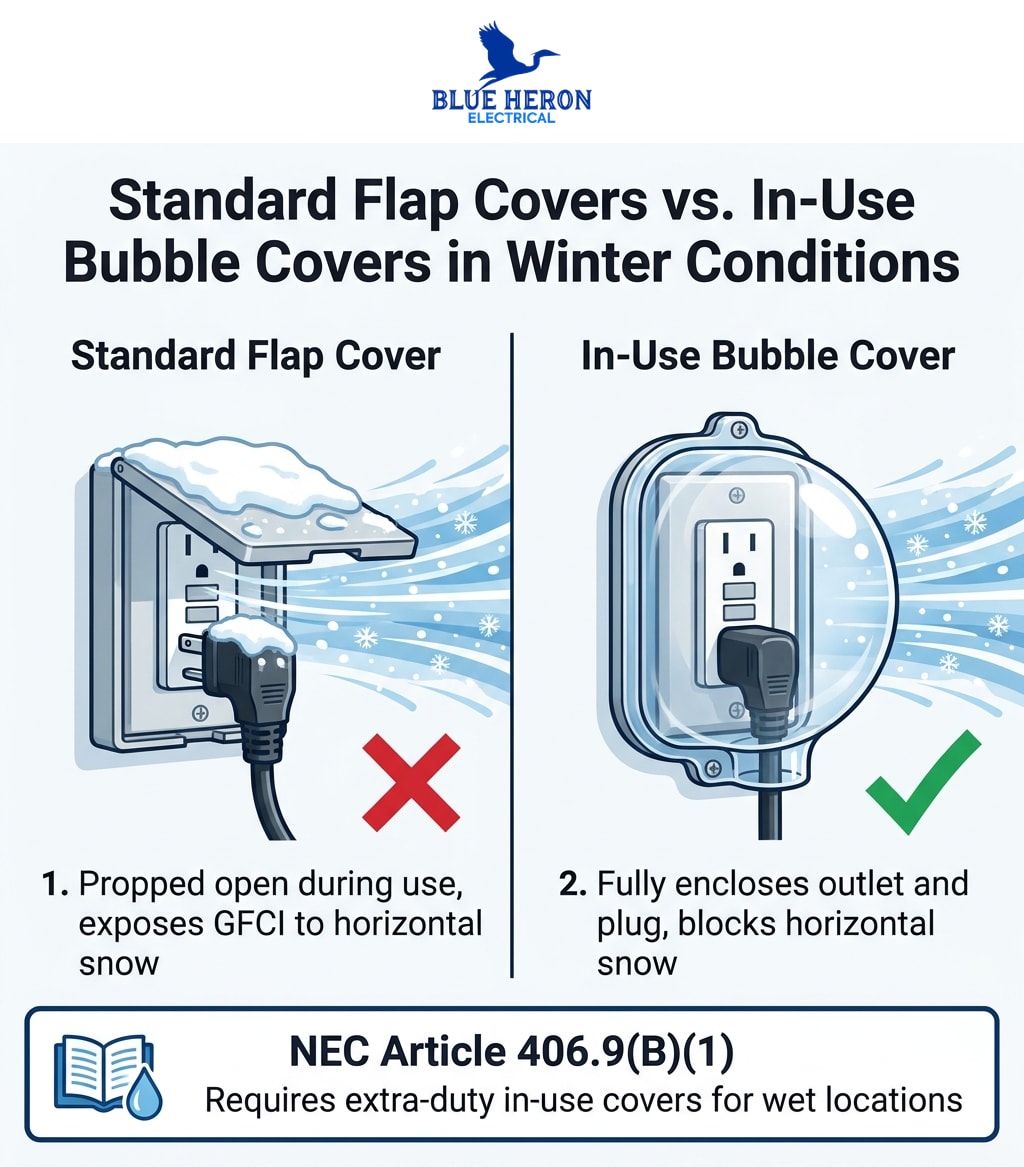
The most significant vulnerability of a standard flap cover is the irony of its design: it only protects the outlet when absolutely nothing is plugged into it. The moment you insert a cord to power your holiday lights or a block heater, the spring-loaded flap is forced to remain propped open.
This creates an exposed, gaping wedge right at the point of electrical connection. Instead of deflecting the elements, the propped-open flap actually acts as a funnel, catching falling and blowing snow and directing it straight into the active GFCI. Your outlet is left completely exposed to the elements exactly when it is under an active electrical load, guaranteeing that moisture bridging will occur as soon as the snow begins to melt.
• Active Use Protection — Standard Flap Cover: None. Flap remains propped open when a cord is plugged in. — Extra-Duty In-Use (Bubble) Cover: Complete. Housing closes fully over the plugged-in cord.
• Weather Resistance — Standard Flap Cover: Only deflects vertical rain when unplugged. — Extra-Duty In-Use (Bubble) Cover: Blocks horizontal blowing snow, freezing rain, and ice.
• Moisture Bridging Risk — Standard Flap Cover: Extremely high during winter precipitation. — Extra-Duty In-Use (Bubble) Cover: Virtually eliminated due to sealed housing.
• Code Compliance — Standard Flap Cover: No longer compliant for wet locations under modern NEC. — Extra-Duty In-Use (Bubble) Cover: Fully compliant with NEC Article 406.9(B)(1).
Why DIY Weatherproofing is a Dangerous Winter Gamble
When faced with a repeatedly tripping GFCI in freezing temperatures, it is tempting to look for quick, makeshift solutions. A quick search online might suggest wrapping the outlet in plastic grocery bags, sealing the edges with heavy duct tape, or cutting a hole in a plastic food storage container to shield the plug. These DIY fixes are not just ineffective; they are actively dangerous.
The condensation trap: Wrapping an active electrical connection in a plastic bag creates a sealed micro-environment. Because the electrical draw generates slight heat, and the outside air is freezing, condensation rapidly forms on the inside of the plastic bag. You are essentially manufacturing the exact moisture bridging problem you were trying to prevent, trapping water directly against the live GFCI face.
The failure of adhesives: Duct tape and electrical tape are not designed to maintain their adhesive properties in deep freezing temperatures. The adhesive hardens, cracks, and peels away, leaving sticky residue on your cords while failing to keep out the horizontal blowing snow common to Sterling Heights MI winters.
Most importantly, attempting to override or force a tripping GFCI to stay on without fixing the moisture source is a severe safety hazard. As licensed professionals at Blue Heron Electrical focused on strict electrical safety, our team sees the dangerous results of compromised outdoor electrical systems every winter. If a GFCI cannot properly detect a ground fault because its internal mechanics are frozen or corroded from trapped moisture, it can no longer protect you from electrical shock. Electrical components exposed to the winter elements require professional-grade, code-approved solutions. If your system has already been compromised by moisture, you may need emergency electrical repairs to safely restore functionality.
The Code-Compliant Fix: Extra-Duty In-Use Covers
The only permanent, safe solution to prevent snow from tripping your exterior outlets is to upgrade the physical housing to an extra-duty in-use cover, commonly referred to as a "bubble cover." This upgrade completely eliminates the vulnerabilities of the standard flap design and ensures your outdoor connections remain secure, dry, and active throughout the harshest winter weather.
As part of your November pre-winter prep, prioritizing this upgrade means you will not be standing in the freezing dark trying to reset a breaker on Christmas Eve.
Understanding the NEC Requirements
The National Electrical Code (NEC) is the benchmark for safe electrical design and installation. Recognizing the severe hazards of exposed outdoor connections, NEC Article 406.9(B)(1) mandates that all 15- and 20-ampere, 125- and 250-volt receptacles installed in wet locations must have an enclosure that is weatherproof whether or not the attachment plug cap is inserted.
Furthermore, these covers must be rated as "extra-duty." This specific designation means the housing is manufactured from high-impact polycarbonate or heavy-duty die-cast metal that will not shatter, crack, or become brittle under freezing temperatures or physical impact. At Blue Heron Electrical, our commitment to strict NEC compliance ensures that every installation our electricians perform meets these rigorous standards, providing reliable protection year after year.
How 'Bubble' Covers Protect Active Connections
The brilliance of the in-use cover lies in its deep, domed housing. When you plug in your holiday lights, the cord routes downward through specific, gasket-sealed exit slots at the bottom of the enclosure. The heavy-duty front cover then swings completely shut, locking into place over both the outlet face and the plug itself.
This design completely blocks horizontal snow, freezing rain, and ice accumulation. Because the cord exits from the bottom, gravity works in your favor, preventing water from traveling up the cord and into the connection. Upgrading to these covers—or even exploring options like installing dedicated soffit outlets for holiday lighting—requires a licensed electrician. A professional must ensure the weather-resistant gasket behind the box is perfectly sealed against the siding, preventing moisture from rotting the wall behind the outlet, and confirming the GFCI itself hasn't already suffered hidden water damage.
Beyond the Outlet: Preparing Your Home's Electrical System for Deep Freezes
Securing your exterior GFCIs is a critical first step, but true winter readiness requires looking at your home's electrical system as a whole. In our experience keeping local power systems running smoothly, the specific threat of ice accumulation and deep freezes common in Macomb County winters can cause broader power reliability issues. Before the ground freezes solid in Sterling Heights MI, take the time to evaluate your overall electrical resilience.
Here is a checklist for comprehensive winter electrical preparation:
• Inspect all exterior extension cords: Cold weather causes standard vinyl cord insulation to become rigid and brittle. Inspect every inch of your cords for cracks, exposed wiring, or fraying before the snow falls. Always use cords rated "SJTW" (hard service, weather-resistant, thermoplastic) for outdoor winter use.
• Calculate and balance your electrical load: Running multiple massive holiday light displays, inflatable yard decorations, and an engine block heater simultaneously can easily overload a single exterior circuit. Distribute your heavy electrical loads across multiple independent circuits to prevent nuisance breaker trips at the main panel.
• Test your GFCI mechanisms monthly: Press the "Test" button on your outdoor receptacles. You should hear a sharp click, and the power should cut off. Press "Reset" to restore it. If the button does not click or the power remains on, the internal safety mechanism has failed, and the unit must be replaced immediately.
• Evaluate whole-home backup power: Severe ice storms frequently pull down local power lines, leaving homes without heat for days. If you rely on electric heating, well pumps, or medical equipment, consider proactive home generator installation before the peak storm season arrives.
• Schedule a pre-winter electrical evaluation: Have a licensed professional inspect your exterior panel, weatherhead, and outdoor receptacles to ensure all seals are intact and no hidden corrosion has compromised your system during the rainy autumn months.
Frequently Asked Questions About Winter GFCI Tripping
Why does my outdoor GFCI trip in the snow?
Your outdoor GFCI trips in the snow due to a process called moisture bridging. When blowing snow accumulates on the face of the outlet, the slight heat from the electrical draw causes it to melt. This water seeps into the connections, creating a conductive path that the GFCI detects as a ground fault, triggering the safety shutoff.
Do I need a special cover for outdoor outlets in winter?
Yes, you need an extra-duty in-use cover, often called a bubble cover. Standard flap covers only protect the outlet when nothing is plugged in. An in-use cover features a deep housing that closes completely over the cord while it is actively plugged in, shielding the connection from horizontal blowing snow and freezing rain.
Why do my holiday lights keep tripping the breaker?
Holiday lights typically trip the breaker for one of three reasons: moisture has infiltrated the outdoor outlet or the cord connections, the extension cords have cracked insulation exposing bare wires to the wet ground, or you have overloaded a single circuit with too many high-wattage displays. Upgrading your covers during November pre-winter prep usually solves the moisture issue.
Can a GFCI outlet freeze and stop working?
Yes, a GFCI outlet can freeze if moisture has already bypassed the cover and penetrated the internal housing. When the trapped water freezes and expands, it can physically jam the internal spring mechanisms, preventing the outlet from tripping during a fault or preventing you from resetting it once it has tripped.
Are standard flap covers safe to use in the winter?
Standard flap covers are only safe if the outlet is completely unused during the winter months. Because the flap must remain propped open to accommodate a plug, it acts as a funnel for snow and ice when actively used, making it highly unsafe for powering winter equipment or holiday lighting.
What is an extra-duty in-use cover?
An extra-duty in-use cover is a highly durable, weather-resistant enclosure mandated by the National Electrical Code for wet locations. It is built from high-impact materials designed to withstand freezing temperatures and features a domed design that allows cords to be plugged in while the cover remains entirely shut and sealed against the elements.
Secure Your Holiday Lighting Before the First Deep Freeze Hits
Understanding exactly why snow trips the outlet is the first step to securing a permanent, reliable fix. The constant cycle of resetting a tripped GFCI is not just annoying; it is a clear warning that your electrical connections are exposed to dangerous moisture bridging. Relying on standard flap covers or dangerous DIY plastic bag wraps simply will not stand up to harsh winter weather.
Remind yourself that upgrading to an extra-duty in-use cover is a safe, code-compliant solution that prevents dark holiday displays and freezing hands. By addressing this vulnerability now, you ensure your exterior electrical system is fully prepared for whatever the season brings. If you are tired of fighting with your outdoor outlets in the snow, reach out to an experienced electrician in Macomb or the Sterling Heights MI area to inspect your exterior receptacles and perform the necessary, code-compliant upgrades safely.
Customer Testimonials

Service Areas