
Does a Gas Furnace Need Electricity to Run? Why Your Heat Fails During a Grid Outage

The Winter Heating Myth: Why Gas Furnaces Fail During Power Outages
It is a common misconception that as long as you pay your natural gas bill, your home will stay warm during a winter blackout. After all, if the appliance burns gas to create heat, it should work off the grid, right? Unfortunately, this is a dangerous myth. If you find yourself asking, does a gas furnace need electricity to run, the short answer is an absolute yes. While natural gas provides the raw fuel for the flame, electricity acts as the brain, the lungs, and the muscle of your entire heating system.
When the power grid goes down, your gas heating system goes down with it. This is why November pre-winter readiness is so critical. You need to understand exactly how your home's mechanical systems operate before the first major freeze hits. If you want to ensure your family never loses heat during an outage, explore our home generator services or schedule a standby generator installation today.
In our years serving homes across Sterling Heights, our team at Blue Heron Electrical sees many homeowners caught completely off guard when their heat fails during a winter storm. They assume that because they have a gas line, they are immune to electrical grid failures. This misunderstanding often stems from older generations of heaters, like antique wood stoves or gravity-fed floor heaters, which operated on basic thermodynamics. Today, HVAC technology is highly advanced. Your system relies on a complex network of electrical safety switches, motorized fans, and computer boards to function safely. Without a steady supply of 120-volt household current, your gas supply is completely useless.
Waiting until your house is freezing to discover this reality puts you in a difficult position. By prioritizing November pre-winter readiness, you give yourself time to evaluate your electrical infrastructure and put a reliable backup plan in place. Understanding the electrical dependency of your heating equipment is the first step toward true winter resilience.
Does a Gas Furnace Need Electricity to Run?
Yes, a gas furnace requires electricity to run. When our electricians get dispatched to freezing homes during late fall power outages, we frequently have to explain that while a furnace consumes natural gas or liquid propane to generate the physical heat, it requires electrical power to manage the combustion process safely and distribute that heat throughout your home. Without electricity, your heating system is essentially a heavy metal box sitting idle in your basement or utility closet.
Modern electronic ignition gas furnaces are designed with strict safety protocols. These systems have built-in safety mechanisms that actively prevent the main gas valve from opening if there is no electrical power detected. This prevents raw gas from flooding your home when the ignition source is offline. The electricity in your system is responsible for powering several critical components that make heating possible.
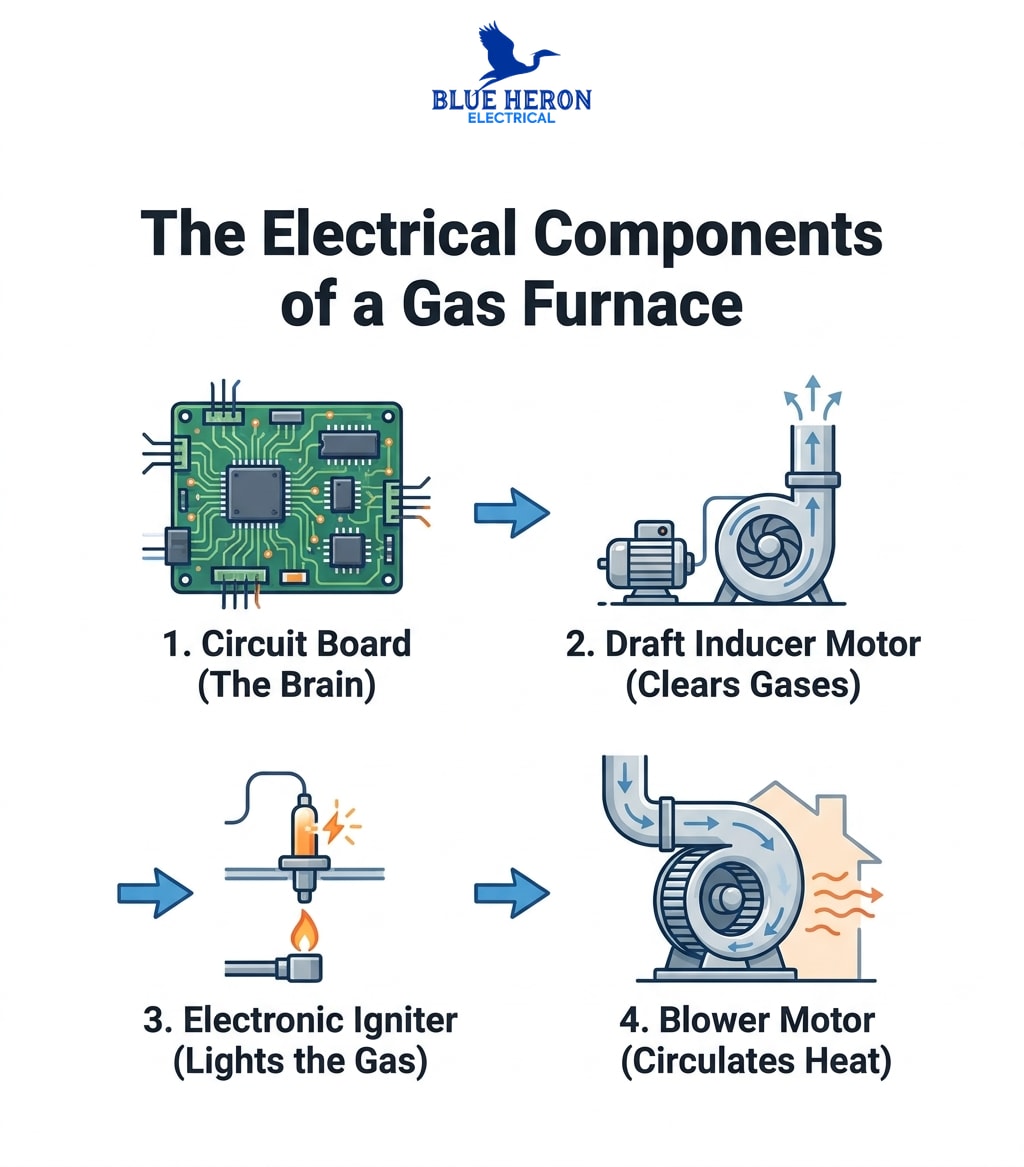
Here are the primary electrical components that require power to operate:
• The Blower Motor: This is the large fan that physically pushes the warm air through your ductwork and into your living spaces.
• The Electronic Igniter: This component uses electrical resistance to get hot enough to light the gas burner, replacing old-fashioned standing pilot lights.
• The Circuit Board: The computer brain of the system that communicates with your thermostat and controls the timing of the heating cycle.
• The Draft Inducer Motor: A smaller fan that clears dangerous combustion gases, like carbon monoxide, out of the heat exchanger and safely vents them outside.
If any single one of these electrical components loses power, the entire heating cycle halts immediately. The system is hardwired to prioritize your safety over your comfort, meaning a power outage guarantees a loss of heat unless you have an alternative electrical source ready to take over.
What Parts of a Gas Furnace Use Electricity?
To truly understand why your heat fails during a blackout, it helps to look at the sequence of operations. When your thermostat detects that the room temperature has dropped, it sends an electrical signal to the furnace. From that moment on, a carefully timed sequence of electrical events must occur in a specific order. If the power drops at any point during this sequence, the system locks out.
All of these internal components are powered by standard 120-volt household electricity. Let's break down exactly what parts of a gas furnace use electricity and why they are so vital to keeping your home warm.
The Circuit Board and Thermostat
The control board is the absolute brain of your HVAC system. It is a printed circuit board that receives low-voltage electrical signals from your thermostat. When you set your thermostat to 70 degrees, the thermostat acts as an electrical switch, closing a circuit that tells the control board to wake up. The circuit board then dictates exactly when the fans turn on, when the gas valve opens, and when the igniter glows. Without electricity, this brain is dead, and the system cannot even register that your house is cold.
The Draft Inducer Motor
Before any gas is allowed to flow, the circuit board sends 120 volts of electricity to the draft inducer motor. This is a small but critical fan located near the top of the unit. Its job is to pull air through the heat exchanger and push any lingering, dangerous combustion gases (like carbon monoxide) up and out through the exhaust flue. The system has an electrical pressure switch that verifies this fan is running. If the inducer motor does not have electricity to spin, the pressure switch will not close, and the system will refuse to light the gas.
The Electronic Igniter
Unlike older units that relied on a constantly burning standing pilot light, modern electronic ignition gas furnaces use a hot surface igniter or a direct spark igniter. A hot surface igniter works very much like the filament in a traditional lightbulb or a toaster. The circuit board sends a surge of electricity to the igniter, causing it to glow bright orange and reach extreme temperatures. Once it is hot enough, the electrical gas valve opens, releasing fuel across the glowing igniter to create the burner flame. No electricity means no ignition source.
The Blower Motor
The blower motor is the largest electrical draw in your entire heating setup. Once the gas is burning and the heat exchanger is sufficiently warm, the circuit board sends power to this massive fan. The blower motor pulls cold air from your home's return vents, forces it over the hot metal of the heat exchanger, and blows the newly heated air out through your supply vents. Even if you could somehow magically light the burner without power, you would have no way to move that heat into your living room without the electrically powered blower motor.
How Many Watts Does It Take to Run a Gas Furnace?
If you are planning your November pre-winter readiness strategy, you will likely start looking into backup power. To do that correctly, you need to understand the electrical load of your heating equipment. You cannot simply plug a heavy appliance into a small battery bank and expect it to work. You must account for both running wattage and starting wattage.
For most modern electronic ignition gas furnaces, the running wattage is surprisingly low. Once the system is up and running, it typically requires between 400 and 800 watts of continuous electricity. This covers the steady spinning of the blower motor, the draft inducer, and the operation of the circuit board. However, running wattage is only half of the equation.
The starting surge: Electric motors require a massive jolt of extra energy just to start spinning from a dead stop. This is known as starting wattage or surge wattage. When your furnace's blower motor first kicks on, it may demand two to three times its normal running wattage for a split second. If your backup power source cannot handle a sudden 1,500 to 2,000-watt surge, the generator will overload, the breaker will trip, and your heat will not turn on.
• Running Wattage — Typical Wattage Range: 400 - 800 Watts — What It Powers: Continuous operation of the blower, inducer, and control board.
• Starting (Surge) Wattage — Typical Wattage Range: 1,200 - 2,400+ Watts — What It Powers: The initial split-second jolt needed to overcome the inertia of the heavy blower motor.
Our master electricians strongly advise against guessing your wattage needs. We have seen too many homeowners overload undersized generators during winter storms. Always consult an electrical professional to measure your system's exact draw before purchasing backup equipment.
Safe Backup Power Solutions for Winter Grid Outages
When the grid goes dark, desperation often sets in. Unfortunately, this is when homeowners make dangerous mistakes. On our emergency calls across Metro Detroit, we regularly see people attempting highly unsafe DIY setups to force their heating systems to run. You must never use a "suicide cord" (a homemade extension cord with two male ends) to backfeed power into your wall outlets. You should also never attempt to cut the hardwired electrical line of your heating unit to splice a standard extension cord plug onto it. These methods violate electrical codes, risk catastrophic house fires, and can send lethal voltage back onto the utility lines, endangering the very utility workers trying to restore your power.
With Metro Detroit's heavy ice storms and freezing rain acting as a frequent catalyst for sudden grid failures, having a reliable backup power plan is a necessity rather than a luxury. The only safe way to power your heating equipment during an outage is through professionally installed, code-compliant electrical integration.
This is exactly why our licensed experts at Blue Heron Electrical focus so heavily on installing safe, code-compliant backup power solutions like transfer switches. A manual transfer switch is a dedicated electrical panel installed next to your main breaker box. It allows you to safely connect a portable generator to your home's wiring. When you flip the switch, it physically disconnects your home from the utility grid before connecting it to the generator. This guarantees that your generator power only goes to your essential appliances—like your heating unit and refrigerator—without backfeeding onto the street.
For seamless protection, a standby generator is the ultimate solution. These permanent units monitor the utility grid 24/7. If the power drops, the standby unit automatically turns itself on, switches the power source, and restores your heat within seconds, whether you are home or away. Keep in mind that integrating these systems requires adequate electrical capacity. Older homes may require electrical panel upgrades to safely accommodate a new transfer switch or a whole-home standby system. (Certain energy-efficient electrical upgrades may even qualify for federal tax credits or local utility incentive programs; we always recommend verifying current programs with your utility or a tax professional). Prioritizing this as part of your November pre-winter readiness ensures your home is equipped to handle the harshest winter weather.
Frequently Asked Questions About Furnace Electrical Requirements
When the temperature drops and the lights go out, homeowners often scramble for answers. If you are looking into safely connecting a portable generator to your furnace, it helps to first understand the fundamental limitations of your equipment. Here are the most common questions our team fields from Sterling Heights residents regarding heating systems and grid failures.
Can you light a gas furnace manually without power?
No, you absolutely cannot. Attempting to manually light modern electronic ignition gas furnaces is highly dangerous and physically impossible. These units are equipped with electronic safety valves that remain firmly locked shut without electrical power. There is no standing pilot light to ignite with a match, and trying to bypass the electrical gas valve can result in a catastrophic gas leak or explosion.
How can I run my gas furnace without electricity?
The short answer is that you cannot run it without electricity. The only safe and effective way to keep the system operating during a blackout is by supplying alternative electricity. This requires a professionally installed backup generator connected through a certified transfer switch. There are no safe workarounds or manual overrides that bypass the system's need for electrical power.
Will a gas fireplace work without electricity?
It depends heavily on the age and model of the fireplace. Some older models equipped with a traditional standing pilot light and a millivolt gas valve may ignite without grid power. However, the blower fans that actually distribute that heat into your room run on 120-volt electricity. Without power, the fire may burn, but the heat will largely stay trapped inside the firebox or vent straight up the chimney, providing very little warmth to your living space.
What happens to my furnace if the power goes out while it's running?
The system will immediately and safely shut down. The moment electricity is lost, the spring-loaded electronic gas valve automatically snaps closed. This is a crucial safety feature designed to prevent raw, unburned gas from continuously pouring into the combustion chamber. Once power is restored, the circuit board will reboot, run a diagnostic check, and restart the heating cycle from the beginning.
Can I plug my furnace directly into a portable generator?
No, you cannot. Residential heating systems are hardwired directly into your home's electrical panel; they do not have a standard plug that you can pull out of a wall socket. To use a portable generator safely, your home must be equipped with a professionally installed manual transfer switch. Splicing wires to create a makeshift plug for an extension cord is a severe code violation and a massive fire hazard.
Keep Your Home Warm and Safe During Outages
As we have covered extensively, your heating equipment relies on a complex network of motors, igniters, and circuit boards to keep your family comfortable. So, does a gas furnace need electricity to run? Yes, it absolutely does. Without a reliable source of power, your system cannot ignite the fuel or circulate the warm air you depend on when the temperatures plummet.
Do not wait for the next major ice storm to realize your home is vulnerable. Finalize your November pre-winter readiness strategy now while the weather is still manageable. Whether you need to inspect your current electrical setup, upgrade an outdated panel, or install a safe backup power transfer switch, proactive planning is your best defense against winter blackouts. If you need immediate assistance or want to discuss your backup power options with a local team you can trust, reach out to an emergency electrician today to ensure your home stays warm, safe, and fully powered all winter long.
Customer Testimonials

Service Areas