
Calculating Essential Circuits for Backup Power: Why the Furnace Blower Beats the Fridge in Winter

Are You Prioritizing the Right Appliances for the Next Winter Storm?
Do you know exactly what will stay powered when the grid fails this winter? When calculating essential circuits for backup power, many homeowners make a critical mistake. Here at Blue Heron Electrical, our team frequently sees Sterling Heights residents prioritize the kitchen refrigerator over the gas furnace blower. As November pre-winter readiness begins, securing reliable electricity is an urgent priority before ice storms hit. Planning a standby system requires deciding exactly which specific circuits make the "essential" cut, and prioritizing food preservation over home heating during a winter outage can lead to disastrous consequences for your property.
To ensure your home remains safe and warm when utility lines go down, you need a professional approach to generator services.
The Hidden Danger of Miscalculating Winter Loads
The true cost of an outage: When a severe winter storm knocks out electricity, the immediate instinct is often to protect the groceries. A refrigerator full of food represents a tangible loss that homeowners want to avoid. However, in our years of helping Michigan families weather severe outages, we've found that replacing spoiled groceries is a minor inconvenience compared to the catastrophic damage caused by burst pipes. This is why load calculation is not just a simple math exercise, but a vital winter survival strategy.
In sub-freezing temperatures, a home's internal climate can drop to dangerous levels in just a few hours without the furnace blower actively circulating heat. The structural envelope of a house loses heat rapidly through windows, doors, and roof vents. Once the indoor temperature dips below freezing, water resting inside your plumbing lines expands as it turns to ice. This expansion exerts immense pressure on copper, PEX, and PVC pipes, eventually causing them to rupture. When the thaw inevitably comes, thousands of gallons of water can flood your walls, floors, and foundation.
If you miscalculate your standby power needs and overload the system, the main breaker on the unit will trip to protect itself. An overloaded system that trips leaves your home completely defenseless against the cold. You lose both the refrigerator and the furnace, defeating the entire purpose of having a backup plan. Accurate calculations ensure that the most critical life-safety and property-protection systems remain online without overwhelming the power source.
Starting Wattage vs. Running Wattage: The Math Behind the Breakers
Understanding how electrical loads are calculated requires distinguishing between two very different types of power demands. Failing to account for the difference between these two metrics is the number one reason we see backup systems fail during an emergency.
• Running Wattage: This is the continuous power an appliance draws to operate under normal conditions. Once a motor is spinning or a heating element is warm, the energy required to maintain that state is relatively stable and predictable.
• Starting Wattage (Surge): This is the temporary, massive spike in power required to start a motor-driven appliance from a dead stop. Overcoming inertia requires significantly more energy than maintaining momentum.
Calculating essential circuits for backup power requires using the starting wattage of the largest motor in your home, not just adding up the running wattages of everything you want to plug in. If you only calculate based on running watts, your system will instantly overload the moment a large motor attempts to cycle on.
• Gas Furnace Blower (1/2 HP) — Typical Running Watts: 800 Watts — Typical Starting Watts: 2,300 Watts — Surge Multiplier: ~3x
• Sump Pump (1/3 HP) — Typical Running Watts: 800 Watts — Typical Starting Watts: 1,300 Watts — Surge Multiplier: ~1.5x - 2x
• Kitchen Refrigerator — Typical Running Watts: 700 Watts — Typical Starting Watts: 2,200 Watts — Surge Multiplier: ~3x
• Essential LED Lighting (10 Bulbs) — Typical Running Watts: 100 Watts — Typical Starting Watts: 100 Watts — Surge Multiplier: 1x (No Surge)
Why Motor-Driven Appliances Require a Surge
Motor-driven appliances—like compressors in refrigerators and blowers in HVAC systems—rely on inductive loads. An inductive load uses electromagnetic fields to create physical rotation. When a motor is completely stationary, it acts almost like a short circuit for a fraction of a second, drawing a massive influx of current to generate the magnetic field necessary to break physical inertia.
This surge requirement is often two to three times the continuous running watts. For example, a refrigerator compressor might only need a few hundred watts to keep running, but it requires a massive jolt of electricity to initially pressurize the refrigerant. If your backup source does not have the overhead capacity to handle that split-second surge, the breaker will trip, shutting down power to the entire house.
Why the Gas Furnace Blower Demands Priority
A common misconception we hear among homeowners is that a gas furnace does not require much electricity because it uses natural gas or propane to generate heat. While the fuel source provides the thermal energy, the system relies entirely on electricity to operate safely and effectively.
The electrical components of a gas furnace:
• The Draft Inducer Motor: This small fan clears residual gases from the heat exchanger before ignition, ensuring safe combustion.
• The Igniter: Whether a spark igniter or a hot surface igniter, this component requires an electrical charge to light the gas.
• The Main Blower Motor: This is the heavy lifter. It forces the heated air through your ductwork and across the entire square footage of your home.
A standard 1/2 horsepower gas furnace blower motor requires significant starting wattage, often exceeding 1,500 to 2,000 watts just to spin up. In places like Sterling Heights MI, prioritizing this blower motor is a life-safety and property-protection necessity. The extreme cold means that heating cannot be treated as an optional luxury.
When you compare this electrical draw to a modern refrigerator, you begin to see the mechanical conflict. Both appliances have large inductive motors that cycle on and off automatically based on thermostat readings. If your backup system has limited capacity, both cannot always start simultaneously. If the furnace and the fridge happen to cycle on at the exact same millisecond, the combined surge will easily exceed the limits of a standard portable setup. Understanding the technical requirements for wiring a backup portable generator to your furnace ensures that your heating system receives the dedicated power it needs without triggering an overload.
How to Rank Your Home's Essential Circuits
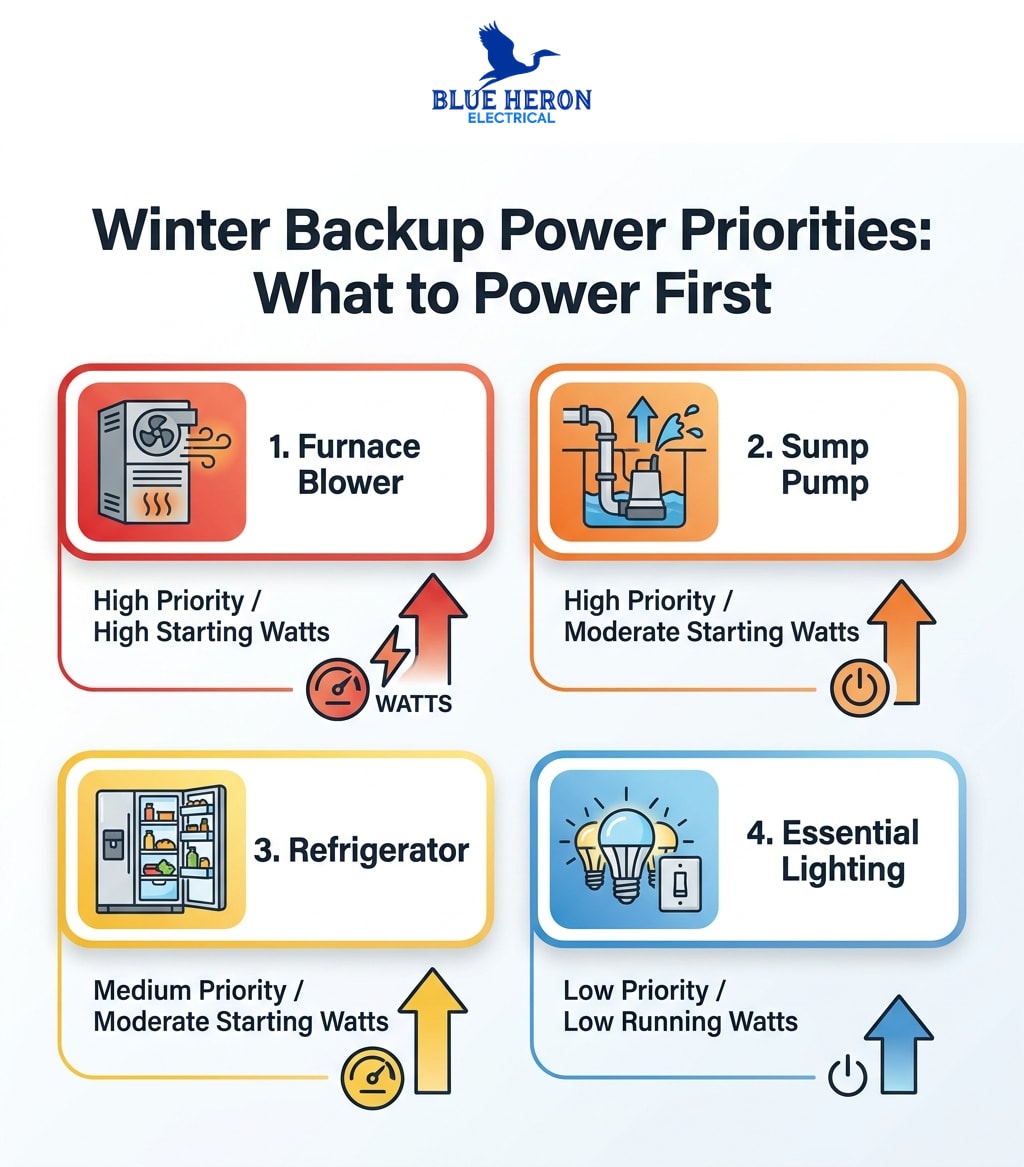
When capacity is limited, you must establish a clear, actionable hierarchy for your breakers. A professional load calculation maps these priorities directly to the specific breakers in your electrical panel, ensuring that the most critical infrastructure remains powered. Here is the hierarchy our electricians recommend:
1. Gas Furnace Blower (Life Safety and Pipe Protection): As established, maintaining indoor temperatures above freezing is the absolute highest priority during a winter outage. This prevents the catastrophic property damage of burst pipes and keeps your family safe from hypothermia.
2. Sump Pump (Water Damage Prevention): Winter weather often brings freeze-thaw cycles. If snow melts rapidly or freezing rain accumulates, groundwater can quickly fill your basement sump pit. A sump pump requires a moderate surge to start, but keeping it powered prevents severe flooding and structural water damage.
3. Refrigerator and Freezer (Food Preservation): Once the heating and water management systems are secured, food preservation is the next priority. Modern refrigerators are highly insulated and can keep food safe for several hours without power if the doors remain closed. By staggering its operation, you can keep food cold without fighting the furnace for surge capacity.
4. Essential Lighting and Outlets (Communication and Visibility): These are non-inductive loads. LED lighting, phone chargers, and internet routers require very little running wattage and zero starting surge. They can easily be factored into the remaining available capacity to provide basic visibility, medical device support, and communication with the outside world.
The Risk of Simultaneous Startup and Generator Overload
The most dangerous moment during a power outage is often the exact second power is restored via your backup system. If your transfer switch is engaged and multiple essential circuits are left in the "on" position, you face the mechanical reality of simultaneous startup.
The overload scenario: The grid goes down, and your home loses power. The temperature in the house begins to drop, causing the furnace thermostat to call for heat. Meanwhile, the temperature inside the refrigerator rises, causing its internal thermostat to call for cooling. When you fire up your backup power source and flip the transfer switch, both the fridge compressor and the furnace blower attempt to start at the exact same time.
This combined starting wattage spike creates a massive, instantaneous demand for electricity. Even if your generator has enough continuous running watts to support both appliances, the sheer force of the dual surge will exceed the unit's maximum starting capacity, causing the breaker to trip immediately. You are left in the dark, wondering why your carefully planned system failed.
This is why DIY calculations often miss the mark. They add up running wattages on a notepad but fail to account for the chaotic nature of automated thermostats. Working with our team at Blue Heron Electrical ensures you benefit from professional expertise in accurate load calculations. Professional load management strategies—such as installing systems with adequate surge overhead, utilizing smart load-shedding modules, or physically staggering the start of heavy appliances—ensure families aren't left in the cold due to a tripped breaker during an emergency.
Frequently Asked Questions About Backup Power Loads
What are the most essential circuits to back up?
The most essential circuits to back up are your furnace blower, sump pump, refrigerator, well pump (if applicable), and a few critical lighting or outlet circuits. In winter climates, the furnace blower must always take the top spot to prevent pipes from freezing and bursting. Prioritizing these specific breakers ensures your home remains safe, dry, and habitable during a prolonged grid failure.
How do you calculate wattage for essential circuits?
You calculate wattage by identifying the starting wattage of the largest motor-driven appliance, then adding the continuous running wattage of all other appliances that will operate simultaneously. You must never simply add up the running watts of everything on your list, as this ignores the massive surge required to start inductive motors. A professional load calculation will map these exact figures to ensure your total demand never exceeds the system's maximum threshold.
Why does my generator trip when the furnace turns on?
Your system trips because the furnace blower requires a massive surge of starting wattage that, when combined with other active loads, exceeds the backup unit's surge capacity. Even if the generator seems to be running fine with the lights and TV on, the sudden demand from the furnace motor acts like a short circuit for a fraction of a second. If the system does not have the overhead capacity to handle that spike, its internal safety breaker will trip to prevent electrical fires or engine damage.
Can a generator run a furnace and a refrigerator at the same time?
Yes, a generator can run a furnace and a refrigerator at the same time if it is properly sized to handle the combined running wattage and at least one of their starting surges. However, we advise that on smaller backup systems, they should never be started at the exact same time to avoid overloading the system. A common load management strategy is to let the furnace cycle on and stabilize before switching on the breaker that powers the kitchen refrigerator.
How many circuits do I need for a transfer switch?
Our technicians typically recommend between 6 and 10 circuits for a standard portable generator setup, carefully selected based on a professional load calculation. This usually covers the furnace, a few kitchen outlets, the refrigerator, the sump pump, and essential lighting. The exact number depends entirely on the total wattage capacity of your power source and the specific amperage of the breakers you choose to isolate.
Finalize Your Winter Backup Plan Before the Freeze
Surviving a winter power outage safely requires more than just buying a piece of equipment; it requires a clear, logical hierarchy of what to back up first. By prioritizing your heating system over your refrigeration, you protect your home from the catastrophic damage of burst pipes.
Guessing on wattage requirements can lead to a tripped system exactly when you need heat the most. As November pre-winter readiness continues, now is the ideal time to finalize your plans before severe weather arrives. Seek professional help for accurate load calculations and safe integration by scheduling your home generator installation with Blue Heron Electrical today.
Customer Testimonials

Service Areas