
Addressing Flickering Bathroom Lights When the Hair Dryer is Running
The Morning Routine Interruption: Dimming Vanity Lights
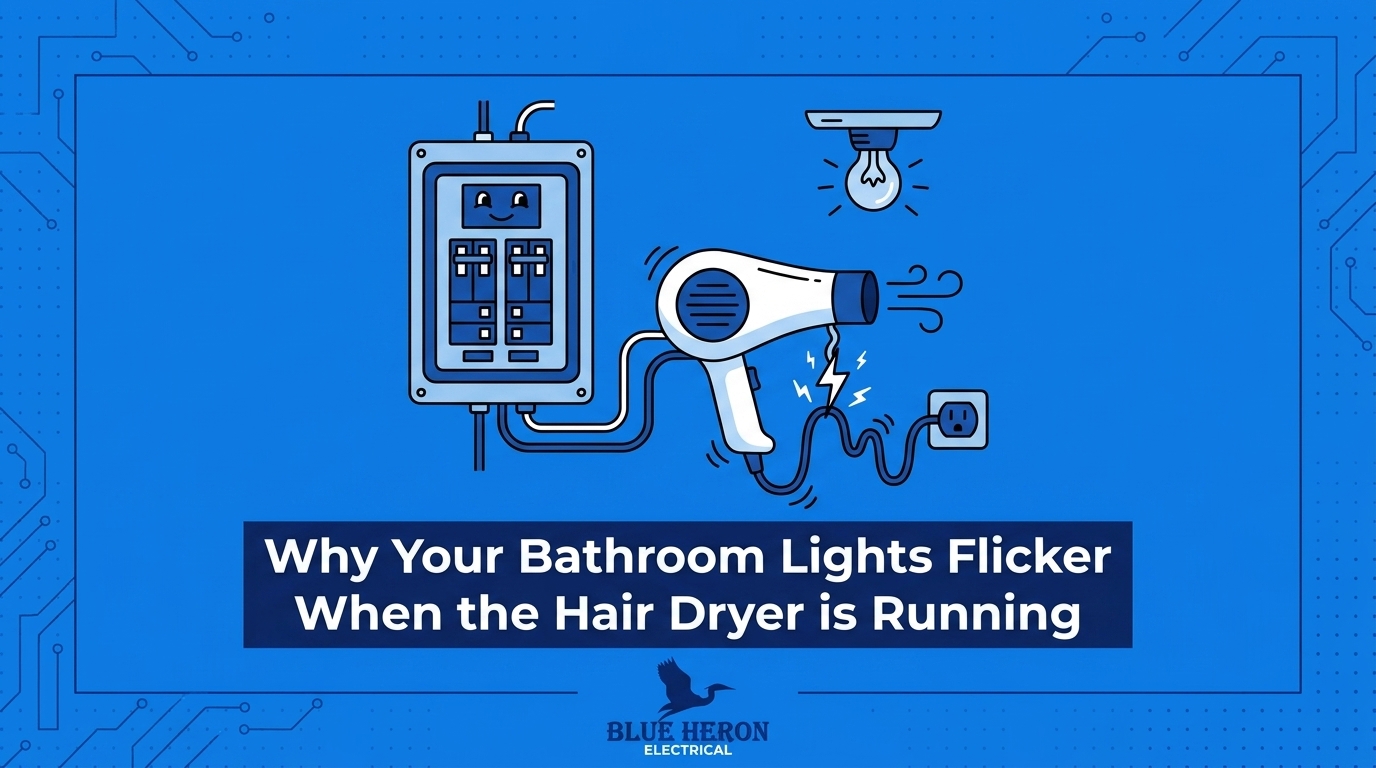
You step out of the shower, plug in your styling tools, and the moment you power them on, the room goes noticeably dark. Here at Blue Heron Electrical, addressing flickering bathroom lights when the hair dryer is running is one of the most frequent issues we hear about, especially during the chaotic rush of August back-to-school morning routines. When multiple family members are trying to get ready at the same time, the sudden demand for electricity can expose underlying weaknesses in your home's wiring. If you are tired of this daily disruption, understanding the root cause is the first step in comprehensive residential electrical services.
We find that many Sterling Heights homeowners initially brush off this sudden drop in lighting as a minor, harmless quirk of living in a residential property. However, it actually represents a critical decision point. You have to determine whether this is simply a momentary annoyance or a clear signal that your bathroom's electrical infrastructure is falling short of modern safety codes. When vanity lights dim the instant a high-draw appliance is switched on, the electrical system is communicating that it is struggling to handle the concurrent load.
During those busy August back-to-school morning routines, the bathroom becomes a high-traffic zone. One person might be using a hair dryer while another turns on a curling iron or an electric razor. When all of these devices pull power from the exact same circuit that powers your overhead lighting, the electrical current is stretched beyond its intended capacity. Recognizing this pattern is essential for maintaining a safe environment, as our team frequently sees chronic overloading lead to tripped breakers, overheated wires, and potential fire hazards.
Instead of simply accepting the flicker as a daily reality, our electricians emphasize the importance of looking closer at what is happening behind your walls. The electrical panel and the wiring running to your bathroom were designed with specific limits in mind. When those limits are tested every single morning, the resulting power drop requires a professional assessment to ensure your home remains both functional and fully compliant with modern safety standards.
Understanding Voltage Sag on Overloaded Circuits
When our team explains why your lights react so dramatically to your grooming tools, we break down a technical concept known as voltage sag. Voltage sag is a temporary, sudden drop in electrical voltage that occurs when a heavy electrical load is introduced to a circuit. When you turn on a device that requires a massive amount of power to start up and run, it momentarily starves the other devices sharing that same electrical pathway.
The Mechanics of an Overloaded Circuit:
1. The Appliance Draw: Modern hair dryers typically draw between 1,500 and 2,000 watts of power to generate high heat and strong airflow instantly.
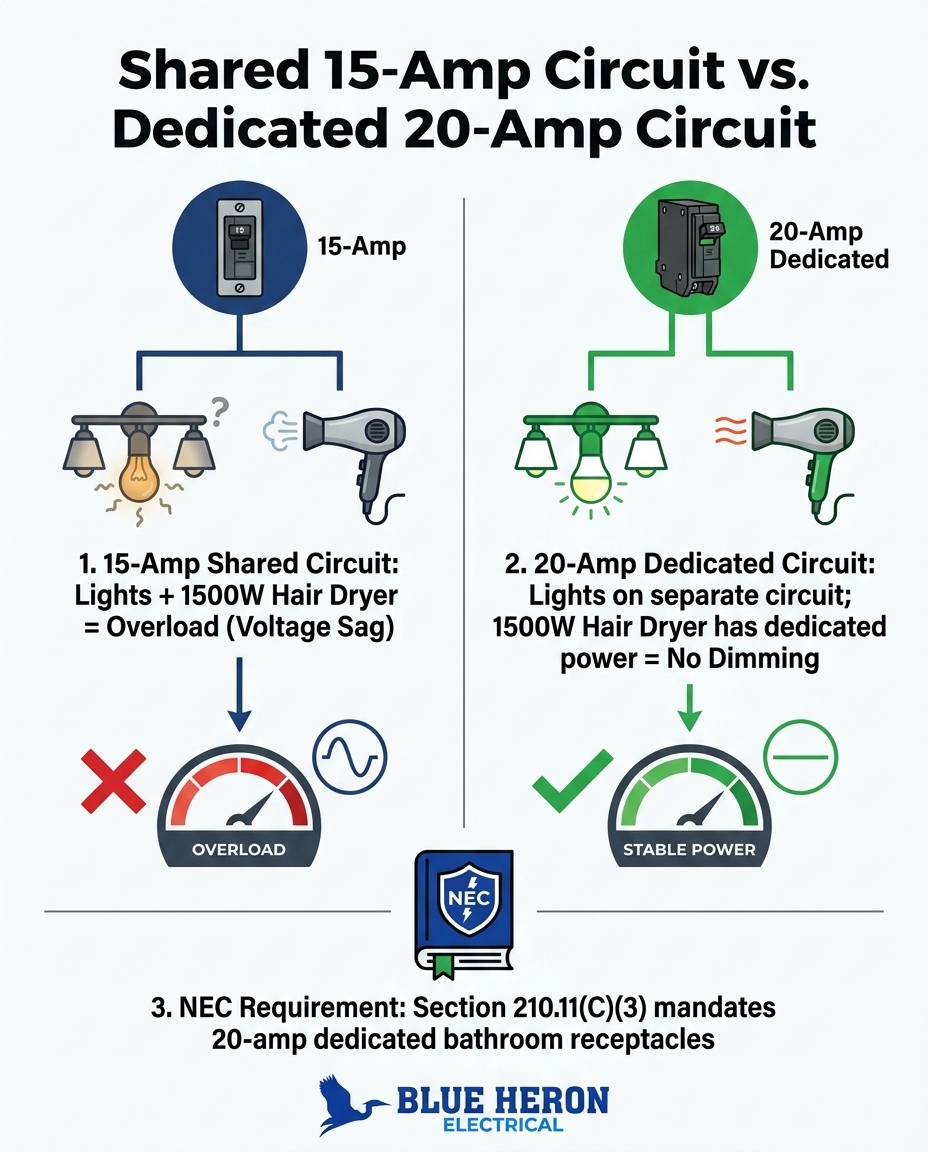
2. The Circuit Capacity: Many standard residential lighting and outlet circuits are rated for only 15 amps. On a standard 120-volt system, a 15-amp circuit can safely handle a maximum of 1,800 watts of total power at any given time.
3. The Overload Event: If your bathroom lights are using 200 watts, and you turn on an 1,800-watt hair dryer on the same shared circuit, the total demand instantly hits 2,000 watts. This exceeds the circuit's safe capacity.
4. The Visual Symptom: Because the electrical current is bottlenecked, the voltage drops. The hair dryer pulls the lion's share of the available power, causing the lights to dim or flicker visibly.
In our field experience, this phenomenon becomes particularly obvious on shared circuits, where the bathroom receptacles and the overhead lighting are wired into the exact same breaker. If you want to dive deeper into the various reasons your home's illumination might be unstable, learning what causes flickering lights and when to call an electrician can provide broader context for overall electrical health.
The issue of voltage sag is often heavily exacerbated by seasonal shifts. As late-summer mornings start transitioning to cooler fall temperatures, homeowners frequently plug in small portable space heaters to take the chill out of the bathroom air. Running a 1,500-watt space heater concurrently with a 1,500-watt hair dryer during those busy August back-to-school morning routines guarantees a massive overload, often resulting in a completely tripped breaker rather than just a momentary flicker.
The Standard for Safety: Dedicated Bathroom Receptacles
Because the daily use of high-wattage grooming appliances has become the norm rather than the exception, we've watched electrical safety standards evolve significantly over our years in the industry. The solution our licensed electricians implement for voltage sag in the bathroom is not simply buying lower-wattage tools; it is upgrading the infrastructure to meet current code requirements. The National Electrical Code (NEC) sets the benchmark for safe residential wiring, and it addresses this specific issue directly.
Under NEC Section 210.11(C)(3), modern standards mandate a 20-amp dedicated circuit requirement specifically for bathroom receptacle outlets. This means that the outlets where you plug in your hair dryers, curling irons, and electric razors must be on their own separate 20-amp breaker, completely isolated from the lighting circuit. By separating the receptacles from the lights, the high power draw of a grooming tool has absolutely no impact on the vanity illumination.
• 15-Amp Shared Circuit — Capacity: 1,800 Watts Max — Common Configuration: Lights, fan, and outlets all on one breaker — Result During Hair Dryer Use: Significant voltage sag, dimming lights, potential tripped breaker
• 20-Amp Dedicated Circuit — Capacity: 2,400 Watts Max — Common Configuration: Outlets on an isolated breaker; lights separate — Result During Hair Dryer Use: No dimming, stable power delivery, safe operation
When our team handles projects, achieving this 20-amp dedicated circuit requirement is often a critical component of safe bathroom electrical remodeling. When homeowners update their vanities, mirrors, and lighting fixtures, ensuring the underlying wiring meets this NEC standard is paramount. A 20-amp circuit utilizes thicker gauge wire than a standard 15-amp lighting circuit, allowing it to safely carry the heavier electrical load without overheating.
We always warn our customers that simply swapping a 15-amp breaker for a 20-amp breaker in your electrical panel without upgrading the physical wiring inside the walls is incredibly dangerous and a severe fire hazard. The wire gauge must match the breaker's amperage rating. Implementing the 20-amp dedicated circuit requirement is a complex process that demands professional expertise to ensure the new lines are routed safely and terminated correctly according to local building codes.
Why Older Homes Struggle with Modern Electrical Demands
When we get calls for frequent dimming lights, there is a strong chance the homeowner resides in one of Sterling Heights' older properties. Many legacy homes were built decades before modern, high-wattage hair dryers, advanced styling tools, and electric space heaters were common household items. The electrical infrastructure was simply not designed to support the heavy loads we consider standard today.
In older construction, electricians frequently utilized legacy wiring practices that grouped bathroom lights, the bathroom exhaust fan, the bathroom outlets, and sometimes even the receptacles in adjacent bedrooms or hallways onto a single 15-amp breaker. When you plug a hair dryer into a system designed for a few incandescent bulbs and an electric toothbrush, the resulting voltage sag is inevitable. The wiring is physically incapable of delivering the required current without bottlenecking.
Resolving chronic voltage sag in these properties often goes beyond pulling a single new wire. It frequently involves comprehensive electrical panel upgrades to safely support the addition of new dedicated circuits. If your current breaker box is full, outdated, or relies on old fuse technology, it must be modernized to accommodate the 20-amp dedicated circuit requirement safely.
Our team at Blue Heron Electrical brings specific expertise in safely bringing older Metro Detroit homes up to modern electrical code without compromising the integrity of the property. Navigating legacy wiring requires a deep understanding of historical building practices and modern safety standards. One local homeowner reached out last spring with a series of legacy electrical issues that needed fixing. Our team thoroughly educated the customer on all available options for modernizing their system, and then efficiently completed the work to bring the home up to current standards.
Upgrading an older home's electrical capacity is strictly a job for licensed professionals. Attempting to bypass older wiring, splice into existing overloaded circuits, or modify the main panel without proper licensing can result in catastrophic failure. A professional assessment ensures that the entire system, from the meter to the bathroom outlet, can handle your daily routines safely.
Recognizing When an Inconvenience Becomes a Code Issue
Homeowners often tolerate flickering lights for years, assuming it is just a quirk of their house. However, there is a distinct line between a rare, momentary dimming and a consistent, significant drop in lighting power that indicates a serious underlying problem. Guiding yourself through this decision point requires paying close attention to how your electrical system behaves under stress.
Based on the hundreds of electrical assessments we perform, here is a checklist of warning signs our electricians look for that indicate your bathroom electrical system requires professional intervention to meet the 20-amp dedicated circuit requirement:
• Consistent Dimming: If the vanity lights dim every single time the hair dryer is turned on and stay dim until it is turned off, the circuit is continuously bottlenecked.
• Frequent Tripped Breakers: If your morning routine is regularly interrupted by a breaker tripping and shutting off power to the bathroom, this is not a nuisance—it is a safety mechanism preventing an electrical fire.
• Sizzling or Buzzing Sounds: Any audible noise coming from the outlet or the light switch when high-wattage appliances are running indicates dangerous electrical arcing.
• Warm Outlets or Switches: If the plastic faceplate of the outlet feels warm or hot to the touch after using a hair dryer, the wiring behind it is overheating due to the excessive load.
• Burn Marks or Discoloration: Black or brown smudges around the outlet slots are a definitive sign that the receptacle has overheated and requires immediate professional replacement.
Ignoring these signs during your daily routine is a risk to your property. For example, one homeowner living in an older property reached out to us during the winter because they needed to add outlets, update their electrical box, and install a new chandelier. By addressing the core capacity issues at the panel first, we completed the necessary upgrades quickly and safely, ensuring the entire system could handle the new load without faltering.
Bringing a bathroom up to the modern 20-amp dedicated circuit requirement is an investment in home safety, not just convenience. It eliminates the daily frustration of voltage sag while protecting the physical wiring hidden behind your drywall. Reaching out to a professional to assess these symptoms is the most responsible action a homeowner can take when dealing with outdated infrastructure.
Frequently Asked Questions About Bathroom Electrical Circuits
Why do my lights dim when I turn on my hair dryer?
This happens due to voltage sag on an overloaded circuit. A standard hair dryer pulls massive wattage, typically between 1,500 and 2,000 watts. If your bathroom lights share the same 15-amp circuit as the outlet, the sudden draw of the appliance starves the lights of power, causing a noticeable drop in brightness.
What exactly is voltage sag?
Voltage sag is a brief, temporary decrease in electrical voltage caused by a sudden, heavy demand for power on a specific circuit. When an appliance requires a large surge of current to operate, it reduces the available voltage for other devices on that line. In a residential bathroom, this is visually noticeable as flickering or dimming vanity lights.
Does my bathroom need a 20-amp circuit?
Yes, modern National Electrical Code (NEC) requires at least one dedicated 20-amp circuit strictly for bathroom receptacles. This 20-amp dedicated circuit requirement ensures that high-draw grooming appliances can operate safely at full capacity without overloading the home's lighting circuits or tripping breakers.
Is it dangerous if lights flicker when an appliance turns on?
Occasional, very slight dimming when a major appliance starts up might just be a nuisance, but severe or continuous flickering indicates an overloaded circuit or loose wiring. Overloaded circuits force electricity through wires that are not rated for that volume, which can cause them to overheat, melt insulation, and pose a significant fire hazard.
Can I upgrade my bathroom outlet to 20 amps myself?
No. Upgrading to a 20-amp circuit requires installing new, thicker gauge wire through the walls and installing a new, matching breaker at the main electrical panel. This is complex, high-voltage work that must be performed by a licensed electrician to meet building codes, pass inspection, and ensure complete safety.
How do electricians fix overloaded bathroom circuits?
Our licensed electricians at Blue Heron Electrical resolve the overload by running a brand new, dedicated line directly from the main electrical panel to the bathroom. We install a 20-amp breaker and the appropriate thicker wiring, effectively separating the high-draw outlets from the delicate lighting circuit to eliminate voltage sag entirely.
Bringing Your Home's Electrical System Up to Standard
Resolving dimming lights during busy August back-to-school morning routines is fundamentally about safety and code compliance, not just aesthetics. When you turn on a hair dryer and the lights drop, your home is signaling that its electrical infrastructure is overwhelmed by modern demands. Achieving the modern 20-amp dedicated circuit requirement provides lasting peace of mind, ensuring that your grooming tools run efficiently without putting your home's wiring at risk of overheating.
If you are experiencing consistent voltage sag, tripped breakers, or warm outlets, it is time to stop tolerating the inconvenience and address the root cause. Our team encourages you to consult our local experts for proper circuit breaker services in Sterling Heights to evaluate your home's electrical capacity. A professional assessment will identify exactly what it takes to bring your property up to current safety standards, delivering a reliable, flicker-free start to your day.
Customer Testimonials

Service Areas