
What Electrical Work Can Be Done Without a Permit in Michigan?
Preparing for Winter Outages: Do You Need a Permit for Backup Power?
Are you weighing different backup power setups and wondering which ones require a call to the city inspector? When looking at generator options comparisons for homeowners, the question of permits is often the most confusing part of the process. You might assume that because you own the property, you can make whatever changes you see fit. However, as October pre-winter preparation begins across Michigan, understanding the legal line between a simple weekend project and a strictly regulated electrical alteration is critical for your safety. At Blue Heron Electrical, our team routinely fields calls from Sterling Heights residents who are surprised by how strict these regulations can be.
Minor cosmetic updates to your home usually skip the municipal red tape. But the moment a project alters your home's power distribution, the state of Michigan requires strict regulatory oversight. This is especially true when integrating backup power systems. Safe, code-compliant infrastructure is the only way to guarantee reliable winter heating when the grid goes down. If you are planning to rely on a generator this winter, your first step should be consulting with a professional who handles residential electrical services to assess your current setup.
The Hidden Dangers of Unpermitted Work
In our years of inspecting residential properties, we constantly see how uninspected electrical alterations compromise a home's safety in ways that remain hidden until the system is under stress. A wire that is improperly gauged or a circuit that is overloaded might function fine under normal conditions, but it can quickly overheat when you plug in heavy winter heating appliances.
Modern electrical loads demand proper panel capacity. Older homes simply were not built to handle the simultaneous draw of smart appliances, home offices, and backup heating systems. Upgrading your infrastructure ensures your home can safely distribute the power it needs. If you suspect your current system is undersized for a generator, exploring professional electrical panel upgrades is the safest way to move forward.
The Strict Limits: What Electrical Work Can Be Done Without a Permit?
Many homeowners in Sterling Heights MI older residential neighborhoods are surprised to learn just how restrictive local electrical codes actually are. The baseline for what constitutes legal, unpermitted work in Michigan is incredibly narrow.
Minor Cosmetic Replacements
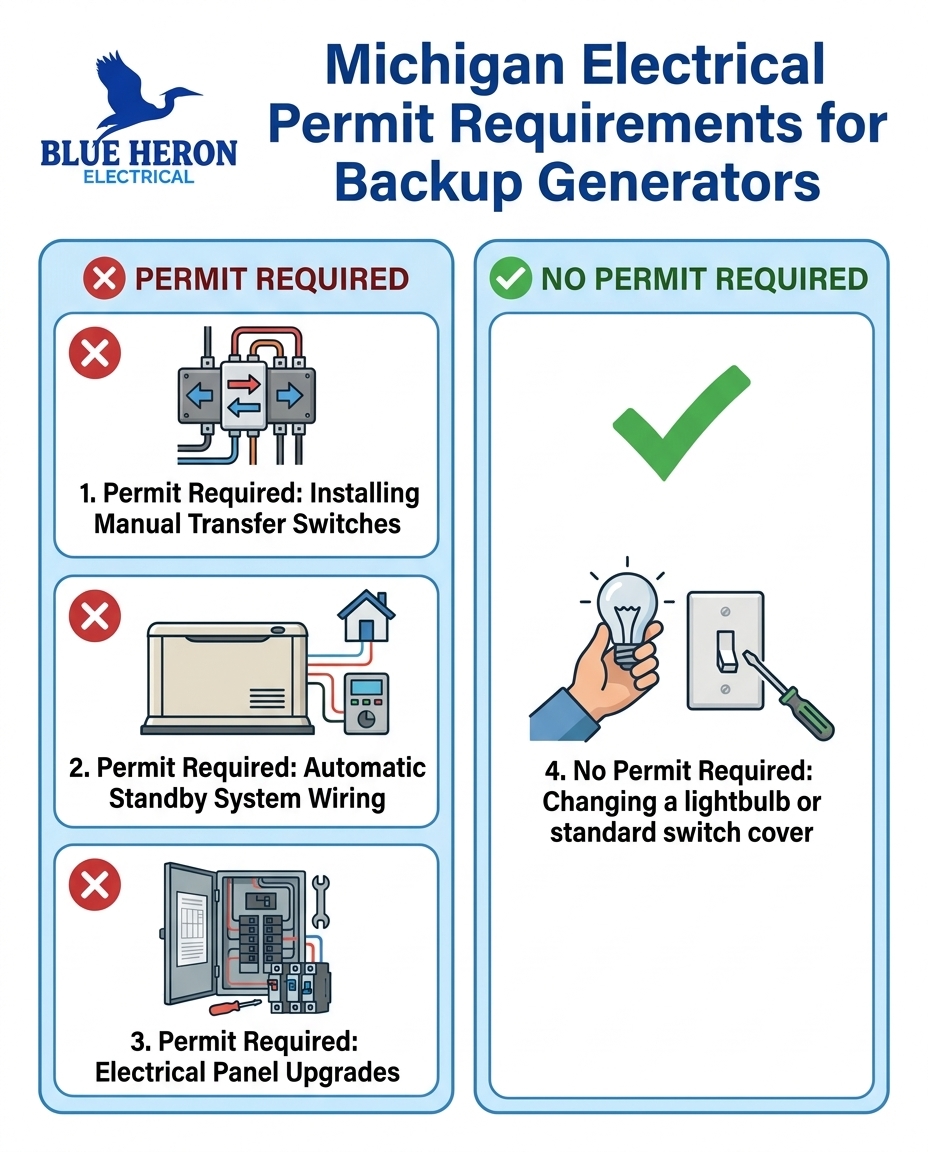
The general rule of thumb our electricians share with clients is that if you are replacing a simple, plug-and-play consumable or a decorative cover, you do not need a permit. You are legally allowed to:
• Swap a lightbulb: Changing a burnt-out bulb in an existing fixture is standard maintenance.
• Replace a switch plate cover: Unscrewing a plastic cover and putting a new one over an existing switch is purely cosmetic.
• Plug in a device: Using existing, properly wired wall outlets for standard appliances requires no oversight.
Strictly Prohibited DIY Alterations
Michigan law explicitly requires an electrical permit for installing, altering, or rebuilding any electrical wiring. This means you cannot legally run new wire through your walls, alter existing circuits, or install new breakers in your panel without proper permitting and inspections. If a project involves exposing bare wire or connecting anything to the main electrical panel, it requires legal approval. If you are unsure where your project falls, it is always best to read up on what electrical repairs require a licensed electrician before picking up a tool.
The "I Own the Home" Misconception
A common myth we encounter in the field is that owning the home exempts a person from state and local electrical codes. This is entirely false. Electrical codes exist to prevent catastrophic fires and protect utility workers, not to inconvenience homeowners. Even if you are doing the work yourself in a home you own free and clear, modifying the electrical infrastructure without a permit is a violation of state law.
Generator Transfer Switches: Why Professional Installation is Non-Negotiable
The Problem: Homeowners often purchase a portable generator from a big-box store and assume they can just wire it directly into their home's electrical panel to power their furnace and lights during an outage.
The Cause: This assumption stems from a misunderstanding of how electricity flows. Connecting a generator directly to a home without a transfer switch causes a deadly phenomenon known as "backfeeding." Backfeeding occurs when generator power flows in reverse out of your house and into the neighborhood utility lines. The transformers on your street, which normally step down high voltage for residential use, will step that generator power back up to thousands of volts. This creates a lethal hazard for utility workers who are trying to repair downed lines, believing the grid is dead.
The Solution: National Electrical Code (NEC) Article 702 governs Optional Standby Systems and strictly mandates the use of approved transfer equipment. Installing a manual transfer switch isolates your home's circuits safely from the main grid. Because this requires opening the main panel and re-routing circuits, it is a major electrical alteration that demands a permit and a licensed professional.
At Blue Heron Electrical, we see the need for proper panel preparation frequently. Just recently, our crew worked with a homeowner who purchased an older home in the spring that required significant electrical upgrading, including a new breaker panel. After our team provided several repair options, we installed a new breaker panel to successfully upgrade the home's electrical system, ensuring it could safely handle modern demands and future backup power integration.
Blue Heron Electrical maintains strict adherence to Michigan electrical codes, protecting homeowners from fines and ensuring transfer switches operate safely under heavy loads. Whether you are adding a transfer switch or undertaking broader electrical remodeling, professional installation guarantees your system isolates properly and protects the utility crews working to restore your power.
Portable vs. Standby Generators: Electrical Infrastructure Requirements
When comparing backup power options for Sterling Heights MI older residential neighborhoods, the focus usually falls on the generators themselves. However, as our local installation experts always advise, the real comparison should be on the electrical infrastructure required to support them safely. Neither option allows for unpermitted, DIY electrical panel modifications.
• Permit Required — Portable Generator (with Manual Switch): Yes (for the transfer switch installation) — Automatic Standby Generator: Yes (for the entire system integration)
• Panel Modification — Portable Generator (with Manual Switch): Requires a dedicated manual transfer sub-panel or interlock kit. — Automatic Standby Generator: Requires an automatic transfer switch (ATS) and complex whole-home integration.
• Load Management — Portable Generator (with Manual Switch): Manual. You choose which specific circuits to power up. — Automatic Standby Generator: Automatic. Requires precise load calculations to ensure the generator isn't overwhelmed.
• Inspection Process — Portable Generator (with Manual Switch): Local inspector verifies the transfer switch isolates the grid. — Automatic Standby Generator: Local inspector verifies the ATS, gas lines, and panel capacity.
Both options demand professional oversight and local inspections. Automatic standby systems, in particular, require complex whole-home integration. The automatic transfer switch constantly monitors utility voltage and seamlessly shifts the home's load to the generator the moment power drops. This requires sophisticated wiring that must meet stringent NEC standards.
Evaluating Your Current Electrical Panel
Older homes often lack the panel capacity to support modern backup power systems safely. Before any generator integration can begin, a professional must perform a comprehensive load calculation. This process involves evaluating the square footage of your home, the draw of your major appliances, your HVAC system's starting amperage, and your typical daily usage. If your current panel is an outdated 60-amp or 100-amp service, our team will likely need to upgrade it to a modern 200-amp panel before a transfer switch can be legally and safely installed.
How Michigan's Winter Ice Storms Expose Dangerous DIY Wiring
Macomb County and Sterling Heights experience severe winter weather that frequently downs power lines, making code-compliant backup power essential. When temperatures drop and ice accumulates, the electrical grid takes a beating. But the grid isn't the only thing under stress—your home's internal electrical system works overtime during these months.
Heavy seasonal loads during winter ice storms stress a home's electrical system to its absolute limits. Running furnaces, blower motors, and multiple space heaters simultaneously draws a massive amount of continuous current. Uninspected, DIY transfer switches and amateur wiring jobs are highly prone to catastrophic failure when they are needed most. A loose connection or an undersized wire that goes unnoticed during a mild fall day will quickly overheat and melt under the sustained draw of winter heating appliances.
The risks of fire hazards are incredibly high when running space heaters and emergency equipment on unpermitted circuits. Our emergency dispatch team at Blue Heron Electrical has seen firsthand how extreme weather impacts vulnerable systems. One customer reached out during a severe winter storm with freezing temperatures when a fallen tree ripped the service box completely off their home. After our electricians assessed the emergency situation after hours, we established a temporary generator hookup and completely replaced the box, restoring safety and preventing the interior plumbing from freezing.
Getting your system checked during October pre-winter preparation is vital. Passing local Michigan inspections guarantees the system has been verified by an independent third party to handle emergency winter demands safely. It is the only way to have total confidence that your backup power will work when the ice storm hits.
Beyond Generators: Other Home Projects That Demand a Permit
While backup power is a major focus heading into winter, it is far from the only project that requires municipal oversight. To keep your home safe and compliant, you must recognize that almost all significant electrical work falls under strict permit requirements in Michigan. In our daily service routes, we constantly find unpermitted DIY work that puts families at risk.
Here are common home improvements that strictly require an electrical permit:
• Adding new outlets: Splicing into an existing circuit to add a new receptacle for a home office or entertainment center requires a permit to ensure the circuit isn't overloaded.
• Upgrading an electrical panel: Moving from fuses to breakers, or upgrading from 100 amps to 200 amps, involves disconnecting the main service and requires rigorous inspection.
• Hardwiring new appliances: Installing a new electric oven, hot tub, or dedicated HVAC circuit involves running new, heavy-gauge wire directly from the panel.
• Extensive lighting upgrades: While swapping a fixture might be fine, undertaking a full lighting installation that involves running new wire for recessed lights across a ceiling requires a permit.
Skipping the permit process has long-term consequences. Unpermitted work can void your homeowners insurance policy. If a fire starts due to an illegal DIY wiring job, the insurance company has grounds to deny the claim. Furthermore, unpermitted alterations frequently complicate selling the property later, as home inspectors will flag unapproved panel modifications, forcing you to pay for retroactive permits and professional repairs before the sale can close. Whether undertaking a major renovation or a specific fixture upgrade, compliance is key.
Frequently Asked Questions About Michigan Electrical Permits
What electrical work can be done without a permit in Michigan?
You can legally perform minor cosmetic updates, such as replacing a lightbulb or swapping out a decorative switch plate cover, without a permit. Any work that involves exposing bare wire, running new circuits, or altering the electrical panel strictly requires a permit and a licensed professional. State law mandates oversight for all structural electrical alterations to prevent fire hazards.
Do I need a permit to install a generator transfer switch?
Yes, installing a generator transfer switch always requires an electrical permit in Michigan. This process involves opening the main electrical panel, re-routing critical circuits, and installing equipment that interacts with the municipal power grid. A local inspector must verify that the switch properly isolates your home to prevent dangerous backfeeding.
Can a homeowner legally install a standby generator?
No, a homeowner cannot legally install a fully automatic standby generator on their own. These complex systems require an electrical permit for the automatic transfer switch and whole-home integration, as well as a mechanical permit for the natural gas or propane line connections. Only licensed professionals can pull these permits and ensure the system meets National Electrical Code standards.
Why is backfeeding a generator dangerous and illegal?
Backfeeding pushes electrical current from your generator in reverse, out of your home and into the neighborhood utility lines. Neighborhood transformers will step this voltage up to lethal levels, creating a deadly hazard for utility workers repairing downed lines. It is illegal and highly dangerous, which is why NEC codes mandate approved transfer switches to isolate your home.
What happens if I do electrical work without a permit in Michigan?
Performing unpermitted electrical work can result in municipal fines, mandatory tear-outs of the completed work, and a requirement to hire a licensed electrician to redo the project. Additionally, unpermitted wiring can void your homeowners insurance policy if it causes a fire. It will also create significant hurdles during the inspection process if you ever try to sell your home.
How do I know if my electrical panel can support a whole-home generator?
The only way to know for sure is to have a licensed electrician perform a comprehensive load calculation on your home. They will evaluate your panel's total amperage capacity, the draw of your major appliances, and your HVAC system's starting requirements. Older panels often require a capacity upgrade before they can safely support a standby generator system.
Ensure Your Home's Electrical System is Code-Compliant and Winter-Ready
Avoiding permits is never worth the safety risks or the legal liabilities that follow. While it might be tempting to look for shortcuts when preparing for winter, the reality is that proper, code-compliant infrastructure is the foundation of reliable backup power. Homes in Sterling Heights MI older residential neighborhoods often need professional updates to safely handle modern electrical demands and emergency heating loads.
Before the first major ice storm hits, take the time to ensure your system is ready to protect your family. Proper transfer switches and panel capacities are not optional upgrades—they are essential safety mechanisms. If you are unsure about your current setup, we encourage you to schedule an inspection or consultation with a licensed local expert. Exploring professional electrical panel upgrades now will give you the peace of mind that your home is safe, compliant, and ready for whatever the Michigan winter brings.
Customer Testimonials

Service Areas