
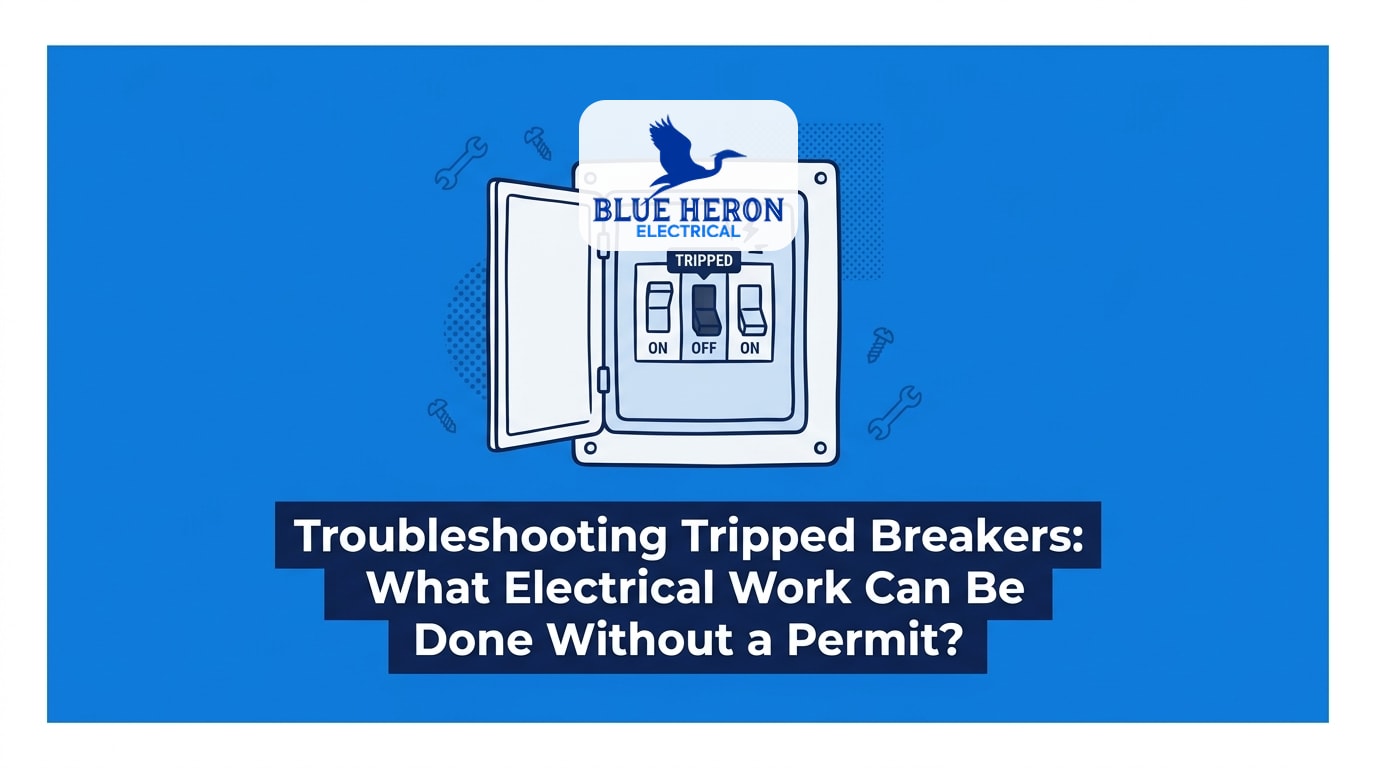
Troubleshooting Tripped Breakers: What Electrical Work Can Be Done Without a Permit?
The Hidden Danger of Fall Cold Snaps on Older Electrical Systems
According to the National Fire Protection Association (NFPA), heating equipment is a leading cause of home fires, making safe home maintenance tips and troubleshooting essential as temperatures drop. At Blue Heron Electrical, we know exactly when the first October pre-winter cold snap hits Sterling Heights—our dispatch team sees a massive spike in calls from homeowners who instinctively reach for portable space heaters to warm up a chilly room before turning on the main furnace for the season. However, this sudden demand often results in a tripped circuit breaker, leaving entire sections of the house in the dark.
The immediate challenge for any homeowner is determining whether that tripped breaker is simply a temporary overload from a high-draw appliance, or a critical warning sign that an aging electrical panel is beginning to fail. While basic load management is perfectly safe for a homeowner to handle, any structural changes to the home's wiring or panel require professional residential electrical services. Our team frequently sees cases where ignoring repeated breaker trips creates highly unsafe conditions behind the walls, eventually necessitating extensive electrical remodeling to correct the thermal damage caused by overloaded circuits.
Many older Sterling Heights neighborhoods feature homes built with 60-amp or 100-amp electrical services. In our experience working on these legacy systems, they were designed for an era before multiple televisions, home offices, and high-wattage space heaters were standard in every household. Because electrical distribution systems are a top leading cause of home structure fires, treating a tripped breaker as a mere nuisance rather than a safety mechanism is a dangerous oversight.
Why Your Space Heater Keeps Tripping the Circuit Breaker
To understand the strain placed on your home's infrastructure, we always tell our customers it helps to look at the basic math of electrical loads. A standard space heater draws massive amounts of continuous power—often operating at 1,500 watts. On a standard 120-volt residential circuit, that heater alone draws 12.5 amps of continuous electrical current.
If that specific circuit is governed by a standard 15-amp breaker, you only have 2.5 amps of capacity remaining. Turning on a television, a desktop computer, or even a few older incandescent light bulbs on that same circuit will easily push the total draw past the 15-amp maximum threshold. The circuit breaker, functioning exactly as it was engineered to do, snaps shut to cut the power before the physical copper wires inside your walls can exceed their thermal limits and melt their protective insulation.
The Capacity Limits of Older Homes
Homes built decades ago were simply not designed for today's immense electrical demands. While modern construction anticipates high continuous loads, our electricians regularly encounter older electrical panels struggling to safely manage modern winter heating equipment. Furthermore, harsh winter storms and heavy summer rains in Metro Detroit drive high demand for heavy-duty HVAC and generator installations, placing immense strain on aging electrical systems that must constantly adapt to extreme weather shifts.
Continuous loads from heating devices degrade older breakers over time. The internal bi-metallic strip that controls the tripping mechanism can become weakened from constant heating and cooling cycles, making the breaker more prone to nuisance tripping even under normal loads. There is a distinct difference between an isolated trip—such as plugging too many things into one room on a cold October morning—and repeated trips that indicate compromised, degrading infrastructure.
Safe Home Maintenance Tips and Troubleshooting for Electrical Loads
Before assuming your panel is failing, there are safe ways to manage your electrical loads. By following proper load balancing techniques we recommend to all our Sterling Heights clients, you can often resolve temporary overloads without needing to open the panel or touch any wiring.
1. Unplug the suspected device immediately: If a space heater trips the breaker, unplug it from the wall before doing anything else. This removes the immediate source of the heavy electrical draw.
2. Turn off other devices on the circuit: Identify what else lost power when the breaker tripped. Turn off those switches or unplug those devices to reduce the baseline load on that specific circuit before attempting a reset.
3. Reset the breaker once: Locate your electrical panel. Find the breaker that has moved to the "tripped" middle position. Push it firmly to the "off" position, then snap it aggressively back to the "on" position. If it holds, the issue was likely a simple, temporary overload.
4. Practice load balancing: Move high-draw appliances to separate, dedicated circuits. A space heater should never be on a shared circuit with other heavy appliances like microwaves, refrigerators, or heavy-duty gaming computers.
5. Observe clear safety boundaries: Never repeatedly force a breaker back to the "on" position if it immediately trips again. A breaker that refuses to reset is doing its job by protecting your home from a dangerous short circuit or a severe wiring fault.
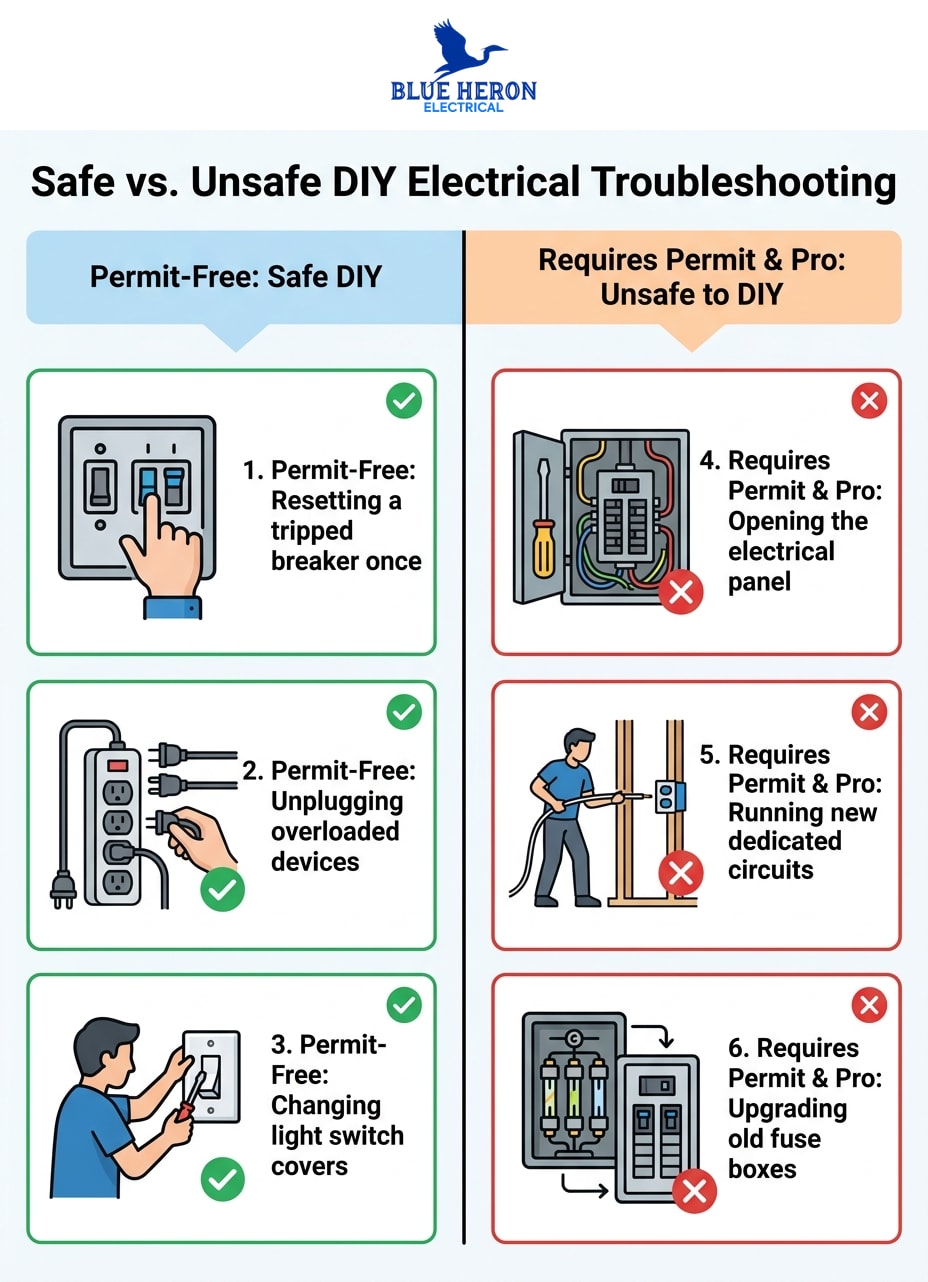
• Unplugging devices from overloaded outlets — Safety Classification: Safe / Permit-Free — Reasoning: Reduces electrical draw without altering the home's infrastructure.
• Resetting a tripped breaker one time — Safety Classification: Safe / Permit-Free — Reasoning: Restores power after a temporary, isolated overload event.
• Repeatedly forcing a breaker on — Safety Classification: Highly Dangerous — Reasoning: Bypasses safety mechanisms, risking melted wires and electrical fires.
• Moving high-draw heaters to dedicated circuits — Safety Classification: Safe / Permit-Free — Reasoning: Balances the load across the home's existing capacity safely.
What Electrical Work Can Be Done Without a Permit?
When troubleshooting electrical issues, it is critical to understand the legal and safety boundaries of DIY work. Minor, everyday tasks that do not alter the home's permanent electrical infrastructure can generally be done without municipal oversight. These permit-free tasks include swapping a cracked light switch cover, changing a lightbulb, or resetting a tripped breaker after a space heater overload.
However, any work involving the home's primary electrical distribution system crosses the line from DIY maintenance to professional, regulated work. Tasks that strictly require permits include running new dedicated circuits for heavy appliances, hardwiring equipment directly into the home's grid, and opening the electrical panel to modify breakers, bus bars, or main lugs. Homeowners frequently ask us, does rewiring a home require a permit in Michigan? The answer is unequivocally yes, as unpermitted modifications pose severe risks to the structure and its occupants.
The Risks of Unpermitted DIY Troubleshooting
The legal and insurance risks of performing unpermitted electrical work are substantial. Opening a panel to test breakers exposes homeowners to lethal voltage, where a single slip of a tool can result in severe injury or an arc flash.
Furthermore, improper DIY fixes can void homeowners' insurance policies in the event of a fire. Insurance policies are written with the expectation that the property adheres to local building codes. If a fire originates from an electrical panel that was modified without a permit, the insurance adjuster will likely uncover the unauthorized work during their investigation. This can lead to a complete denial of the claim, leaving the homeowner entirely responsible for the financial devastation.
The Dangers of DIY Panel Diagnostics and When to Call an Expert
Repeated breaker trips are a symptom of a larger, systemic issue that cannot be solved by simply unplugging devices or moving a space heater to another room. When an electrical panel trips repeatedly, the right next step is professional intervention.
Older electrical setups present highly specific hazards that require trained eyes to identify. Outdated fuse boxes or degraded wiring often suffer from brittle insulation and loosened connections. When heavy, continuous loads from space heaters flow through these compromised connections, the electrical resistance generates excess heat. This dramatically increases the risk of an arc fault or a localized electrical fire behind the drywall.
A professional inspection identifies these hidden hazards that basic DIY troubleshooting misses. At Blue Heron Electrical, our licensed electricians bring deep, first-hand expertise in local Metro Detroit municipal codes, ensuring all diagnostics and repairs pass inspection and keep the home legally compliant. When our team inspects a failing panel, we evaluate microscopic signs of thermal damage, test the torque on main lug connections, and assess the integrity of the bus bars. These are highly technical assessments that require specialized meters, protective gear, and years of rigorous training to execute safely.
Securing Winter Safety Through Professional Panel Upgrades
The ultimate solution for homes that cannot safely support winter heating loads is a comprehensive panel upgrade. Replacing an outdated panel involves safely disconnecting the municipal power feed, removing the degraded legacy enclosure, and installing a modern, high-capacity panel designed to handle today's intensive electrical demands.
During this process, ensuring proper grounding and installing modernized breakers eliminates the constant nuisance tripping caused by space heaters. A modernized system provides a stable, safe power supply that can effortlessly manage the continuous draw of heavy-duty winter equipment. Legitimate electrical panel upgrades are always permitted and rigorously inspected by local authorities to guarantee safety. Additionally, federal tax credits and local utility incentive programs may apply to qualifying electrical panel upgrades that support energy-efficient heating installations—we always advise our customers to verify current programs with their tax professional.
For example, when our Blue Heron Electrical crew recently helped a homeowner who purchased an older property that required significant electrical upgrades, including a new breaker panel, the necessity for a professional approach became clear. During the project, our electrical team provided multiple code-compliant options to help prioritize the necessary electrical work. All tasks were accomplished successfully, leaving the home's infrastructure modernized and capable of handling future seasonal demands without the constant risk of overloaded circuits. Upgrading the panel is a proactive measure that prevents dangerous emergency outages when freezing temperatures finally arrive.
Frequently Asked Questions About Home Electrical Troubleshooting
Why does my space heater keep tripping the breaker?
A space heater keeps tripping the breaker because it draws a massive amount of continuous power, often overloading standard 15-amp or 20-amp residential circuits. When the total electrical draw on a single circuit exceeds its capacity, the breaker cuts the power to prevent the internal wall wires from overheating and causing a fire. Moving the heater to a dedicated circuit without other high-draw appliances is usually the best immediate solution to this problem.
Is it safe to keep resetting a tripped circuit breaker?
No, it is highly dangerous to repeatedly reset a tripped circuit breaker. A breaker trips specifically to protect your home from an electrical overload or a dangerous short circuit. Forcing it back on without resolving the underlying issue can cause the internal wiring to overheat, potentially leading to an electrical fire. If a breaker trips immediately after being reset, leave it in the off position and contact our licensed professionals.
What electrical work can a homeowner do without a permit?
Homeowners can perform minor, non-structural tasks without a permit, such as changing a lightbulb, swapping a decorative switch cover, or resetting a tripped breaker once. However, any work that involves altering the home's permanent wiring, running new circuits, or opening the electrical panel strictly requires a municipal permit. Undertaking unpermitted electrical work poses severe safety risks and can void your homeowners' insurance policy.
How do I know if my electrical panel needs an upgrade?
Your electrical panel likely needs an upgrade if you experience frequent breaker trips, flickering lights when appliances turn on, or if you still rely on an outdated fuse box. Other critical warning signs we look for include scorch marks around the breakers, a slight burning smell near the panel, or an outdated system that cannot support modern appliances. A professional inspection can definitively determine if your panel meets current municipal safety codes.
Can a tripped breaker cause an electrical fire?
The tripped breaker itself is designed to prevent an electrical fire by cutting off the power supply when an overload is detected. However, if the breaker is old, degraded, or repeatedly forced back on despite a fault, the internal mechanism may fail to trip during the next overload event. When a faulty breaker fails to interrupt the current, the wiring can overheat and ignite surrounding building materials.
What is the difference between a temporary overload and a failing electrical panel?
A temporary overload occurs when too many devices are plugged into a single circuit at once, and the issue is resolved simply by unplugging them and resetting the breaker. A failing electrical panel, on the other hand, will cause breakers to trip frequently even under normal loads, or it may exhibit physical signs of degradation like rust, buzzing sounds, or excess heat. When temporary load balancing no longer works, the panel itself is likely compromised and requires professional attention.
Ensure Your Electrical System is Ready for Winter
As your local Sterling Heights experts, we know a tripping breaker is your home's way of signaling that it simply cannot handle the current electrical load. While minor load balancing and resetting a breaker once are perfectly safe practices, repeated issues require expert attention to prevent serious hazards. Do not wait until the deep freeze sets in to discover your electrical system is compromised. Schedule a pre-winter panel inspection with Blue Heron Electrical to ensure your home's infrastructure is safe, legally compliant, and fully prepared to handle the heavy demands of the cold season ahead.
Customer Testimonials

Service Areas