
Identifying and Replacing Federal Pacific Panels Before Winter
The Hidden Danger Lurking in Mid-Century Basements
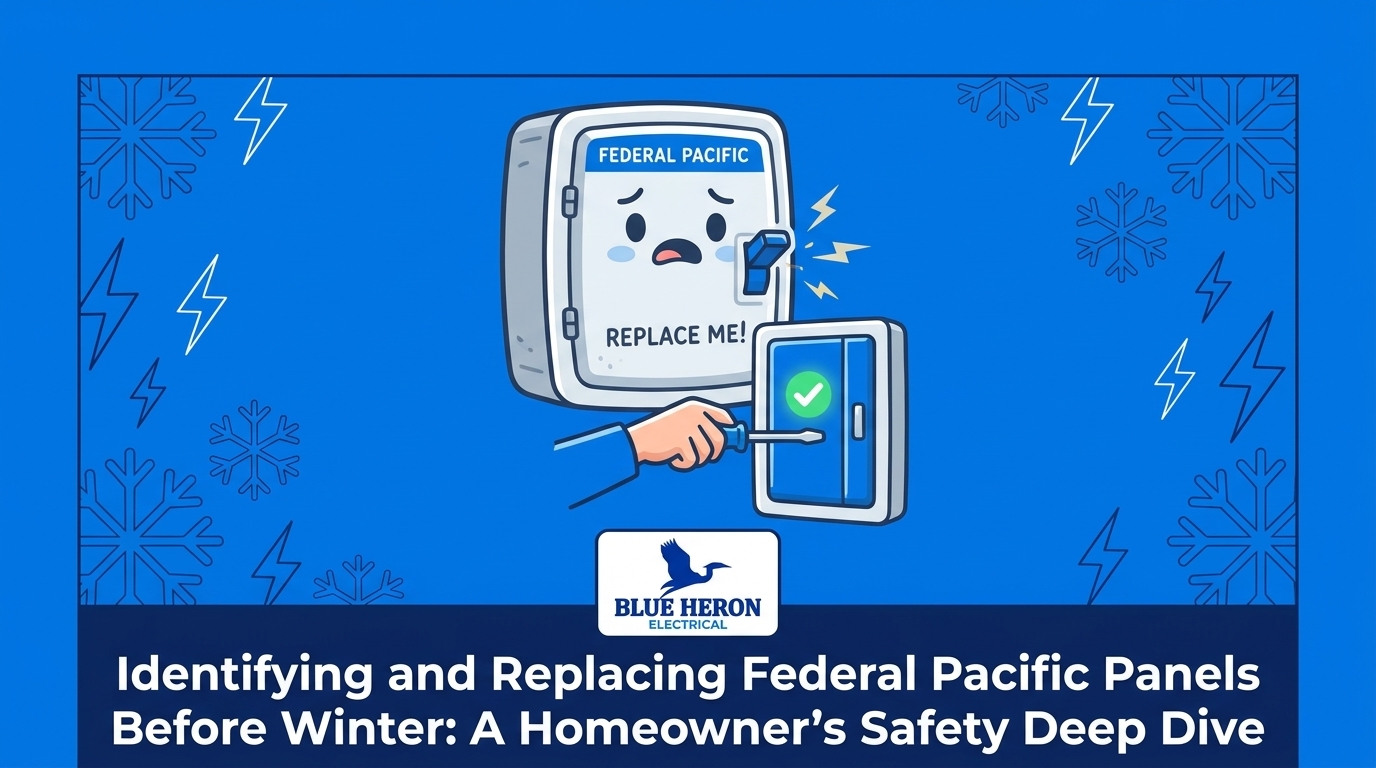
Your electrical panel is supposed to be the ultimate safety net for your home, but what if that net is fundamentally broken? Identifying and replacing Federal Pacific panels before winter is one of the most critical steps a homeowner can take when preparing an older property for the cold months ahead. At Blue Heron Electrical, our team frequently fields calls from homeowners who head down to their basements to reset a tripped breaker, only to discover a legacy brand that home inspectors and electricians have warned about for decades.
During the September pre-winter heating season, you face an important decision point. You can either proactively address this known electrical hazard in the fall, or risk a catastrophic breaker failure when your home's heating demand peaks. This is not about scare tactics; it is about understanding the mechanical realities of outdated electrical infrastructure. Older panels simply were not designed to handle the continuous, heavy electrical loads of modern appliances and supplemental heating systems.
To understand what is at stake, it helps to compare how different panels respond to electrical stress. If you are unsure about the state of your home's electrical panels, a professional evaluation from our experienced local electricians is the safest first step.
• Trip Mechanism — Modern Electrical Panel: Reliably cuts power the moment an overload is detected. — Legacy Federal Pacific Panel: Documented history of jamming and failing to trip during overloads.
• Connection Style — Modern Electrical Panel: Secure, bolted or tightly clamped bus bar connections. — Legacy Federal Pacific Panel: "Stab-Lok" design that can become loose, leading to arcing.
• Code Compliance — Modern Electrical Panel: Meets strict current National Electrical Code (NEC) standards. — Legacy Federal Pacific Panel: Obsolete technology that no longer meets modern safety requirements.
Addressing this issue before the frost sets in ensures your family stays warm and safe without relying on compromised equipment.
What Makes Federal Pacific Stab-Lok Breakers a Documented Hazard?
The problem with Federal Pacific Stab-Lok panels is not just age; it is a well-documented mechanical flaw. Between the 1950s and the 1980s, these panels were installed in millions of homes across the country. They were affordable, widely available, and heavily marketed to builders during the post-war housing boom. However, as these systems aged and household electrical demands increased, a disturbing pattern emerged.
The Consumer Product Safety Commission (CPSC) eventually launched an investigation into the Federal Pacific Stab-Lok brand. While the investigation was closed without a formal, government-mandated recall—largely due to budget constraints at the time—the CPSC officially noted the hazard. Independent testing has repeatedly shown that a significant percentage of these breakers fail to trip under overload conditions. When a breaker fails to trip, it allows excess current to continue flowing through wires that are only rated for a specific capacity. If you have one of these systems, prioritizing panel changes is a vital safety upgrade.
The Mechanics of a Breaker Failure
To understand why this is so dangerous, you have to look at how a circuit breaker is supposed to work. Inside a standard breaker, a bimetallic strip or an electromagnet monitors the flow of electricity. If you plug in too many devices and the circuit draws more amps than the wire can handle, the strip heats up, bends, and physically snaps the circuit open. This cuts the power instantly, preventing the wire inside your wall from overheating.
With a defective Federal Pacific Stab-Lok breaker, this mechanical action often jams. The internal components bind up, meaning the switch stays in the "on" position even as massive amounts of electricity surge through the circuit.
• Overheated wiring: When the breaker fails to stop the flow, the copper wire inside your walls gets hotter and hotter.
• Melted insulation: The protective plastic casing around the wire eventually melts away, exposing bare, energized copper.
• Arcing and ignition: Exposed wires can arc against surrounding building materials, easily igniting dry wood framing or drywall paper.
A properly functioning breaker sacrifices itself to save your home. A defective legacy breaker protects its switch position while sacrificing your home's wiring.
Why Winter Heating Pushes Electrical Systems to the Limit
You might wonder why a panel that has been in your home for forty years suddenly becomes an urgent threat as the seasons change. The answer lies in how we consume electricity during the colder months. Intermittent summer cooling loads—like an air conditioner cycling on and off—certainly draw power, but winter heating introduces a different kind of stress: continuous, high-amperage draws.
Sterling Heights' freezing winters demand continuous, heavy heating loads, severely stressing residential electrical systems. When the temperature drops below freezing, your furnace blower motor runs for hours at a time. More importantly, we frequently see homeowners turn to supplemental heating sources to stay comfortable. A standard portable space heater draws roughly 1,500 watts of power. On a standard 15-amp household circuit, that single space heater is pulling 12.5 amps continuously.
If you plug a space heater into a bedroom outlet, and someone turns on a vacuum cleaner or a hair dryer on that same circuit, you have instantly created an overload condition. In a modern panel, the breaker trips immediately, you reset it, and you learn not to run both devices at once.
In our years of servicing Sterling Heights MI residential properties equipped with legacy panels, we have seen that same scenario play out differently. The continuous draw from the space heater has already pre-heated the circuit. When the overload hits, the Stab-Lok breaker jams. The heater keeps running, the vacuum keeps running, and the wire inside the wall begins to cook. This specific, continuous overload condition is exactly what these outdated breakers fail to protect against, making winter the most dangerous time to rely on them.
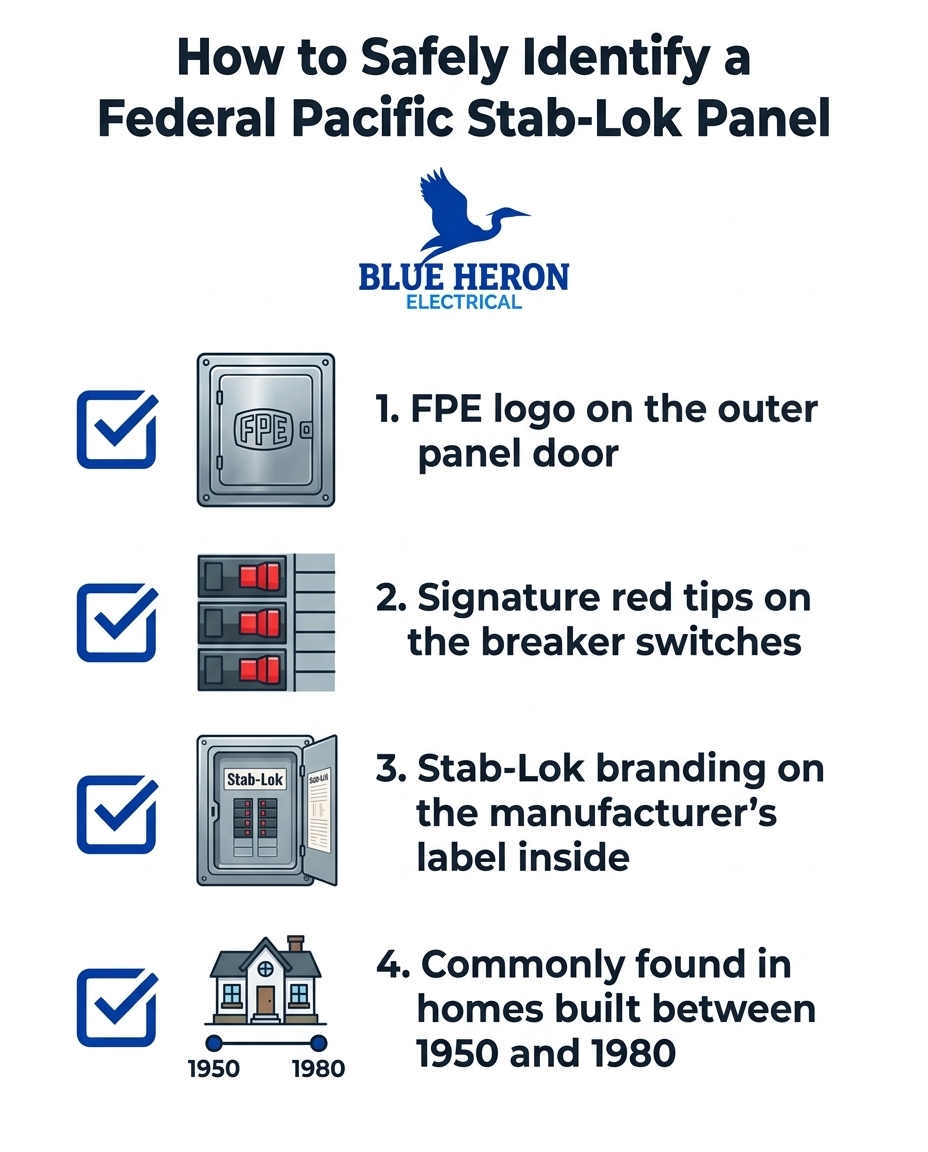
Visual Checklist: How to Identify a Stab-Lok Panel in Your Home
If you live in a home built between 1950 and 1990, it is worth taking five minutes to check your electrical panel. Homeowners can safely identify a Federal Pacific Stab-Lok panel without ever touching the internal components. Safety first: Never remove the metal dead front cover of your electrical panel. Visual identification from the outside is all you need.
• Check the outer door: Look for the Federal Pacific Electric (FPE) logo or name stamped directly on the metal door of the panel.
• Look for signature red tips: Open the outer door and look at the breaker switches themselves. Many Stab-Lok breakers feature distinct red plastic tips on the ends of the toggle switches.
• Read the manufacturer's label: Look at the paper label pasted inside the panel door. You will often see the "Stab-Lok" branding printed clearly in the documentation.
• Note the age of your property: If your home was built or heavily renovated between the 1950s and 1980s, you are in the prime demographic for original FPE installations.
• Check the breaker numbering: FPE panels often have numbers stamped into the metal next to the breaker slots, rather than printed on a sticker.
The Risks of Delaying Action During Peak Heating Season
Ignoring a known safety hazard rarely ends well, but the risks compound rapidly as temperatures drop. The September pre-winter heating season is the ideal window for mechanical upgrades because you avoid the emergency rush that happens when the first deep freeze hits. Delaying action means you are knowingly pushing an outdated system to its absolute limits.
Just last season, our team at Blue Heron Electrical helped a local homeowner who realized they needed to update the electrical box in their older home during a winter cold snap. They reached out to us for help, and fortunately, our electricians completed the update quickly alongside other necessary electrical tasks, restoring safety before the system was pushed too far. Waiting until a breaker actually fails often results in a loss of power during freezing conditions, forcing you to rely on emergency electrical services just to keep the heat running.
Beyond the immediate physical danger of hidden electrical fires behind your drywall, there are significant administrative risks to delaying this upgrade. Many homeowners insurance providers are fully aware of the statistics surrounding Federal Pacific panels. If a home inspector or an insurance adjuster identifies one of these panels in your basement, your carrier may require immediate replacement to maintain your coverage. If a fire does occur and the investigation points back to a known, documented hazard that was ignored, it can severely complicate your insurance claim. Proactive replacement eliminates this liability and secures your home before emergency weather strikes.
Navigating the Replacement Process Safely and Legally
Because the dangers associated with these panels are so severe, replacing them is strictly professional work. Do not attempt to replace a panel or swap out breakers yourself. The risks of extreme electrocution and catastrophic fire are simply too high. The main service lines coming into your panel from the street remain fully energized even if you turn off the main breaker. Only a licensed professional has the training and authority to manage this hazard safely.
Working with a dedicated team means you benefit from professional, safety-first expertise in identifying code violations and safely mitigating hazardous legacy equipment in older homes. A licensed electrician will coordinate with your local utility company to temporarily disconnect power to the house. Once the home is safely de-energized, the entire hazardous panel is removed from the wall.
The replacement process is about more than just swapping a metal box. It is an opportunity to bring your entire home up to current National Electrical Code (NEC) standards. Modern panels include advanced safety features like Arc Fault Circuit Interrupters (AFCI) and Ground Fault Circuit Interrupters (GFCI) that provide layers of protection legacy systems never had. If you suspect your home is at risk, scheduling circuit breaker services in Sterling Heights ensures your electrical infrastructure is thoroughly evaluated. For many Sterling Heights MI residential properties, this upgrade provides the ultimate peace of mind, knowing the home's safety net will function exactly as designed under heavy winter loads.
Planning Your Upgrade: Inspections, Permits, and Next Steps
Understanding the logistics of a panel swap can help alleviate the stress of a major home repair. While the idea of replacing your main electrical hub might sound disruptive, our professional crew can execute the transition smoothly and efficiently.
Another one of our customers decided to update the electrical panels in their house last winter; the process went smoothly, with our professional service ensuring the home was never without heat for long. However, tackling this during the September pre-winter heating season is always preferable to mid-winter emergency work.
Here is what the typical professional replacement process looks like when you work with us:
1. Initial Evaluation: A licensed electrician inspects your current setup, calculates your home's total electrical load, and determines the appropriate size for your new panel.
2. Permitting: The contractor pulls the necessary municipal permits. This is a critical step; unpermitted electrical work is illegal and can void your homeowners insurance. You can learn more about panel upgrade permit and inspection requirements in Michigan to understand the legal framework.
3. Utility Coordination: The electrician schedules a temporary power disconnect with the local utility provider for the day of the installation.
4. Installation Day: The old panel is removed, the new panel is mounted, and every circuit is carefully re-landed, labeled, and tested. This usually takes a full day.
5. Municipal Inspection: A city or township inspector reviews the work to ensure it strictly adheres to the NEC, providing a final layer of safety verification.
By planning ahead, you control the timeline, ensuring the work is completed on your schedule with minimal disruption to your daily life.
Frequently Asked Questions About Legacy Electrical Panels
Why are Federal Pacific panels dangerous?
Federal Pacific Stab-Lok panels are dangerous because their breakers have a high, documented failure rate when it comes to tripping under overload conditions. Instead of cutting the power when a circuit is overloaded, the breakers often jam and remain active. This allows excess electricity to overheat the wiring inside your walls, which can easily melt the insulation and start a hidden electrical fire.
How do I know if I have a Stab-Lok panel?
You can identify a Stab-Lok panel by looking at the outside of your electrical box without removing any covers. Look for the Federal Pacific Electric (FPE) logo on the door, check for signature red tips on the breaker switches, and look for the "Stab-Lok" name printed on the manufacturer's label inside the door. If your home was built between 1950 and 1980, the chances of having one of these panels are significantly higher.
Are Federal Pacific panels still legal?
Federal Pacific panels are not explicitly "illegal" to have in an existing home, as they were installed under the building codes of their time, but they no longer meet current safety standards. However, they are obsolete and cannot be legally installed in new construction or renovations today. Most home inspectors will flag them as a major safety defect during a real estate transaction.
Will insurance cover homes with Federal Pacific panels?
Many homeowners insurance companies will refuse to write a new policy or renew an existing policy if they discover a Federal Pacific panel in the home. Because the fire hazard is so well-documented, insurance carriers view these panels as a massive liability. If you are buying a home with one of these panels, you will likely be required to replace it to secure coverage.
Can I just replace the breakers instead of the whole panel?
Replacing individual breakers in a Federal Pacific panel is not a safe or viable long-term solution. The fundamental design flaw exists within the Stab-Lok connection mechanism itself, meaning even aftermarket replacement breakers carry inherent risks. Furthermore, investing money into an obsolete, uninsurable metal enclosure does not solve the underlying safety hazard; a full panel replacement is the only recommended fix.
How long does a professional panel replacement take?
A professional panel replacement typically takes a single full day to complete, usually between six to eight hours. During this time, the power to your home will be disconnected by the utility company so the electricians can work safely. Once the new panel is installed and the circuits are reconnected, power is restored the same day, keeping disruption to a minimum.
Securing Your Home's Electrical System for the Season Ahead
Preparing your home for winter means looking beyond the furnace and ensuring the infrastructure that powers it is actually safe. Identifying and addressing a Federal Pacific Stab-Lok panel is not just a routine maintenance task; it is a critical intervention that protects your property from a documented fire hazard. When temperatures drop and your family relies on heavy continuous heating loads, you need absolute confidence that your circuit breakers will do their job.
Modernizing your electrical panel removes the anxiety of relying on defective legacy equipment. It brings your home up to current safety codes, satisfies insurance requirements, and provides a stable, reliable foundation for all your winter energy needs. If you suspect your basement houses one of these outdated systems, do not wait for the first winter storm to test its limits. Reach out to our team at Blue Heron Electrical for a professional evaluation today, and secure the clear, professional guidance you need to keep your home safe and warm all season long.
Customer Testimonials

Service Areas