

GFCI Outlet Failures: Why Your Outdoor Receptacles Stopped Working Over Summer
The September Surprise: Discovering Unresponsive Outdoor Receptacles
Dealing with GFCI Outlet Failures: Why Your Outdoor Receptacles Stopped Working Over Summer is a common challenge that frustrates countless homeowners as the seasons change. In our years of providing electrical solutions, our team at Blue Heron Electrical frequently sees a surge of these exact service calls during the September early fall transition. You walk outside to plug in a leaf blower, an electric pressure washer, or early holiday lighting, only to discover the outdoor outlet is completely dead. The breaker inside your home hasn't tripped, yet the exterior receptacle refuses to deliver power. When you press the reset button on the outlet itself, it feels stiff, spongy, or simply clicks without restoring electricity. This is not a temporary glitch; it is a permanent hardware failure caused by months of environmental exposure.
Understanding why this happens is the first step toward securing your home's exterior power. When an outdoor Ground Fault Circuit Interrupter (GFCI) fails to reset after a long season of heat and humidity, the internal safety mechanisms have died. Rather than attempting to force the outlet to work, homeowners need professional intervention to restore safety and functionality. Whether you need an assessment of your exterior wiring or comprehensive electrical services, partnering with experts for circuit breaker and GFCI services in Sterling Heights ensures your home remains protected against electrical hazards.
The Hidden Toll of Summer Weather
Most homeowners assume that if an outlet is installed outdoors, it is inherently immune to the elements. The reality we see in the field is much more complex. Standard electrical components are highly sensitive to moisture, temperature fluctuations, and airborne debris. Over the course of a long summer, your outdoor receptacles are subjected to a relentless cycle of baking heat during the day and cooling condensation at night. This continuous thermal expansion and contraction stresses the seals around the outlet box, creating microscopic pathways for moisture to enter.
By the time the September early fall transition arrives, the cumulative damage has already been done. The outlet may have worked perfectly in May, but after months of silent degradation, the internal circuitry finally gives out. Discovering this failure right when you need to begin fall yard preparations is incredibly common, and it serves as a critical warning sign that your exterior electrical infrastructure requires immediate attention.
The Mechanics of Moisture: How Summer Humidity Corrodes GFCI Sensors
To understand why an outdoor receptacle suddenly dies, you have to look inside the device. A GFCI outlet is essentially a miniature computer designed to monitor the flow of electricity. It constantly measures the current going out and the current coming back. If it detects an imbalance as small as four or five milliamps—indicating that electricity is escaping its intended path and potentially traveling through water or a person—it severs the power in a fraction of a second. This life-saving technology relies on highly sensitive internal components that are exceptionally vulnerable to corrosion.
In regions like Sterling Heights MI, the climate provides the perfect storm for electrical degradation. Our electricians consistently notice that the combination of intense late-summer rainstorms and heavy, persistent humidity creates an environment where moisture inevitably finds its way into electrical boxes. Understanding how Michigan summer storms stress home electrical systems is crucial for recognizing why these specific components fail prematurely. While an indoor GFCI might last 10 to 15 years, we routinely find that an unprotected or improperly sealed outdoor unit can corrode and fail in just a few seasons.
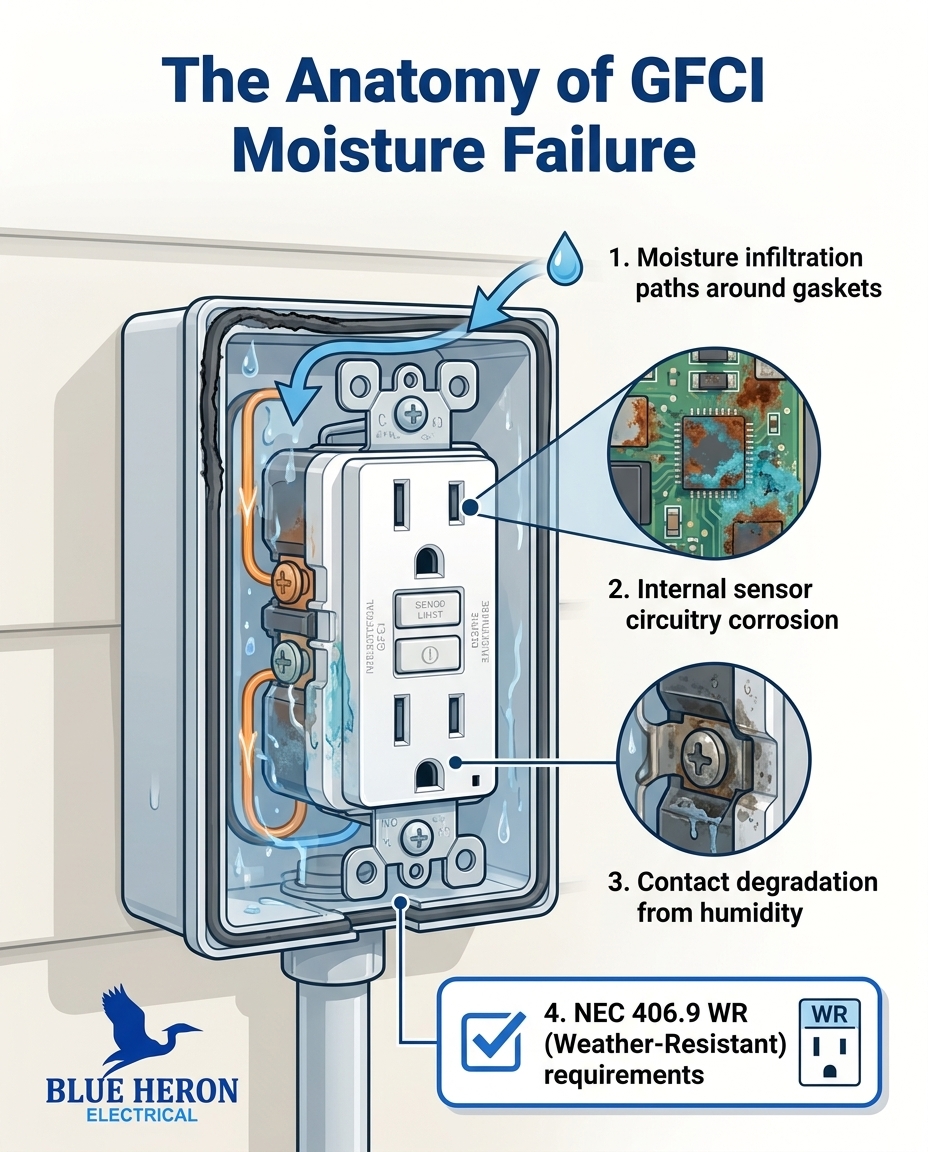
Moisture Infiltration Paths
Water rarely pours directly into an outlet; instead, it infiltrates through subtle, invisible pathways over time. The primary culprits include:
• Degraded Gaskets: The foam or rubber gaskets sealing the cover plate to the exterior wall can dry rot, crack, or shrink due to UV exposure, allowing driving rain to seep behind the cover.
• Condensation Buildup: Extreme temperature and humidity fluctuations cause condensation to form directly on the internal metal components of the outlet, even if the exterior cover is perfectly sealed against rain.
• Improper Caulking: If the top and sides of the electrical box were not properly caulked during installation, water running down the siding can pool behind the receptacle housing.
• Capillary Action: Moisture from damp soil or splashing rain can travel up tiny crevices in the conduit or wiring insulation, drawing water directly into the back of the outlet box.
Sensor Circuitry Degradation
Once moisture breaches the housing, the destruction of the GFCI begins at a microscopic level. The internal mechanics rely on a delicate sensing transformer and a printed circuit board. When high humidity and condensation introduce water to these components, galvanic corrosion occurs.
The copper coils inside the current transformer begin to oxidize, turning green and brittle. The tiny solder joints on the circuit board degrade, disrupting the flow of data to the internal microchip. Most importantly, the mechanical contacts that physically open and close the circuit become pitted and rusted. When this micro-corrosion attacks the ground fault detection board, it permanently blinds the sensor to electrical faults. At this point, the GFCI can no longer guarantee your safety, and its internal fail-safe mechanism permanently locks the outlet in the "tripped" position to prevent a shock hazard.
Nuisance Trips vs. Hardware Death: Why the Reset Button Won't Work
When an outdoor outlet stops working, the instinct is to simply push the reset button. However, it is vital to distinguish between a temporary safety trip and permanent hardware death. A "nuisance trip" occurs when the GFCI detects a temporary, minor ground fault. This might happen if you plug in a slightly damp extension cord, if a splash of water hits a power tool, or if morning dew creates a temporary conductive path. In these scenarios, once the moisture dries or the faulty cord is removed, the GFCI will click back in and resume normal operation.
Hardware death, on the other hand, means the internal mechanisms have rusted solid. If you are experiencing this during the September early fall transition, you are likely dealing with a dead unit rather than a nuisance trip.
How to Tell the Difference
Understanding the physical symptoms of a dead GFCI can prevent dangerous situations. Here is a breakdown of what to look for when evaluating an unresponsive outlet:
• Button Resistance — Nuisance Trip (Temporary): The reset button depresses smoothly and clicks firmly into place. — Hardware Death (Permanent): The button feels spongy, completely jammed, or refuses to catch and stay in.
• Visual Indicators — Nuisance Trip (Temporary): The LED indicator light (if equipped) turns green or turns off when reset. — Hardware Death (Permanent): The LED indicator remains red, blinks continuously, or is completely dead.
• Power Restoration — Nuisance Trip (Temporary): Power is immediately restored to the plugged-in device after resetting. — Hardware Death (Permanent): No power is restored, even when the main breaker is confirmed on.
• Physical Condition — Nuisance Trip (Temporary): The outlet face looks clean and intact. — Hardware Death (Permanent): Visible rust on the mounting screws, discoloration, or brittle plastic on the faceplate.
The Dangers of Forcing a Reset
If your GFCI outlet refuses to reset, you must never attempt to force the button in with a tool or tape it down. The outlet is refusing to reset because its internal self-test has failed; it knows it can no longer protect you from electrocution. Forcing a compromised outlet to deliver power bypasses its life-saving safety mechanisms. If a ground fault occurs while you are using a forced outlet, the electricity will travel through your body instead of tripping the circuit, leading to severe injury or worse. When an outlet reaches this state of failure, it immediately transitions from a minor inconvenience to a situation requiring emergency electrical repair to ensure the safety of your property and family.
NEC 406.9 Compliance: The Role of Weather-Resistant (WR) Receptacles
Replacing a dead outdoor GFCI is not as simple as buying the cheapest outlet off the shelf. The National Electrical Code (NEC) dictates strict standards for exterior electrical installations to prevent the exact type of corrosion and failure discussed above. Specifically, NEC 406.9 mandates the use of Weather-Resistant (WR) receptacles in all damp and wet locations.
A standard indoor GFCI is built with standard steel screws, unprotected copper contacts, and basic thermoplastic faces. If installed outside, even under a covered porch, the ambient humidity will destroy it. A WR-rated receptacle is engineered specifically for the harsh realities of exterior environments.
The Anatomy of a Weather-Resistant Receptacle
WR receptacles are visually identifiable by the letters "WR" stamped directly onto the face of the outlet. They feature significant internal and external upgrades designed to combat moisture and temperature swings:
• UV-Stabilized Polycarbonate: The plastic face and body are formulated to resist fading, cracking, and becoming brittle under direct sunlight.
• Corrosion-Resistant Components: The internal contacts, mounting straps, and terminal screws are typically nickel-plated or made from specialized brass alloys that resist rust and galvanic corrosion.
• Enhanced Sealing: The internal circuitry is often potted or coated to provide an extra layer of defense against condensation.
The Critical Importance of In-Use Covers
Even a WR-rated receptacle will fail if it is left completely exposed to driving rain. This is why the NEC also requires heavy-duty "extra-duty" in-use covers, commonly referred to as bubble covers. Older style flap covers only protect the outlet when nothing is plugged in. The moment you lift the flap to plug in a string of lights or a pool pump, the outlet is exposed to the weather. An extra-duty in-use cover features a deep, clear dome that closes completely over the plugged-in cord, maintaining a weatherproof seal while the outlet is actively delivering power.
At Blue Heron Electrical, we maintain rigorous safety standards when addressing outdoor electrical failures. We do not just swap out a broken part; we upgrade degraded units with proper weather-resistant (WR) receptacles and heavy-duty in-use covers built specifically to withstand the harsh conditions of Michigan weather. This comprehensive approach ensures that your new exterior outlets provide reliable, safe power for years to come.
Why Outdoor Electrical Upgrades Require Licensed Professionals
When an outdoor GFCI fails, many homeowners are tempted to treat the replacement as a quick weekend DIY project. However, exterior electrical work carries significantly higher risks than swapping a light switch in a dry living room. Because these outlets are exposed to moisture and are often connected to high-draw equipment like pressure washers or landscape lighting transformers, proper grounding and weatherproofing are absolute necessities.
Improper installation of an outdoor receptacle can lead to immediate water ingress, silent corrosion, and severe shock hazards. If the ground wire is not securely bonded, or if the line and load wires are reversed on the back of the GFCI, the outlet may still deliver power but will completely fail to provide ground-fault protection. You would have no idea the safety mechanism is broken until someone receives a shock.
The Value of Professional Expertise
A licensed electrician understands the nuances of exterior electrical systems. They know how to properly seal the box against the exterior siding, how to ensure the conduit connections are watertight, and how to verify that the entire circuit is properly grounded back to the main panel. When an outdoor GFCI system fails because of moisture, the right next step is professional replacement.
We recently helped a homeowner in Sterling Heights MI who experienced this reality when updating an older home. They needed to add reliable outlets both inside and outside the house, alongside updating their main electrical box to handle the new load. Our licensed professionals were able to complete the work efficiently and in a friendly manner, while crucially identifying potential problem areas in the existing exterior wiring before they caused a safety hazard. All the electrical additions and updates were successfully completed, giving the homeowner total confidence in their exterior power.
Relying on dedicated Sterling Heights electricians ensures that your outdoor electrical upgrades are performed to code, fully tested, and guaranteed to protect your family from the unique hazards of wet-location electricity.
Frequently Asked Questions About Outdoor GFCI Diagnostics and Failure
Why won't my outdoor GFCI outlet reset after summer?
The short answer is that the internal circuitry has permanently corroded due to moisture exposure. Over the summer, high humidity and temperature changes cause condensation to form inside the outlet box. This moisture attacks the delicate sensing transformer and circuit board inside the GFCI. By the time the September early fall transition arrives, the mechanical contacts have rusted solid, permanently locking the device in the tripped position as a fail-safe measure.
Does rain ruin outdoor GFCI outlets?
Direct rain will rapidly ruin standard, unprotected GFCI outlets, which is why proper hardware is required. A standard indoor GFCI uses unprotected steel and copper components that rust quickly when wet. However, Weather-Resistant (WR) outlets are built with nickel-plated contacts and UV-stabilized plastics to withstand damp environments. Even with WR outlets, you must use heavy-duty in-use covers to prevent driving rain from entering the receptacle while cords are plugged in.
How do you know if a GFCI outlet is bad?
A bad GFCI outlet will exhibit physical resistance or fail to restore power after a reset attempt. If you push the "Reset" button and it feels spongy, jammed, or refuses to click back into place, the internal spring mechanism is compromised. Additionally, if the button clicks in but the outlet still does not provide power (and the main breaker in your electrical panel is switched on), the GFCI's internal circuitry has died and the unit must be replaced.
Why did my outdoor outlet suddenly stop working?
Outdoor outlets often fail suddenly due to the cumulative, invisible effect of summer humidity. While the failure seems abrupt when you go to plug something in, the degradation has been happening silently for months. Micro-corrosion slowly eats away at the ground fault detection board until the connection is completely severed. Once the internal self-test fails, the outlet shuts itself down permanently to prevent a shock hazard.
Are outdoor GFCI outlets waterproof?
No, outdoor GFCI outlets are weather-resistant, not entirely waterproof. They are designed to withstand high humidity, dampness, and indirect exposure to the elements, but they cannot survive being submerged or blasted directly with a hose. Their weather resistance relies heavily on the integrity of the exterior gasket, the caulking around the electrical box, and the use of a closed extra-duty bubble cover to keep bulk water out.
Can I just replace the outdoor GFCI myself?
No, replacing an outdoor GFCI is strictly licensed professional work due to strict local codes and safety risks. Exterior electrical work requires precise weatherproofing, proper grounding, and adherence to NEC 406.9 standards. An improper DIY installation can easily result in reversed line/load wiring, which bypasses the shock protection entirely, or poor sealing that leads to immediate water ingress and severe electrocution hazards.
Restore Safe Outdoor Power with a Local Expert
A dead outdoor GFCI is more than a seasonal inconvenience; it is a critical safety hazard indicating that the hardware has reached the end of its usable life. Understanding how summer moisture invisibly ruins these internal components validates the necessity of professional intervention. Do not attempt to force a compromised outlet to work. Before harsher late-fall and winter weather arrives, secure your home's exterior power by scheduling an inspection for circuit breaker and GFCI services in Sterling Heights. A licensed expert will ensure your home is equipped with the proper, code-compliant weather-resistant technology to keep your family safe year-round.
Customer Testimonials

Service Areas