
What Electrical Work Can Be Done Without a Permit: A Homeowner's Guide to Safe Winter Power
Why Do My Breakers Keep Tripping When I Plug In Winter Devices?
Are your lights flickering the moment you turn on a space heater in the bedroom? When the temperature drops across Macomb County, one of the most common homeowner questions answered by our team is whether fixing a constantly tripping breaker requires a professional or just a quick DIY adjustment. After years of diagnosing winter power issues in local homes, we've found that the short answer depends entirely on whether your home needs a simple change of habits or a permanent change to its wiring.
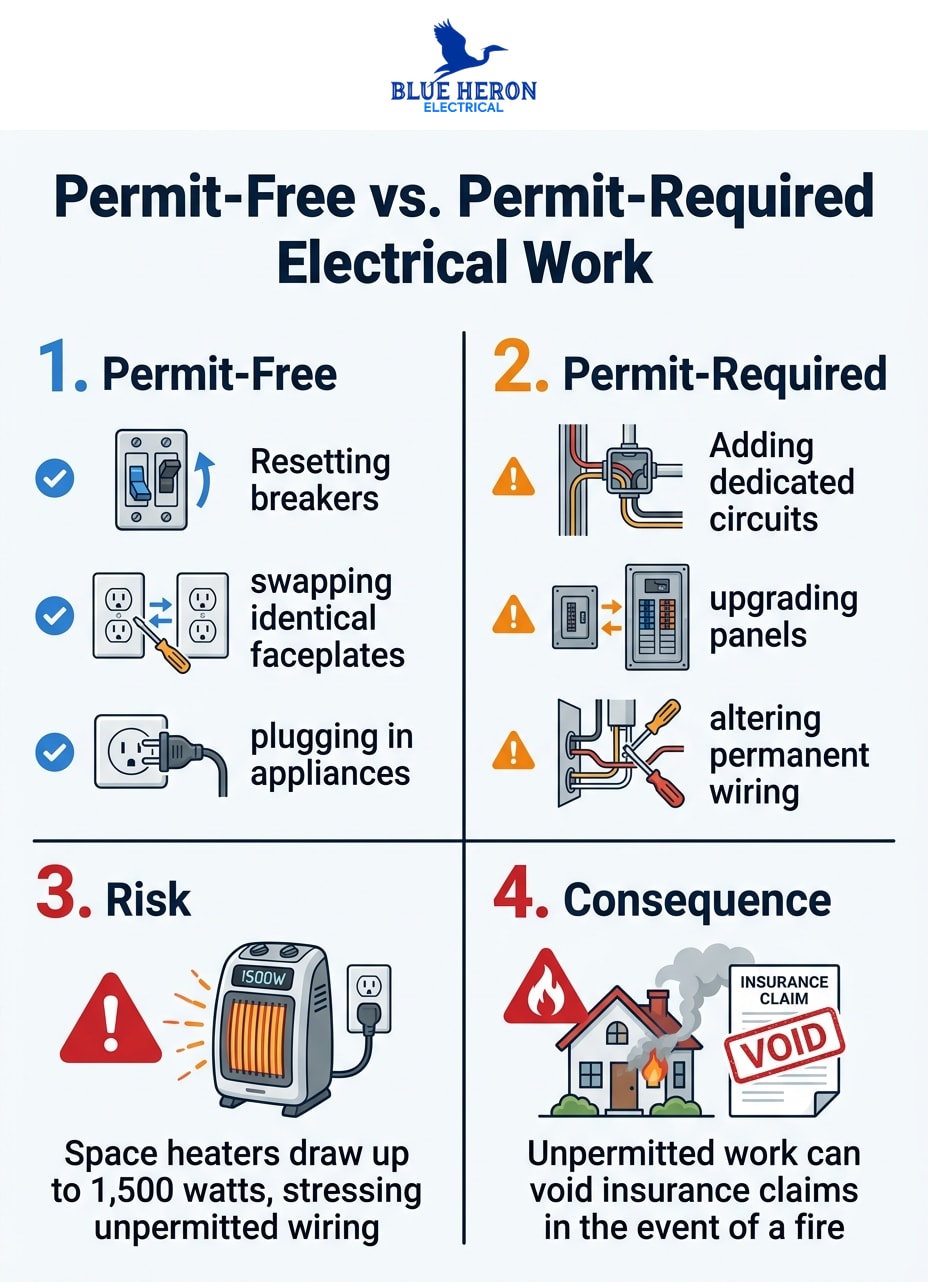
As we head into late fall / November cold snaps, the sudden drop in temperature prompts many families to plug in auxiliary heating and string up extensive holiday lighting displays. This immediately stresses the home's electrical capacity. A typical portable space heater can draw up to 1,500 watts of power. Because a standard 15-amp residential circuit maxes out at roughly 1,800 watts, running a heater alongside just a few lights, a television, or a computer is enough to push the circuit past its safe operating limit, causing the breaker to trip.
This leaves you at a crucial decision point: determining if the issue is a simple DIY fix—like redistributing the load to a different part of the house—or if your home requires professional residential electrical services to safely handle the demand. Permanently solving an overloaded circuit usually involves altering the home's wiring, which brings up the critical question of electrical permits and what you are legally allowed to do yourself.
Understanding the Legal Limits of DIY Electrical Fixes
Before you pick up a screwdriver or head to the hardware store for wire, it is vital to understand what an electrical permit actually is and why local jurisdictions enforce strict building codes. An electrical permit is a formal authorization from your local government to install, alter, or repair electrical wiring. These permits ensure that all work is performed according to the National Electrical Code (NEC), a comprehensive set of safety standards designed to prevent electrical fires and equipment failures.
Our electricians frequently meet homeowners who assume that because they own their property, they can modify it however they see fit. However, local building codes still govern structural and electrical safety. In Sterling Heights residential neighborhoods, these regulations are strictly enforced to protect families, first responders, and property investments from the severe hazards of faulty wiring. When your home faces sustained, heavy electrical loads during the winter, any weak points in your electrical system become immediate fire risks.
Permits are not just administrative hurdles; they are a critical safety checkpoint. When a permit is pulled, it guarantees that an independent inspector will review the work to confirm that the wire gauge, breaker size, and connections are appropriate for the intended load. This oversight is what keeps a minor wiring mistake from turning into a devastating house fire.
Permit-Free Troubleshooting: Which Minor Electrical Tasks Skip the Process?
When we dispatch our crews during late fall / November cold snaps, we always tell our customers the general rule of thumb for DIY electrical work: maintenance is usually fine, but modification requires a permit. You do not need to call the city or pull a permit for everyday tasks that do not alter your home's permanent wiring structure. There are several safe, permit-exempt steps you can take to manage heavy electrical loads.
Here are the common permit-free tasks you can safely handle yourself:
• Resetting a tripped breaker: If a circuit overloads, firmly switching the breaker to the "off" position and then back to "on" is completely safe and requires no special authorization.
• Redistributing appliance loads: Simply moving a heavy-draw appliance, like a space heater, to an underutilized circuit (such as plugging it into an outlet on a different wall that runs back to a different breaker) is the safest DIY solution for winter overloads.
• Swapping identical faceplates: Upgrading the plastic cover on a switch or outlet for aesthetic reasons does not involve touching the wiring and is permit-free.
• Changing lightbulbs: Replacing a burnt-out bulb with a new one of the same or lower wattage is standard homeowner maintenance.
These tasks are exempt from permitting because they do not change the capacity, routing, or fundamental safety mechanisms of your home's electrical system. As long as you are interacting with the devices on the outside of the wall, you are generally operating within safe, legal boundaries.
When Is a Licensed Electrician Legally Required?
If redistributing your electrical load doesn't solve the problem, and your breakers continue to trip, you have likely reached the limit of your home's current capacity. Permanently solving a recurring tripped breaker usually requires adding a dedicated circuit. This is where the line is drawn: adding new wiring or altering existing circuits mandates a permit and, in almost all cases, a licensed professional.
Local building codes in Sterling Heights residential neighborhoods require inspections for any modifications to ensure the system can safely handle high-amperage demands. Upgrading a panel or adding a circuit is often the only safe way to accommodate the sustained heavy loads required for reliable winter heating.
Tasks that legally require a permit and a licensed electrician include:
1. Installing new wiring: Running wire through walls, ceilings, or floors to create new outlets or lighting fixtures.
2. Adding dedicated circuits: Creating a direct, single-use power line from the main panel to a specific appliance, like a heavy-duty space heater or a hot tub.
3. Performing electrical panel upgrades: Replacing an outdated fuse box or an undersized breaker panel with a modern unit that can handle higher overall amperage. (Note: Generic federal tax credits or local utility incentive programs may apply to qualifying panel upgrades, so we always advise readers to verify current programs with their utility or a tax professional.)
4. Replacing main service cables: Upgrading the lines that connect your home to the utility company's power grid.
Attempting these restricted tasks without proper training is incredibly dangerous. Over our years serving the community, Blue Heron Electrical has provided licensed, code-compliant expertise, ensuring homeowners navigate the permit process seamlessly. Our team handles the paperwork, coordinates with local inspectors, and ensures that every connection meets the strict safety standards required for heavy winter use.
The Hidden Dangers of Unpermitted Wiring Under Heavy Winter Loads
The Physical Danger: Substandard DIY wiring is a critical fire hazard, especially when subjected to the sustained high-amperage draw of heating equipment. Michigan's severe cold snaps mean that space heaters, furnace blowers, and holiday lights often run continuously for hours or even days. Our service teams have been called out to far too many winter emergencies where a homeowner has spliced wires incorrectly, used the wrong gauge of wire for the load, or bypassed a safety mechanism. That continuous electrical draw creates immense heat. According to National Fire Protection Association (NFPA) data, heating equipment is a leading cause of home fires, and faulty wiring drastically multiplies this risk. Unpermitted wiring simply cannot be trusted to hold up under the stress of late fall / November cold snaps.
The Financial Risk: Beyond the immediate threat of fire, illegal DIY electrical work carries severe financial consequences. If an electrical fire breaks out and the fire investigator determines it originated from unpermitted, non-code-compliant wiring, your homeowner's insurance provider has grounds to deny your claim entirely. You could be left paying for the total loss of your property out of pocket.
The Real Estate Complications: Unpermitted work also creates major roadblocks when it comes time to sell your home. During the buyer's inspection, unpermitted electrical modifications are frequently flagged. You may be forced to tear down drywall, hire a licensed electrician to bring the work up to code, and pay retroactive permitting fines before the sale can close. Furthermore, unpermitted wiring can prevent the safe addition of modern home upgrades, such as a standby generator installation, because the existing system cannot pass the preliminary safety checks required for the new equipment.
How to Safely Resolve Frequent Breaker Trips This Season
If you are struggling with power issues in your Sterling Heights residential neighborhood, safety must be your immediate priority. The first step is to unplug heavy-draw devices from the affected circuit immediately. Do not simply keep resetting the breaker over and over; a breaker that trips repeatedly is doing its job by protecting your home from overheating wires.
Next, try mapping your circuits. Turn off the main devices in the room, reset the breaker, and plug your space heater into an outlet that you know is connected to a different circuit breaker. If the heater runs smoothly without tripping the new circuit, you know the original circuit was simply overloaded with too many devices.
However, if redistributing the load doesn't stop the breakers from tripping, or if you notice warm outlets, buzzing sounds, or a burning smell, it is time for a professional inspection. A licensed electrician can assess whether your home needs a new dedicated circuit or if there is an underlying wiring fault that needs immediate repair. Many homeowners hesitate to call a professional because they are unsure of the scope of the work or wonder does rewiring a home require a permit in Michigan. When our technicians arrive, we thoroughly evaluate the system, explain exactly what needs to be done, and handle all the necessary permits so you don't have to guess.
Frequently Asked Questions About Home Electrical Permits
Do I need a permit to add an outlet for a space heater?
Yes, you absolutely need a permit to add a new outlet. Adding a new outlet involves running new wiring inside the walls and altering the home's permanent electrical system. Because space heaters draw a massive amount of power during late fall / November cold snaps, this new circuit must be properly sized, permitted, and inspected to ensure it doesn't create a fire hazard.
Can I upgrade my electrical panel myself?
No, upgrading an electrical panel is complex, highly dangerous work that requires a licensed electrician, a permit, and utility coordination. The main electrical panel connects directly to the utility lines, which carry lethal amounts of current that cannot be turned off from inside the house. Only a licensed professional has the training and legal authorization to safely perform a heavy-up or panel replacement.
Is it illegal to do your own electrical work in Michigan?
It depends entirely on the specific task you are performing. Minor maintenance, like swapping a light fixture or replacing an identical switch cover, is perfectly legal for a homeowner to do without a permit. However, altering permanent wiring, adding new circuits, or upgrading panels without a permit is against code and poses severe liability and safety risks.
What happens if I finish my basement without an electrical permit?
If you finish a basement without pulling the required electrical permits, you may face significant fines from your local municipality. More importantly, you may be forced to tear down newly finished drywall so an inspector can retroactively examine the wiring. Unpermitted basement wiring can also lead to insurance claim denials and major complications when attempting to sell the home.
Will my insurance cover an electrical fire if I did the wiring myself?
In our experience working alongside local inspectors, we've seen that insurance providers often deny claims if an investigation reveals that the fire originated from unpermitted, non-code-compliant electrical work. Your policy agreement typically requires that your home adheres to local building codes. If you bypassed the permit process and caused a fire, the insurance company may determine you violated the terms of your coverage.
How long does it take to get an electrical permit for a new circuit?
A licensed electrical contractor can typically secure the necessary permits very quickly, often within a few days or even the same day for emergency situations. When you hire our professionals, we handle all the paperwork, submit the technical diagrams, and schedule the inspections on your behalf, ensuring the process is fast and seamless.
Ensure Your Home's Electrical System is Ready for Winter Demands
When the temperatures drop in Sterling Heights residential neighborhoods, your home's electrical system works overtime to keep you comfortable. Safety should always come first when dealing with heavy winter electrical loads. Never compromise your family's well-being by attempting illegal DIY wiring fixes or ignoring a breaker that refuses to stay on.
If you are unsure about your home's electrical capacity, or if you are tired of constantly resetting tripped breakers every time you plug in a heater, it is time to seek an expert assessment from our team. We encourage you to schedule a professional inspection to ensure your system is fully code-compliant and ready for the season. Whether you need a simple dedicated circuit or comprehensive electrical remodeling, a licensed electrician will provide the safe, reliable power you need for total peace of mind this winter.
Customer Testimonials

Service Areas