
What Electrical Work Can Be Done Without a Permit in Michigan?

Why Do My Breakers Keep Tripping When I Plug In Space Heaters?
Are you plugging in a space heater to take the chill off, only to plunge the room into darkness? Getting common homeowner questions answered is urgent when you are trying to figure out why your power keeps shutting off just as the weather turns cold. The sudden power loss is incredibly frustrating, especially when you are simply trying to keep a specific bedroom or living area comfortable during November pre-winter temperature drops. However, that click you hear from the basement or garage is actually your home's first line of defense working exactly as designed.
To safely resolve these capacity issues, our team at Blue Heron Electrical provides comprehensive residential electrical services that diagnose the root cause of the overload. In our years serving Sterling Heights homeowners, we've found that while flipping the switch back on is a quick temporary fix, solving the underlying problem often requires professional electrical panel upgrades to ensure your home can handle heavy winter loads.
A tripping breaker is never just a nuisance; it is a critical safety mechanism. Circuit breakers monitor the flow of electricity through your home's wiring. When that flow exceeds the safe capacity of the wires—which can cause them to overheat, melt their insulation, and start a fire—the breaker physically interrupts the circuit. The core decision point you face as a homeowner is determining whether this interruption is a simple, correctable overload (like running a vacuum and a heater at the same time) or a symptom of an outdated, failing electrical panel that requires immediate professional intervention.
Many older homes were simply not built to handle the high electrical demands of modern winter appliances. As temperatures drop and supplemental heating devices are pulled out of storage, your electrical system is suddenly pushed to its absolute limits. Understanding how residential electrical services handle these specific capacity issues is the first step in keeping your home safe and warm.
Understanding Your Home's Electrical Capacity During the Holidays
Michigan's extreme seasonal shifts and freezing winters force many homeowners to rely heavily on supplemental heating. A pattern our electricians see often during late fall service calls is that this sudden shift in electrical usage exposes the hidden limitations of standard residential wiring. Most standard bedroom and living room circuits are wired for either 15 amps or 20 amps of total electrical flow. This capacity must be shared among all the outlets and overhead lights on that specific circuit.
When you add extensive holiday displays alongside everyday appliances, you are asking the circuit to deliver more power than the physical wires can safely carry. If you want to safely illuminate your home's exterior without plunging your living room into darkness, investing in custom lighting solutions often requires careful load calculation by a professional to avoid these dangerous overloads.
The technical reality of winter loads:
• Standard capacity: A 15-amp circuit can safely handle a continuous load of about 1,440 watts.
• High-draw devices: A single, standard space heater typically draws 1,500 watts on its highest setting.
• The overload threshold: Plugging just one space heater into a 15-amp circuit maxes out the entire circuit's capacity instantly.
If you have a television, a lamp, or a laptop charger plugged into the same room, the circuit is mathematically guaranteed to overload. The breaker tripping in this scenario is the system doing exactly what it was designed to do: preventing a fire inside your walls.
How Much Power Does a Space Heater Actually Use?
To understand why November pre-winter temperature drops lead to so many tripped breakers, you have to look at the math behind common winter devices. Electrical current is measured in amps, while the power an appliance consumes is measured in watts. You can calculate the amperage draw of any appliance by dividing its wattage by your home's voltage (typically 120 volts).
• Standard Space Heater (High) — Average Wattage: 1,500 Watts — Estimated Amperage Draw (at 120V): 12.5 Amps
• Electric Blanket — Average Wattage: 200 Watts — Estimated Amperage Draw (at 120V): 1.6 Amps
• Hair Dryer (often used in cold mornings) — Average Wattage: 1,800 Watts — Estimated Amperage Draw (at 120V): 15.0 Amps
• Incandescent Holiday Lights (per 100 bulb strand) — Average Wattage: 40 Watts — Estimated Amperage Draw (at 120V): 0.33 Amps
If your bedroom is on a 15-amp circuit, a 12.5-amp space heater leaves only 2.5 amps of available power for the rest of the room. Turning on a hair dryer or stringing up a few too many lights will push the circuit over the edge, causing the breaker to trip to protect the wiring.
What Electrical Work Can Be Done Without a Permit in Michigan?
When dealing with winter electrical overloads, homeowners often wonder where the line is drawn between a quick DIY fix and a project that legally requires professional oversight. Under Michigan regulations, routine homeowner electrical maintenance is entirely exempt from permitting. This means you can perform basic upkeep and minor component swaps without calling a city inspector.
Whether you live in Sterling Heights or anywhere else in the state, local municipalities enforce these state-wide exemptions uniformly. The general rule is that if you are not altering the permanent wiring structure of the home, a permit is likely not required.
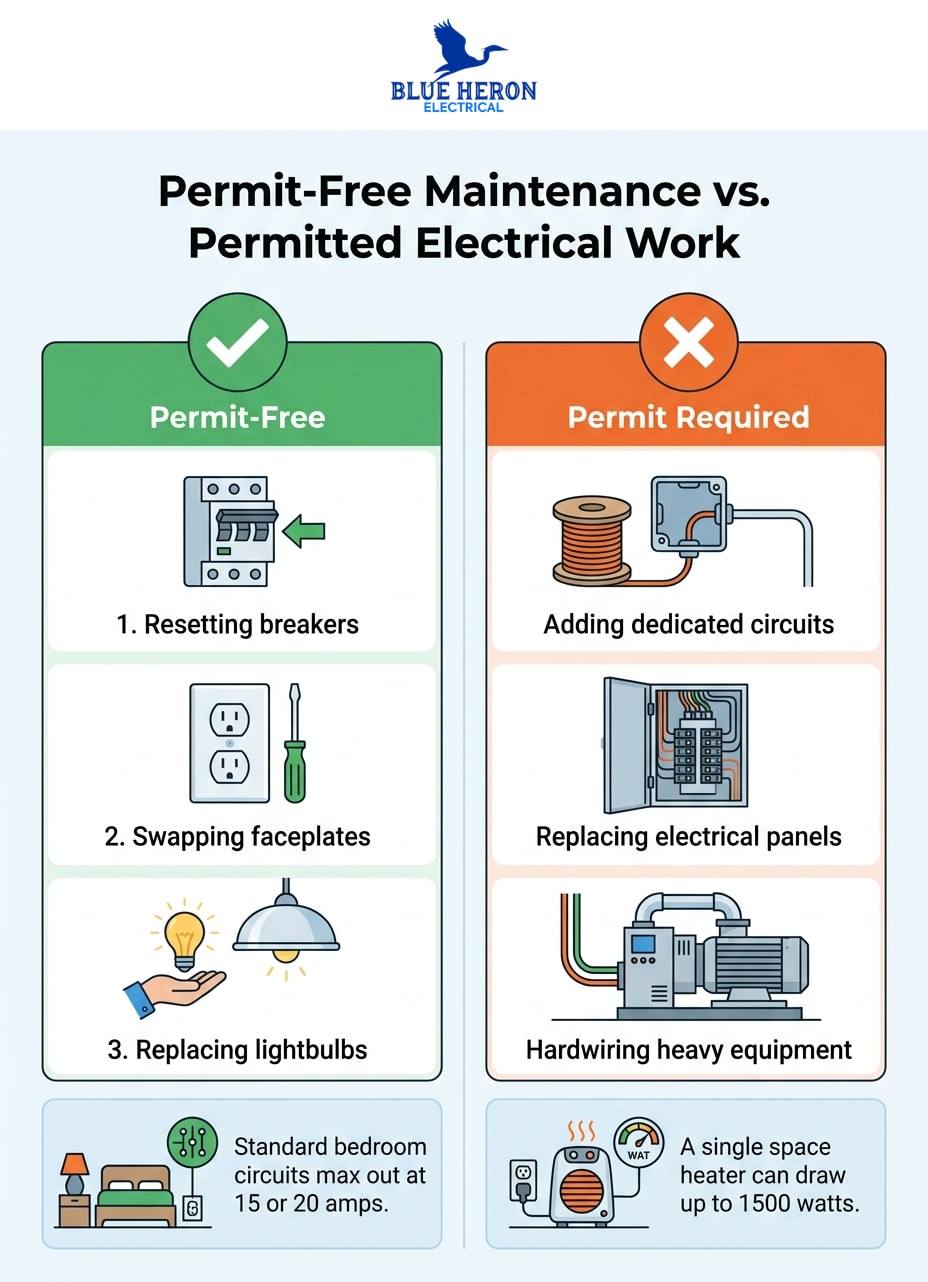
Permit-exempt electrical maintenance includes:
• Resetting a tripped breaker: Flipping a breaker back to the "on" position is safe, permit-free maintenance, provided you have resolved the overload that caused it to trip.
• Swapping a lightbulb: Changing out burnt bulbs for energy-efficient LEDs requires no permit. (Note that federal tax credits or local utility incentives may apply to broader home energy efficiency upgrades, so check with your provider).
• Replacing a standard faceplate: Upgrading the plastic covers over your outlets or switches is considered cosmetic maintenance.
• Replacing an existing switch or receptacle: Swapping a broken outlet for a direct replacement of the same rating (without changing the wiring behind the wall) is generally allowed without a permit for the homeowner who occupies the residence.
However, it is critical to emphasize that any work altering the permanent wiring structure is strictly excluded from this list. If your space heater keeps tripping the breaker, you cannot simply swap a 15-amp breaker for a 20-amp breaker to "fix" the problem. Doing so without upgrading the actual wires in the wall creates a massive fire hazard and violates state law.
Electrical Upgrades That Strictly Require a Permit and Inspection
The boundary where DIY stops and professional, permitted work begins is clearly defined under the Stille-DeRossett-Hale Single State Construction Code Act. When your electrical system cannot handle your winter heating needs, the necessary upgrades require a licensed professional, a state or local permit, and a third-party inspection to verify compliance with the National Electrical Code (NEC).
Adding new dedicated circuits for heavy appliances legally requires a permit. If you want a dedicated outlet in your Sterling Heights home specifically for a heavy-duty space heater, an electrician must run new, properly gauged wire from the panel to the room. This structural alteration to the home's wiring must be documented and inspected.
Furthermore, replacing or upgrading an electrical panel is one of the most heavily regulated tasks in home construction. The panel is the heart of your home's electrical safety system. Upgrading from a 100-amp service to a 200-amp service to handle modern loads requires coordination with the utility company, pulling a permit, and passing a rigorous inspection before the power can be permanently restored.
The same rules apply to hardwiring large equipment. For example, a proper standby generator installation requires permits to ensure the transfer switch is wired correctly. An improperly wired generator can backfeed electricity into the grid, posing a lethal threat to utility workers repairing lines during a winter storm. Because the stakes are so high, step-by-step DIY electrical alterations are never recommended for these advanced tasks.
The Dangers of Ignoring Repeated Circuit Overloads
When a breaker trips during November pre-winter temperature drops, it is easy to view it as a minor inconvenience. However, our team strongly cautions that repeatedly forcing a breaker to reset without addressing the underlying overload is incredibly dangerous. Breakers are mechanical devices with internal springs, contacts, and bimetallic strips. They are not designed to be used as daily on/off switches.
Every time a breaker trips under a heavy load, a small electrical arc occurs inside the casing. Over time, this repeated arcing degrades the internal contacts. The breaker will eventually become "weak," meaning it might trip at lower amperages than it is rated for, or worse, it might fuse closed and fail to trip at all during a critical overload. If a breaker fails to trip, the wires in your wall will continue to heat up until they ignite the surrounding insulation and wood framing.
Warning signs of a failing electrical panel include:
• Burning smells: An acrid, fishy, or burning plastic odor near the panel or outlet is an emergency sign of melting wire insulation.
• Warm to the touch: While breakers can get slightly warm under heavy load, a breaker that is hot to the touch indicates a serious resistance issue.
• Buzzing sounds: A faint humming or buzzing from the panel suggests a breaker is failing to maintain a solid connection.
• Scorched outlets: Black or brown marks around the receptacle where you plug in your space heater mean arcing is occurring at the plug.
If you notice any of these signs, unplug the offending high-draw device immediately. Do not attempt to force the breaker to stay on. The next step is to have a licensed professional diagnose the root cause of the failure.
When Should You Stop Resetting the Breaker?
Homeowners need a clear rule of thumb for when to stop resetting a breaker and call for help. If a breaker trips once because you accidentally ran the microwave and a space heater simultaneously, resetting it after unplugging the heater is fine. However, if a breaker trips more than once for the same reason, or if it trips immediately upon being reset, you have crossed the threshold from an isolated overload into a systemic failure.
Resetting a breaker a third time without professional diagnosis is a severe safety risk. At this point, the physical degradation inside the panel requires a licensed electrician to open the panel, test the load, and determine if the circuit needs to be split or if the entire panel requires an upgrade.
The Hidden Risks of Unpermitted Winter Electrical Upgrades
Faced with the frustration of repeated power outages, some homeowners are tempted to bypass the permit process and attempt their own panel upgrades or hire unlicensed handymen to add circuits. From what we routinely see when called in to fix failed DIY projects across Sterling Heights, this approach carries severe hidden risks that extend far beyond the immediate danger of electrocution.
The most pressing concern is the severe fire hazard associated with improper, unpermitted circuit additions. Electrical codes exist specifically to prevent house fires. Using the wrong gauge of wire, failing to secure connections properly, or overloading the neutral bar in the panel can create hidden hotspots inside your walls that may smolder for hours before erupting into flames.
If a fire does occur, unpermitted electrical work can lead to devastating financial consequences. Insurance companies investigate the cause of electrical fires. If the investigation reveals that the fire originated from an unpermitted circuit or an illegally modified panel, the provider has grounds to deny the homeowner's insurance claim entirely, leaving the family responsible for the total cost of rebuilding.
Furthermore, unpermitted work creates massive complications when attempting to sell a home later. During the closing process in Sterling Heights, home inspectors will look for signs of amateur electrical work. Unpermitted upgrades must often be ripped out and redone by a licensed professional before the sale can proceed, costing far more than doing it right the first time. There are also potential legal penalties and code violations issued by the municipality for performing unlicensed electrical work.
To protect your home and your investment, it is crucial to understand what electrical repairs require a licensed electrician. Blue Heron Electrical's licensed expertise ensures all electrical work meets strict local Michigan codes, protecting homeowners from safety hazards and future liability.
Frequently Asked Questions: Electrical Permits and Winter Safety
Why does my space heater keep tripping the breaker?
Your space heater trips the breaker because it draws more electrical current than the circuit is designed to handle. A standard space heater uses about 1,500 watts, which consumes nearly all the capacity of a standard 15-amp bedroom circuit. When you turn on other devices on that same circuit, the system overloads, and the breaker safely trips to prevent the wires from overheating and causing a fire.
Do I need a permit to add a circuit for a space heater?
Yes, adding any new permanent circuit requires a permit and a municipal inspection. Running new wire from your electrical panel to a new dedicated outlet alters the permanent structure of your home's electrical system. This work must be permitted to ensure the wire gauge and breaker size meet the National Electrical Code standards for continuous heating loads.
Can a homeowner upgrade an electrical panel in Michigan?
No, panel upgrades must be performed by a licensed professional with proper permitting. The electrical panel is the central safety hub of the home, and modifying it involves handling lethal amounts of raw utility power. In municipalities like Sterling Heights, only licensed electrical contractors are permitted to replace or substantially upgrade a main service panel.
Do I need a permit to replace an electrical panel in Michigan?
Yes, replacing an electrical panel falls under strict state permitting requirements. This process involves disconnecting the utility feed, installing a new enclosure, migrating all existing circuits, and ensuring proper grounding and bonding. A third-party inspector must verify that the new panel is installed correctly and safely before the utility company will restore permanent power.
What happens if you do electrical work without a permit?
Performing electrical work without a permit exposes you to significant financial and legal risks. If the municipality discovers the unpermitted work, you may face fines and be forced to tear out the alterations. More importantly, if unpermitted wiring causes a house fire, your homeowner's insurance provider may deny your claim, leaving you completely liable for the damages.
What are the penalties for unpermitted electrical work in Michigan?
Penalties for unpermitted electrical work in Michigan can include municipal fines, stop-work orders on your property, and citations for code violations. Additionally, when you attempt to sell the home, unpermitted work flagged by an inspector must typically be brought up to code by a licensed electrician at the seller's expense before the transaction can close.
Does resetting a tripped breaker require a permit?
No, resetting a breaker is considered routine maintenance, provided the root cause is resolved. You do not need a permit to flip a breaker back to the "on" position. However, if the breaker continues to trip repeatedly, you must stop resetting it and hire a licensed professional to diagnose and repair the underlying issue.
Ensure Your Home's Electrical System is Ready for Winter
A clear understanding of what overloads a circuit is the first and most important step in winter safety. When the November pre-winter temperature drops hit and you pull your supplemental heating devices out of the closet, pay close attention to how your electrical panel responds. If you experience a tripped breaker, remember the unambiguous safety guideline: stop resetting a repeatedly tripping breaker. Forcing the system to carry a load it cannot handle will eventually degrade the breaker and put your home at risk.
If you find yourself constantly battling power interruptions in specific rooms, it is time to talk to an expert about your electrical capacity issues. Don't wait until the deepest freeze of the year to find out your panel can't keep up. Schedule an inspection of your home's electrical system before winter weather peaks to ensure your family stays safe, warm, and fully powered all season long.
Customer Testimonials

Service Areas