
How to Combine DTE Rebates with Federal Credits for Maximum Savings
Why Michigan Homeowners Leave Thousands on the Table With Electrical Upgrades
Learning how to combine dte rebates with federal credits for maximum savings on electrical upgrades could put serious money back in your pocket — money that most Metro Detroit homeowners never collect simply because they don't know the incentives exist or how to layer them together.
Here's the quick answer:
How to Combine DTE Rebates with Federal Credits for Electrical Upgrades:
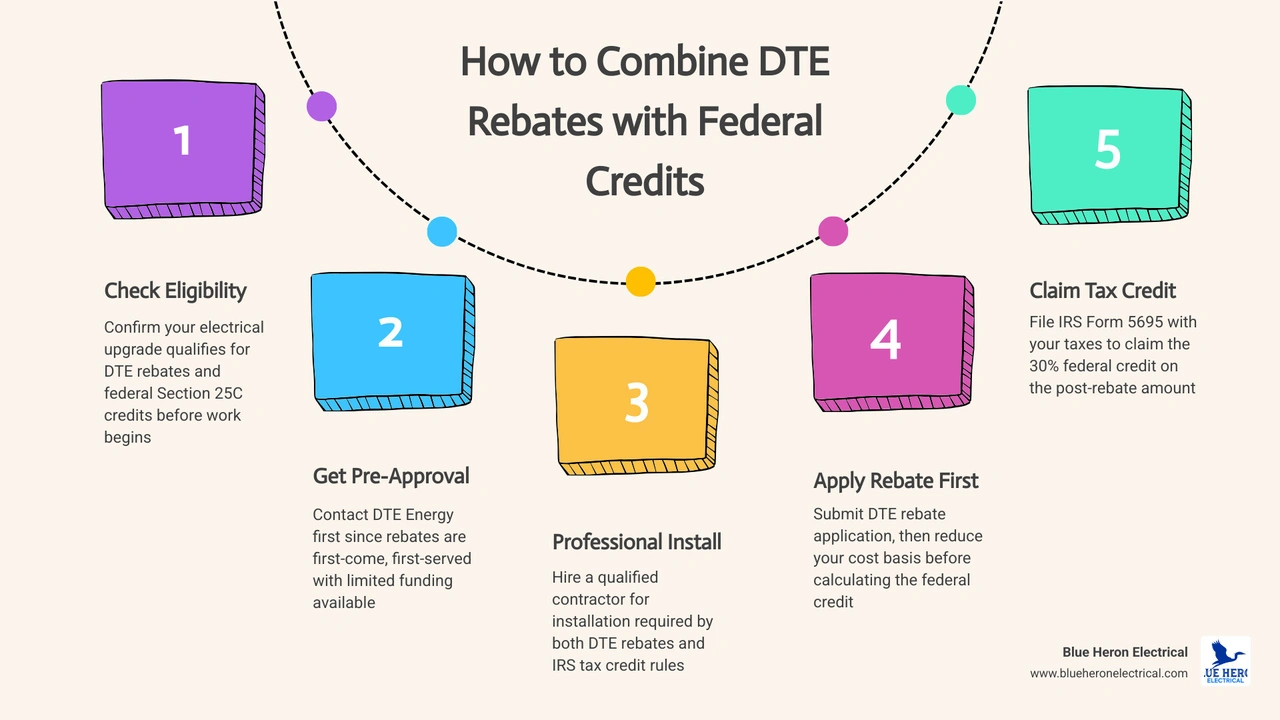
- Check DTE eligibility first — confirm your upgrade qualifies for a DTE Energy rebate before work begins
- Get pre-approval — contact DTE before installation, since rebates are first-come, first-served with limited funds
- Use a qualified contractor — professional installation is required for both DTE rebates and federal tax credits
- Stack, don't double-dip — DTE rebates and federal credits can apply to the same project, but each incentive covers a different cost layer
- Reduce your cost basis — apply DTE rebates first, then calculate your federal tax credit on the post-rebate cost
- File IRS Form 5695 — claim your federal Energy Efficient Home Improvement Credit (Section 25C) when you file your taxes
- Keep all documentation — invoices, manufacturer certifications, and rebate confirmations are all required
The opportunity is real. Federal credits under Section 25C cover 30% of qualifying electrical panel upgrade costs (up to $600), while the HEAR program offers up to $4,000 for electrical load service center upgrades and up to $2,500 for wiring — and DTE Energy rebates can stack on top of those for eligible customers. Done right, a single electrical upgrade project can pull from multiple funding sources at once.
The catch? These programs have funding caps, eligibility rules, and sequencing requirements that trip up even well-intentioned homeowners. Miss a step, and you could lose part of your rebate — or all of it.
This guide walks you through exactly how to do it right.
Understanding the Incentive Landscape for Michigan Electrical Upgrades
Navigating energy efficiency incentives can feel like learning a new language. However, in June 2026, the landscape is incredibly favorable for homeowners and business owners in Southeast Michigan who want to modernize their electrical systems. By modernizing your infrastructure, you aren't just making your property safer; you are preparing it for the future of clean energy.
Whether you are upgrading to a 200-amp service to support a new heat pump, adding solar power, or installing EV charging infrastructure, several layers of financial assistance are available. The two primary pillars of these savings are DTE Energy (your local utility provider) and the federal government (via tax credits established and expanded under the Inflation Reduction Act).
When you plan a project like Electrical Panel Upgrades Troy MI, you must look at both programs simultaneously. They do not operate in complete isolation; instead, they can be layered to offset a substantial portion of your overall project costs.
DTE Energy Efficiency Programs for Homes and Businesses
DTE Energy offers robust rebate programs designed to reduce the peak demand on the electrical grid by encouraging customers to install highly efficient equipment. These rebates are funded through small energy-efficiency surcharges on utility bills, meaning you have already been contributing to this pool of money—so you might as well claim your share!
For residential customers in communities like Royal Oak, Birmingham, and Rochester Hills, DTE provides direct rebates for equipment such as heat pump water heaters, energy-efficient heating and cooling systems, and smart thermostats. Many of these upgrades require underlying electrical modifications, such as running new dedicated branch circuits or upgrading your main panel board.
For commercial and industrial customers, the DTE Energy Efficiency Program for Business offers customized incentives. This program covers everything from high-efficiency commercial HVAC units and commercial refrigeration to industrial LED lighting systems. However, business owners must keep a close eye on the program's funding status. DTE's business rebate funds are strictly limited and distributed on a first-come, first-served basis. Historically, these programs operate with tight annual allocations, often leaving limited funds (such as 12% remaining for electric customers and 13% remaining for natural gas customers as the program year winds down).
To ensure you don't miss out, we always recommend reviewing the process in our guide on How to Apply for DTE Energy Rebates on Lighting and Efficiency Upgrades in Michigan. Working with an experienced contractor who specializes in Commercial Electrical Services Troy MI ensures your business submits the correct pre-approval paperwork before the funding pool runs dry.
Federal Tax Credits: Section 25C and Section 25D in 2026
At the federal level, the tax credits available to homeowners are highly lucrative but governed by strict annual limits and equipment requirements.
- Section 25C (Energy Efficient Home Improvement Credit): This credit allows you to claim 30% of the cost of qualifying home energy upgrades. For an electrical panel upgrade, the maximum credit is $600 per year. However, there is a catch: the panel upgrade must be installed in conjunction with, and enable the installation of, another qualified energy-efficient improvement (such as a heat pump, heat pump water heater, or central air conditioner). The overall annual aggregate limit for Section 25C credits is $3,200, which includes a $1,200 limit for general envelope improvements (like doors, windows, and traditional ACs) and a $2,000 limit specifically carved out for heat pumps and biomass stoves.
- Section 25D (Residential Clean Energy Credit): If you are installing solar panels, wind turbines, geothermal heat pumps, or battery storage systems, you will look to Section 25D. This credit covers 30% of the total project cost with no annual dollar cap. It is valid at the full 30% rate through 2032 before stepping down in subsequent years. This is particularly relevant for battery storage systems of 3 kWh or larger, which are often installed alongside whole-home backup systems.

How to Combine DTE Rebates with Federal Credits for Maximum Savings on Electrical Upgrades
The secret to maximizing your savings lies in "stacking" these incentives legally and strategically. Many people assume that if they receive a rebate from DTE, they are disqualified from claiming a federal tax credit. This is a myth! You can absolutely use both, provided you follow the IRS rules regarding "cost basis reduction."
The golden rule of stacking is that you cannot double-dip on the exact same dollar spent. When you receive a non-taxable utility rebate from DTE, that rebate reduces the purchase price of your project. Consequently, your "cost basis" (the amount you actually paid out of pocket) is lower. You must calculate your 30% federal tax credit using this post-rebate cost basis.
Additionally, your combined incentives—including federal credits, state rebates, and utility programs—cannot exceed 100% of the total project cost.
To help visualize how these incentives work together, let's look at a comparison of how they are structured:
| Incentive Type | Funding Source | How It Is Received | Key Limits & Caps |
|---|---|---|---|
| DTE Utility Rebates | Ratepayer Surcharges | Direct check or bill credit | Varies by equipment; subject to annual program funding limits |
| Section 25C Tax Credit | Federal Government | Reduction in tax liability on Form 5695 | 30% of cost up to $600 for panels; $3,200 overall annual cap |
| Section 25D Tax Credit | Federal Government | Reduction in tax liability on Form 5695 | 30% of total cost; no annual dollar cap; roll-over allowed |
| HEAR State Rebates (MiHER) | Federal Funding (State Administered) | Often applied at point-of-sale | Up to $4,000 for panels; up to $2,500 for wiring (income-restricted) |
Step-by-Step Guide on How to Combine DTE Rebates with Federal Credits for Maximum Savings on Electrical Upgrades
To make sure you don't leave any money on the table, follow this sequence when executing your electrical upgrades:
- Define the Scope of Your Project: Determine what upgrades you need. Are you replacing an old 100-amp panel with a code-compliant 200-amp panel to prepare for an EV charger or a heat pump?
- Verify Equipment and Contractor Eligibility: Ensure the equipment you choose meets the efficiency ratings required by both DTE and the IRS. Both programs require professional installation—DIY projects will not qualify for these incentives.
- Apply for Pre-Approval (If Required): For certain DTE rebates, especially commercial ones, you must secure pre-approval before any physical work begins. Check our Promotions page to see if there are any current seasonal offers that can layer with these programs.
- Complete the Installation: Have your certified electrician complete the work safely and in full compliance with local Michigan building codes.
- Collect Detailed Invoices: Ensure your contractor provides an itemized invoice that clearly breaks down the cost of the electrical panel, wiring, labor, and any associated energy-efficient equipment.
- File for Your DTE Rebate: Submit your rebate application to DTE along with your itemized invoice within the program's specified window (typically within 30 to 90 days of installation).
- Calculate the Adjusted Cost Basis: Subtract your DTE rebate from the total project cost to find your net out-of-pocket cost.
- Claim the Tax Credit: When tax season arrives, file IRS Form 5695. Multiply your adjusted cost basis by 30% to calculate your federal tax credit (up to the $600 limit for panels).
Strategic Timing: How to Combine DTE Rebates with Federal Credits for Maximum Savings on Electrical Upgrades Across Tax Years
If you have a large-scale home electrification plan, trying to do everything at once can actually cost you money. Because the Section 25C tax credit has an annual cap of $3,200 (and a specific $600 cap for electrical panels), executing all your upgrades in a single calendar year might cause you to exceed these limits, leaving eligible tax credits unclaimed.
Instead, use a multi-year sequencing strategy. By spreading your projects across tax years, you can refresh your annual caps and claim the maximum credit for each individual upgrade.
For example, consider this two-year plan:
- Year 1: Install a highly efficient heat pump water heater and upgrade your electrical panel to support it. Your panel upgrade qualifies for a 30% credit up to $600, and your heat pump water heater qualifies for a 30% credit up to $2,000 under Section 25C.
- Year 2: Install a central heat pump system for heating and cooling. This allows you to claim a fresh Section 25C credit of up to $2,000 for the new HVAC system in the second tax year.
By planning your upgrades this way, you maximize your tax savings without running into the annual aggregate ceiling. If you need help managing the upfront costs of a multi-year project, look into our Financing options to keep your cash flow smooth while you wait for your rebates and tax returns to arrive.
Eligible Electrical Upgrades and Stacking Scenarios
Let's look at how these stacking rules play out in real-world scenarios across Oakland County and the Metro Detroit area.
When you upgrade your home's electrical backbone, you aren't just swapping out old parts; you are opening the door to modern conveniences like high-speed EV charging and advanced home protection. Two of the most common upgrades that go hand-in-hand are EV Charger Installation Troy MI and installing Whole Home Surge Protection Troy MI to protect your new, sensitive electronic equipment.
Electrical Panel and Wiring Upgrades
Many older homes in Clinton Township, Madison Heights, and Ferndale still have 100-amp (or even 60-amp) electrical service. To run modern electric appliances, a transition to a 200-amp service is almost always required.
Under the federal High-Efficiency Electric Home Alliance (HEAR) program, low-to-moderate-income households can qualify for up to $4,000 for electrical panel upgrades and up to $2,500 for wiring upgrades. When you combine this with the Section 25C tax credit (30% up to $600) and any local DTE residential programs, the out-of-pocket cost for a panel upgrade can be dramatically reduced.
Whether you are upgrading a panel for safety or capacity, our team handles all forms of Residential Electrical Work Troy MI to ensure your new system is safe, reliable, and fully code-compliant.
EV Chargers and Generator Installations
If you are installing an EV charger at your home, you can leverage the federal Section 30C tax credit, which provides a 30% credit for the cost of installing alternative fuel vehicle refueling property in qualified census tracts.
DTE also offers residential smart charger rebates for customers who enroll in their year-round time-of-use rates. This helps you charge your vehicle during off-peak hours when electricity is cheapest and cleanest.
What about backup power? While there are no federal tax credits or state rebates for traditional diesel or gasoline standby generators, you can still plan a professional Generator Installation Troy MI to keep your home running during Michigan's unpredictable storms. If you choose to install a solar-plus-battery backup system instead of a traditional generator, that battery system does qualify for the 30% Section 25D clean energy tax credit.
LED Lighting Upgrades for Businesses
For commercial properties in Auburn Hills, Southfield, or Troy, lighting represents a massive portion of monthly utility costs. Upgrading outdated fluorescent or metal halide fixtures to high-efficiency commercial LEDs is one of the fastest ways to cut overhead.
DTE's business program offers prescriptive rebates for qualifying commercial LED fixtures. By partnering with us for LED Lighting Upgrades Troy MI, we can help you design a system that qualifies for maximum DTE rebates, while also exploring federal commercial energy tax deductions (such as Section 179D) to write off the remaining installation costs.
Frequently Asked Questions about Combining Electrical Incentives
Can I stack DTE rebates with federal tax credits for the exact same electrical panel upgrade?
Yes, but you must follow the IRS cost basis reduction rules. You cannot claim a 30% tax credit on the portion of the project that was already paid for by a DTE rebate.
For example, if your panel upgrade costs a certain amount, and you receive a rebate from DTE, you must subtract that rebate amount from the total invoice first. Your 30% federal tax credit is then calculated based on the remaining out-of-pocket balance. This ensures compliance with IRS guidelines while still allowing you to benefit from both programs.
Do renters qualify for DTE rebates and federal tax credits on electrical upgrades?
Renters can qualify for certain incentives, but there are limitations. For federal tax credits under Section 25C, the upgrades must generally be installed in your primary residence. Renters who purchase portable energy-efficient appliances or pay for qualifying upgrades themselves may be eligible, but permanent structural upgrades like an electrical panel replacement typically require homeownership.
Additionally, any permanent electrical upgrades will require written landlord permission. If you are renting a home in Metro Detroit, the HEAR program does offer appliance and wiring rebates that can benefit tenants, but coordinating with your landlord is essential to ensure proper permitting and installation.
What is the timeline for receiving DTE rebates compared to federal tax credits?
The timeline for receiving these incentives is very different:
- DTE Rebates: These are processed relatively quickly. Once your contractor completes the installation and you submit the paperwork online, DTE typically issues a rebate check or applies a credit to your utility account within 4 to 8 weeks.
- Federal Tax Credits: These are claimed annually when you file your federal income taxes. You will file IRS Form 5695 along with your standard tax return for the year the equipment was "placed in service." Depending on when your project is completed, you may wait several months to receive this benefit in the form of a reduced tax liability or an increased tax refund.
Conclusion
Maximizing your savings on electrical upgrades in Southeast Michigan doesn't have to be a headache. By understanding the rules of stacking, planning your projects strategically across tax years, and choosing the right local partner, you can modernize your home or business while keeping more money in your wallet.
At Blue Heron Electrical, we serve homeowners and businesses across Oakland County and Metro Detroit—including Troy, Royal Oak, Sterling Heights, and Bloomfield Hills. We are committed to providing dependable, code-compliant work with a relentless focus on safety, clear communication, and long-term reliability.
Ready to upgrade your system and secure your rebates? Schedule your professional electrical upgrade with Blue Heron Electrical today, and let our team help you plan a safe, efficient, and cost-effective project.
Customer Testimonials

Service Areas