

Hardwiring a Hot Tub: Disconnect Switches and GFCI Requirements

Planning Your Hot Tub Installation Before the Freeze Sets In
Your new outdoor spa is finally sitting on the patio, but the process of hardwiring a hot tub: disconnect switches and GFCI requirements can quickly turn a weekend upgrade into a complex electrical project. You cannot simply plug a high-amperage water feature into a standard wall outlet. Before you can enjoy a warm soak, the system must be integrated into your home's electrical grid safely and legally.
If you are tackling early fall hot tub prep before Michigan winter arrives, assessing your current power capacity is the very first step. Many older homes lack the available amperage to support a new spa. Whether you need comprehensive residential electrical services to evaluate your system or full electrical panel upgrades to handle the heavy new load, getting the foundation right is non-negotiable.
Understanding the True Power Demand
Most standard outdoor spas require a dedicated 240-volt circuit to operate effectively. Unlike a standard household appliance that cycles on and off, a hot tub often runs multiple high-draw components simultaneously. When the heater, circulation pumps, jet blowers, and LED lighting systems are all active at once, the electrical demand is massive.
If your home's main electrical panel is already near its maximum capacity, adding a 50-amp or 60-amp load can cause constant breaker tripping or, worse, overheat the main electrical bus bar. This is why a thorough load calculation is a mandatory part of the planning phase. A licensed professional will calculate the total draw of your existing home appliances and determine if your current service panel can safely accommodate the new addition before any trenches are dug or wires are pulled.
Why Outdoor Water and Electricity Demand Strict Safety Codes
Mixing water, outdoor environmental elements, and high-voltage electricity creates one of the most severe life-safety hazards on any residential property. Because the human body becomes highly conductive when submerged in water, even a minor electrical fault that would normally just cause a mild shock can easily become fatal in a spa environment.
To combat this risk, the National Electrical Code (NEC) established Article 680, which specifically governs the installation of swimming pools, fountains, and similar installations. These codes are not arbitrary suggestions; they are legally enforceable standards designed specifically to prevent electrocution. Local municipal inspectors in Sterling Heights enforce these codes rigorously to protect homeowners and their families.
How Outdoor Wiring Differs from Indoor Wiring
Outdoor electrical installations face challenges that indoor systems never encounter. The materials, burial depths, and safety devices required are vastly different.
• Moisture Protection — Standard Indoor Wiring: Standard dry-rated Romex cable inside wall cavities. — Outdoor Pool & Spa Wiring (NEC Article 680): Watertight conduit, specialized outdoor-rated THWN wire, and sealed enclosures.
• Fault Protection — Standard Indoor Wiring: Standard breakers for most rooms; AFCI/GFCI in specific wet zones. — Outdoor Pool & Spa Wiring (NEC Article 680): Mandatory, dedicated Ground-Fault Circuit Interrupter (GFCI) protection for all equipment.
• Disconnect Accessibility — Standard Indoor Wiring: Main panel located in a basement, garage, or utility room. — Outdoor Pool & Spa Wiring (NEC Article 680): Dedicated emergency disconnect switch mounted outside, within strict line-of-sight rules.
• Grounding / Bonding — Standard Indoor Wiring: Standard equipment grounding conductor to the main panel. — Outdoor Pool & Spa Wiring (NEC Article 680): Complex equipotential bonding grid connecting all nearby metal components and water.
This table illustrates why outdoor water features require specialized knowledge. Every component used must be rated for wet locations, UV exposure, and extreme temperature fluctuations.
The Critical Role of GFCI Protection for Hot Tubs
The problem: Standard circuit breakers are designed to protect the wires in your house from overheating and catching fire, not to protect human beings from electrical shock. A standard breaker will only trip if there is a massive overload or a direct short circuit.
The cause: If water intrudes into the spa's control pack, or if a wire's insulation degrades over time, a small amount of electrical current can leak into the water. This "ground fault" might only measure a few milliamps—far too low to trip a standard 50-amp breaker, but more than enough to cause muscular paralysis or fatal electrocution to someone in the water.
The solution: A dedicated Ground-Fault Circuit Interrupter (GFCI) breaker is the primary barrier against this hazard. A GFCI breaker constantly monitors the balance of electrical current flowing out to the hot tub and the current returning from it. If it detects an imbalance as small as 5 milliamps—indicating that electricity has found an unintended path to ground (like through water or a person)—it cuts the power instantly, usually in a fraction of a second.
Upgrading Older Electrical Systems
Because hot tubs typically require 50A or 60A dedicated GFCI breakers, older homes often present unique challenges. A typical pattern we see in summer is older homes needing a complete fuse panel replacement and proper house grounding before the system can safely support a modern GFCI breaker. If your home still relies on outdated wiring, scheduling circuit breaker services in Sterling Heights is a necessary prerequisite to ensure the GFCI device functions correctly and trips when it is supposed to.
Navigating the 5-Foot Rule for Emergency Disconnect Switches
One of the most heavily scrutinized aspects of an outdoor spa installation is the placement of the maintenance and emergency disconnect switch. This switch serves a dual purpose: it allows a technician to safely cut power before opening the control panel for repairs, and it allows anyone to instantly kill the power in the event of an emergency.
The NEC dictates very specific rules for where this switch must be mounted:
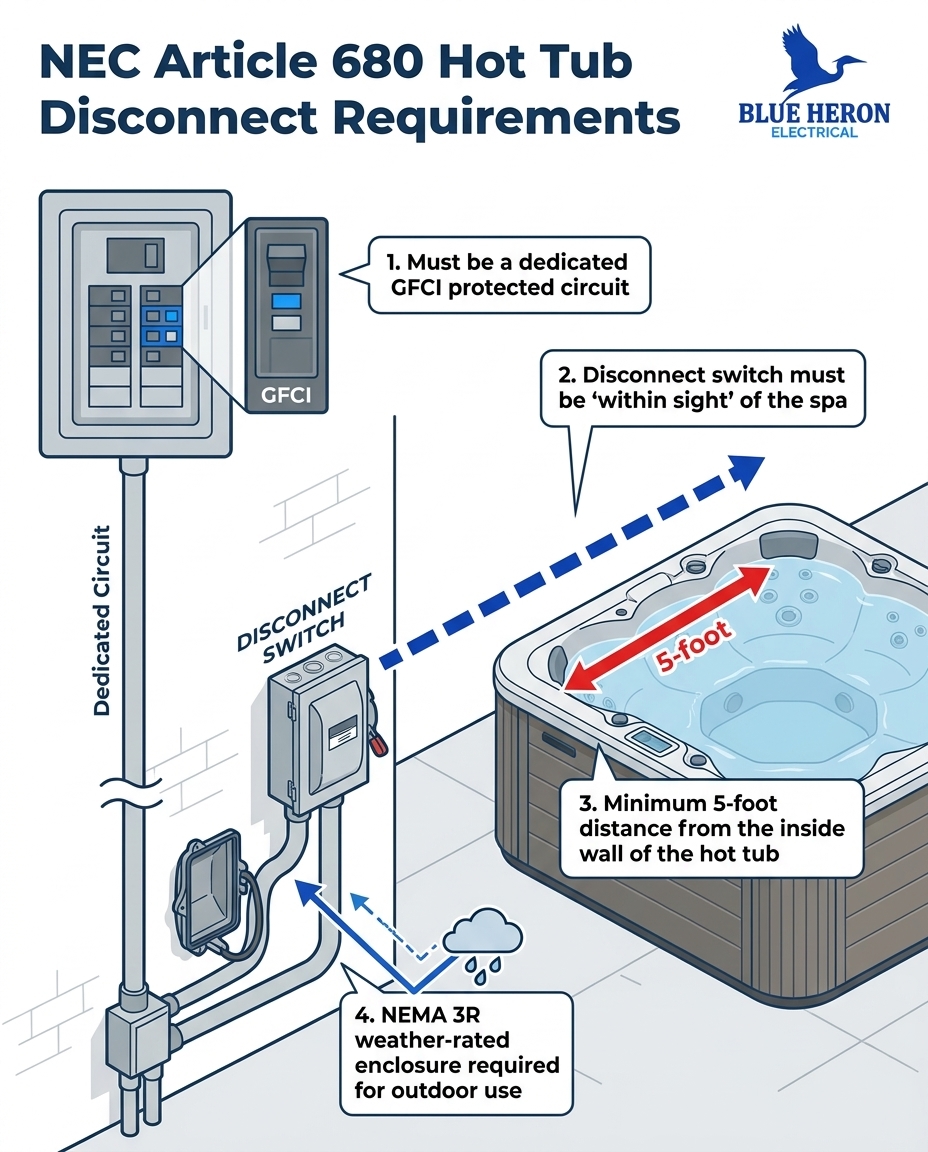
1. The "Within Sight" Requirement: The disconnect switch must be visible from the hot tub. If an emergency occurs, someone must be able to see the switch immediately without running around a corner or into the house.
2. The Minimum Distance: There is a strict 5-foot minimum distance for emergency disconnect placement, measured horizontally from the inside wall of the spa. This ensures that a person sitting in the water cannot reach out and touch the electrical box, preventing a potential path to ground.
3. The Maximum Distance: While it must be at least 5 feet away, it generally cannot be more than 50 feet away, ensuring it remains readily accessible during a crisis.
4. Accessibility: The path to the switch cannot be obstructed by heavy vegetation, locked gates, or permanent structures.
Balancing Aesthetics and Code Compliance
Homeowners often want to hide electrical boxes behind bushes or decorative screens to maintain the aesthetic appeal of their backyard oasis. However, hiding the disconnect switch violates the "within sight" rule. A skilled installer can help you choose a mounting location—such as the side of the house or a dedicated mounting post—that satisfies the strict safety regulations while minimizing the visual impact on your patio design.
Weatherproofing Your Disconnect Switch for Harsh Conditions
Outdoor electrical components must be built to withstand the environment, but standard outdoor boxes are not enough when you factor in local climate extremes. Michigan's freezing winters, heavy spring rains, and deep snowdrifts require specialized equipment to prevent catastrophic electrical failures.
The NEC requires the use of NEMA 3R weather-sealed electrical enclosures for outdoor panels. These enclosures are specifically engineered to protect internal wiring and breakers from falling rain, sleet, and external ice formation. If a standard, unsealed box is used, moisture will inevitably intrude. When that moisture freezes, it expands, potentially cracking the housing, corroding the breaker terminals, and causing the GFCI to fail or trip constantly.
Strategic Mounting Heights for Snow Accumulation
Beyond the enclosure itself, the mounting height is a critical safety factor. If the disconnect switch is mounted too low on an exterior wall or post, a heavy winter snowdrift can completely bury it. If an emergency occurs while the hot tub is in use during a winter evening, a buried switch is useless. Furthermore, freeze-thaw cycles can trap moisture inside improperly sealed underground conduit, leading to wire degradation. Proper trenching depths and the use of specialized watertight conduit (like liquid-tight flexible non-metallic conduit) are essential to protect the wiring from shifting, freezing soil.
Equipotential Bonding: The Unseen Safety Net
While most homeowners understand the concept of a circuit breaker, very few are familiar with equipotential bonding. Bonding is a critical, unseen safety net required for all outdoor water features, and it serves a completely different purpose than standard grounding.
Grounding provides a safe path for fault current to return to the electrical panel, tripping the breaker. Equipotential bonding, on the other hand, connects all the metallic components around the spa—including the motor frame, the heater housing, metal handrails, and even the surrounding reinforced concrete—into a single, uniform electrical potential.
Preventing Voltage Gradients
If a fault occurs, electricity can travel through the soil or a wet concrete pad. If one part of the patio has a different voltage level than the water in the tub, a person stepping out of the spa can bridge that gap, resulting in a severe shock. A solid copper bonding grid eliminates these voltage gradients, ensuring that everything in the immediate vicinity is at the exact same electrical potential. This highly technical step is almost impossible for an untrained homeowner to execute correctly, which is why understanding the grounding requirements for above-ground pools and spas is best left to those who study the code daily.
The Hidden Dangers of DIY Hot Tub Wiring
The problem: With the abundance of online video tutorials, many homeowners are tempted to wire their own outdoor spas to save on installation costs.
The cause: A lack of understanding regarding wire sizing, conduit burial depths, and the extreme life-safety hazards of mixing high voltage with water leads to dangerous, non-compliant installations. Online videos cannot replace a comprehensive knowledge of the NEC and local municipal codes.
The solution: Hiring a professional is the only way to guarantee safety. Working with a licensed professional ensures strict adherence to NEC and local municipal requirements, protecting your family from the serious shock hazards associated with amateur outdoor wiring. Improper wire sizing can cause the insulation to melt and start a fire, while faulty GFCI wiring can leave swimmers entirely unprotected from electrocution.
Insurance and Warranty Liabilities
Beyond the physical dangers, DIY electrical work carries severe financial and legal liabilities. Most hot tub manufacturers explicitly state that the warranty is void if the unit is not installed by a licensed electrician. Furthermore, if an unpermitted, DIY electrical hookup causes a fire or an injury on your property, your homeowners' insurance provider can deny the claim entirely. The assurance that comes from guaranteed code adherence and a legally permitted installation is worth far more than the perceived savings of a DIY attempt.
Frequently Asked Questions
How far does a hot tub disconnect need to be?
The NEC mandates a 5-foot minimum distance from the inside wall of the spa. This specific distance ensures that a person sitting in the water cannot reach out and touch the electrical switch, preventing a direct path to ground. It must also remain visible and generally within 50 feet of the unit.
Why do hot tubs require GFCI breakers?
GFCI breakers are required because they are designed to protect human life from electrocution. They constantly monitor the electrical current and will instantly cut the power if they detect a leak as small as 5 milliamps. Standard breakers only protect wires from overheating, making them insufficient for water-related hazards.
Can a homeowner wire their own hot tub?
While some jurisdictions allow homeowners to pull their own permits, wiring a hot tub is highly dangerous and strongly discouraged for amateurs. The strict requirements for GFCI protection, equipotential bonding, and conduit sealing require specialized knowledge. An improper installation poses a severe life-safety risk and can void your home insurance policy.
Where should a hot tub disconnect be located?
The disconnect must be located "within sight" of the spa, meaning there can be no walls, fences, or heavy vegetation blocking the view. It is typically mounted on the exterior wall of the house or on a dedicated weatherproof post, ensuring it is easily accessible during maintenance or an emergency.
What size breaker do I need for a standard outdoor spa?
Most standard outdoor spas require a dedicated 240-volt, 50-amp or 60-amp GFCI breaker. The exact size depends entirely on the manufacturer's specifications and the total draw of the spa's heaters and pumps. A professional load calculation is required to ensure your home's main panel can support this addition safely.
Does weather affect how my hot tub should be wired?
Yes, local climate drastically impacts outdoor wiring requirements. In regions with freezing temperatures and heavy snow, all electrical components must be housed in NEMA 3R weather-sealed enclosures. Additionally, the disconnect switch must be mounted high enough to remain accessible above typical winter snowdrifts.
Ensuring a Safe Soak This Season
When it comes to enjoying your backyard oasis, safety must always come before convenience. Hardwiring a hot tub: disconnect switches and GFCI requirements are complex for a reason—they are designed to save lives. By trusting a licensed professional to handle the equipotential bonding, load calculations, and weatherproof installations, you guarantee that your new spa is fully code-compliant. Schedule your electrical evaluation today so you can relax knowing your family is completely protected from electrical hazards.
Customer Testimonials

Service Areas