
Why Fall is the Best Time to Trench for New Outbuilding Power

The Closing Window: Planning Your Outbuilding Power Before the Freeze
The intense summer heat has finally broken across Southeast Michigan, leading many homeowners to wonder exactly why fall is the best time to trench for new outbuilding power before the first hard freeze arrives. You step outside, and the air is crisp, the ground is firm, and your yard is finally recovering from the baking summer sun. If you have recently built a detached garage, a pole barn, or a backyard workshop, getting electricity to that structure is likely your next major hurdle. Waiting too long to schedule this excavation risks severe yard damage from spring mud, or worse, hitting frozen ground that halts your project entirely.
Whether you are upgrading your main home or expanding your property's capabilities, professional residential electrical services are the backbone of a safe, reliable system. If you are planning agriculture and outbuilding electrical work, scheduling it now is critical.
The concrete problem is timing: Most homeowners do not realize that underground electrical work is highly dependent on seasonal soil conditions. You are faced with a distinct decision point: schedule your trenching during the ideal September to early October pre-frost window, or put the project on hold until next year. Pushing the project off means dealing with extension cords running across the snow all winter, which is both a safety hazard and a massive inconvenience.
Running power to an outbuilding is a highly specialized project that requires strategic planning. It involves coordinating heavy machinery, navigating local utility lines, and ensuring your home's main panel can handle the added electrical load. By taking advantage of the brief autumn window, you ensure the groundwork is laid smoothly, allowing the final electrical connections to be made safely before the harsh winter weather sets in.
Understanding Soil Dynamics in Southeast Michigan
To understand why timing matters so much, you have to look at the physical ground beneath your feet. The soil in Southeast Michigan is heavily composed of clay, which reacts dramatically to seasonal weather changes. During the peak of summer, the intense sun bakes this clay-heavy soil until it becomes nearly as hard as concrete. Mid-summer digging is incredibly difficult, putting immense strain on professional excavation equipment and slowing down the entire trenching process.
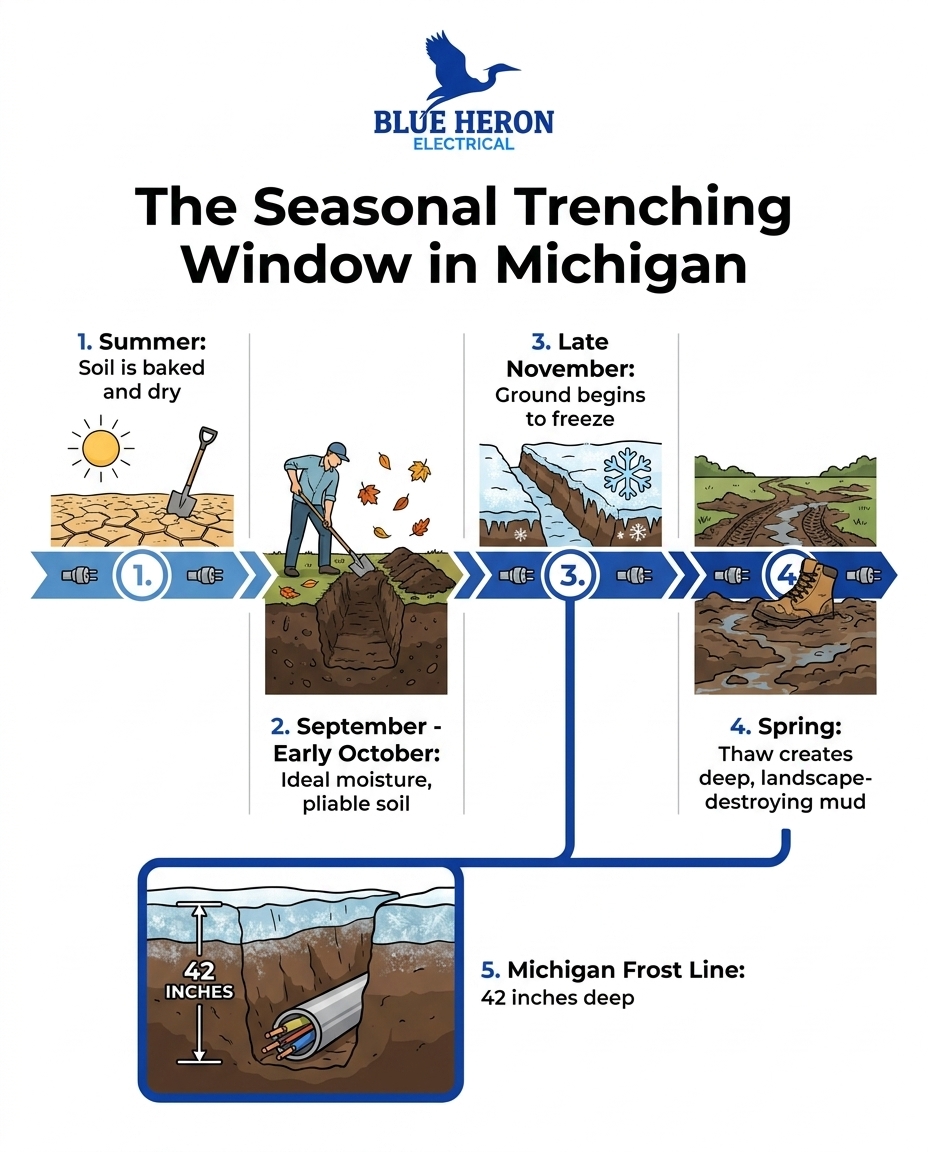
Early fall brings a crucial shift. The moderate moisture from autumn rains makes the ground pliable and much easier to work with. This creates the perfect environment for professional trenching equipment to cut clean, precise lines without tearing up the surrounding turf. Because the ground typically begins to freeze in late November in this region, the September to early October pre-frost window is the absolute best time for Sterling Heights electricians to perform underground installations.
Once late November arrives, the ground hardens into a solid block. Attempting to trench through frozen earth drastically increases labor time, causes excessive wear on heavy machinery, and often results in jagged, uneven trenches that are difficult to backfill properly. This is absolutely not a weekend project for a rented trencher; professional excavation requires specific, pliable soil conditions to ensure clean lines and safe conduit placement.
• Summer — Soil Condition in Southeast Michigan: Baked, dry, and hardened clay — Impact on Trenching for Outbuilding Power: Difficult excavation; high strain on digging equipment.
• Early Fall — Soil Condition in Southeast Michigan: Moderate moisture, highly pliable — Impact on Trenching for Outbuilding Power: Ideal window. Clean trenches, minimal yard damage.
• Winter — Soil Condition in Southeast Michigan: Frozen solid beyond the frost line — Impact on Trenching for Outbuilding Power: Nearly impossible without highly invasive, heavy machinery.
• Spring — Soil Condition in Southeast Michigan: Thawing, saturated, deep mud — Impact on Trenching for Outbuilding Power: Severe landscaping destruction; equipment sinks and ruts.
The Hidden Costs of Spring Trenching
If you miss the fall window, you might assume spring is the next best option. The reality is that spring is often the worst alternative. As the winter snow melts and the ground thaws, Southeast Michigan yards turn into saturated, muddy sponges. Driving heavy trenching equipment over soft, muddy spring lawns guarantees deep ruts and destroyed landscaping. What was supposed to be a simple trench becomes a massive yard restoration project.
Furthermore, spring rains frequently flood open trenches before the conduit can be laid and inspected, causing frustrating project delays. By prioritizing fall trenching, you preserve your yard's aesthetics, maintain the structural integrity of your lawn, and avoid the costly landscaping repairs that inevitably follow spring excavation.
Navigating the 42-Inch Frost Line and NEC Codes
Underground electrical work is heavily regulated to protect homeowners from catastrophic accidents. One of the primary factors dictating how this work is performed in Sterling Heights and Southeast Michigan is the regional frost line. The frost line is the maximum depth to which groundwater in the soil is expected to freeze. In this area, the severe winter climate pushes that frost line down to a staggering 42 inches.
While the frost line dictates structural footings, electrical burial depths are governed by the National Electrical Code (NEC). Specifically, NEC Article 300.5 outlines the strict burial depths required to prevent accidental severing by shovels, tillers, or future landscaping projects.
Common depth requirements include:
• 18 inches deep: For standard PVC conduit running across a typical residential yard.
• 24 inches deep: For direct-burial cable (though conduit is highly preferred for outbuildings).
• 24 inches deep (or more): When running conduit under a residential driveway or parking area.
• 6 inches deep: Only permitted when using rigid metal conduit (RMC) or intermediate metal conduit (IMC), though this is significantly more expensive and less common for long residential runs.
Working with a team that has deep expertise in local frost line codes and NEC regulations establishes a foundation of safety for your property. The type of conduit used—typically Schedule 40 or Schedule 80 PVC—is carefully selected based on the soil temperature and the specific route the trench takes across your yard.
Achieving a clean, code-compliant 18-to-24-inch trench through frozen winter ground is practically impossible without specialized, highly invasive heavy machinery. The frost essentially locks the ground, making the September to early October pre-frost window non-negotiable if you want the job done efficiently and correctly.
The Crucial First Step: Professional Load Calculations
Before a single shovel hits the dirt, a critical behind-the-scenes evaluation must take place. Running power to a detached garage, barn, or workshop is not just about laying the wire in the ground; it is entirely about the source of that power. Physical digging cannot start until your home's main electrical panel is thoroughly evaluated.
A strict protocol of conducting thorough load calculations before breaking ground ensures your safety and technical compliance. A professional load calculation evaluates your home's current square footage, major appliances, HVAC system, and daily electrical usage, then adds the anticipated load of the new outbuilding. If you plan to run power tools, a welder, heavy machinery, or even just a space heater in your new shed, that draws significant amperage.
The professional load calculation process generally involves:
1. Auditing the main panel: Checking the current amperage rating (typically 100 or 200 amps) and identifying any double-tapped breakers or signs of overheating.
2. Calculating existing demand: Factoring in high-draw appliances like electric ranges, dryers, air conditioners, and water heaters.
3. Projecting the outbuilding load: Determining exactly how much power the new subpanel will need to safely operate your intended equipment.
4. Determining the deficit: Figuring out if the existing main panel has enough overhead capacity to support the new underground feed.
If your existing electrical panel capacity is maxed out, it must be upgraded before the trenching begins. Skipping this step is incredibly dangerous and can lead to overloaded circuits, tripped breakers, and severe fire hazards.
A typical pattern we see in older homes is the need for a panel modernization before a subpanel can be added. For example, during a recent summer project, a local homeowner needed an outdated fuse panel replaced and the house properly grounded to handle increased electrical demands. A professional technician swapped out the old fuse panel for a modern breaker system and grounded the house, completing the replacement quickly with minimal interruption to the home. Once the main power source is secure and up to code, the underground trenching can proceed with confidence during the September to early October pre-frost window.
Underground Safety: MISS DIG 811 and Warning Tape
Digging an 18-inch trench across your yard involves significant risk if you do not know what lies beneath the surface. Southeast Michigan yards are spiderwebbed with buried gas lines, water pipes, telecommunication cables, and existing electrical feeds. Striking any of these can result in neighborhood-wide outages, massive fines, or fatal injuries.
This is why strict safety and regulatory protocols are legally required for all underground electrical work.
• Contacting MISS DIG 811: Michigan law requires contacting MISS DIG 811 at least three business days before any excavation begins. This free service dispatches utility companies to mark public lines with color-coded flags or paint (e.g., red for electrical, yellow for gas).
• Professional Warning Tape Installation: Once the electrical conduit is laid in the trench, professionals backfill a few inches of dirt and then install a bright red warning tape running the entire length of the trench. If a future homeowner digs in that area, they will hit the highly visible tape before their shovel strikes your live electrical conduit.
• Securing Local Permits: Extending residential power to an outbuilding is not a DIY task; it requires proper permitting and municipal inspections. Understanding outdoor electrical permits ensures your project complies with local ordinances and will not cause issues if you ever sell your home.
Licensed professionals handle all of this utility coordination and permitting on your behalf. By trusting experts who operate in the Sterling Heights / Southeast Michigan area, you remove the liability from your shoulders and guarantee the project is executed flawlessly.
Frequently Asked Questions About Underground Electrical Trenching
How deep does electrical conduit need to be buried in Michigan?
The exact depth depends on the type of conduit used, but it generally ranges from 18 to 24 inches. According to NEC Article 300.5, standard PVC conduit must be buried at least 18 inches deep in a residential yard to prevent accidental damage. If the conduit passes under a driveway or parking area, that depth requirement typically increases to 24 inches to withstand the weight of vehicles.
Why is it harder to dig trenches in winter?
Winter digging is incredibly difficult because the moisture in the soil freezes solid, essentially turning the ground into concrete. In Michigan, the frost line reaches down to 42 inches, meaning the entire depth of your required electrical trench is locked in ice. Excavating frozen soil damages standard trenching equipment, drastically delays project timelines, and often requires invasive heavy machinery that ruins the surrounding yard.
Can my current electrical panel handle a new subpanel?
You cannot know for sure until a licensed professional performs a comprehensive load calculation. This calculation measures your home's current electrical usage against the total capacity of your main panel, factoring in the specific power demands of your new outbuilding. If your main panel is full or outdated, it will require an upgrade before the new subpanel can be safely installed and powered.
Can I run electrical wire underground in winter?
While it is technically possible to run wire underground during the winter, it is highly discouraged and incredibly cost-prohibitive. Breaking through frozen ground requires specialized, heavy-duty excavation equipment that is expensive to operate and highly destructive to your property. It is always better to plan ahead and secure the trenching during the early fall months when the soil is pliable.
Do I need a permit to run power to my shed?
Yes, extending residential power to any outbuilding requires proper local permits and municipal inspections. Electrical work carries significant fire and safety risks, so local building departments strictly monitor these additions to ensure they meet the National Electrical Code. A licensed professional will handle the entire permitting process, ensuring your new power supply is legal, safe, and fully compliant.
Secure Your Fall Trenching Window Today
Acting now is the smartest way to protect your property and keep your outbuilding project on track. By taking advantage of the September to early October pre-frost window, you save your landscaping from the destruction of spring mud and avoid the impossible task of digging through frozen winter soil. Do not wait until the ground hardens; schedule your professional load calculation and trenching today to ensure your new space has safe, reliable power before the frost sets in.
Customer Testimonials

Service Areas