
Baseboard Heaters vs. Space Heaters: Preparing for Chilly Michigan Mornings
Are Your Bedroom Circuits Ready for the Autumn Chill?
If you find yourself comparing baseboard heaters vs. space heaters, preparing for chilly Michigan mornings often comes down to one critical question: is your home's electrical wiring actually equipped to handle the sudden drop in temperature? September early fall prep marks a distinct shift in the region. Long before the central furnace is turned on for the season, nighttime temperatures begin to plummet, leaving specific rooms—like bedrooms over garages or home additions—uncomfortably cold by dawn.
The immediate reaction for most homeowners is simple and fast: buy a portable unit, plug it into the nearest wall outlet, and enjoy the warmth. However, this quick fix introduces a significant hidden risk. As soon as the temperature drops, electrical contractors see a massive spike in service calls for tripped breakers and damaged receptacles. The root cause is almost always an overloaded 120V bedroom circuit that simply cannot sustain the continuous energy demand of portable heating equipment.
Before you commit to a long-term strategy for supplemental warmth, it is important to evaluate your home's capacity. Whether you need an assessment of your current panel or comprehensive residential electrical services, understanding the fundamental differences between plug-in convenience and hardwired reliability will protect both your property and your peace of mind.
The Math Behind the Heat: 120V Space Heaters on Shared Circuits
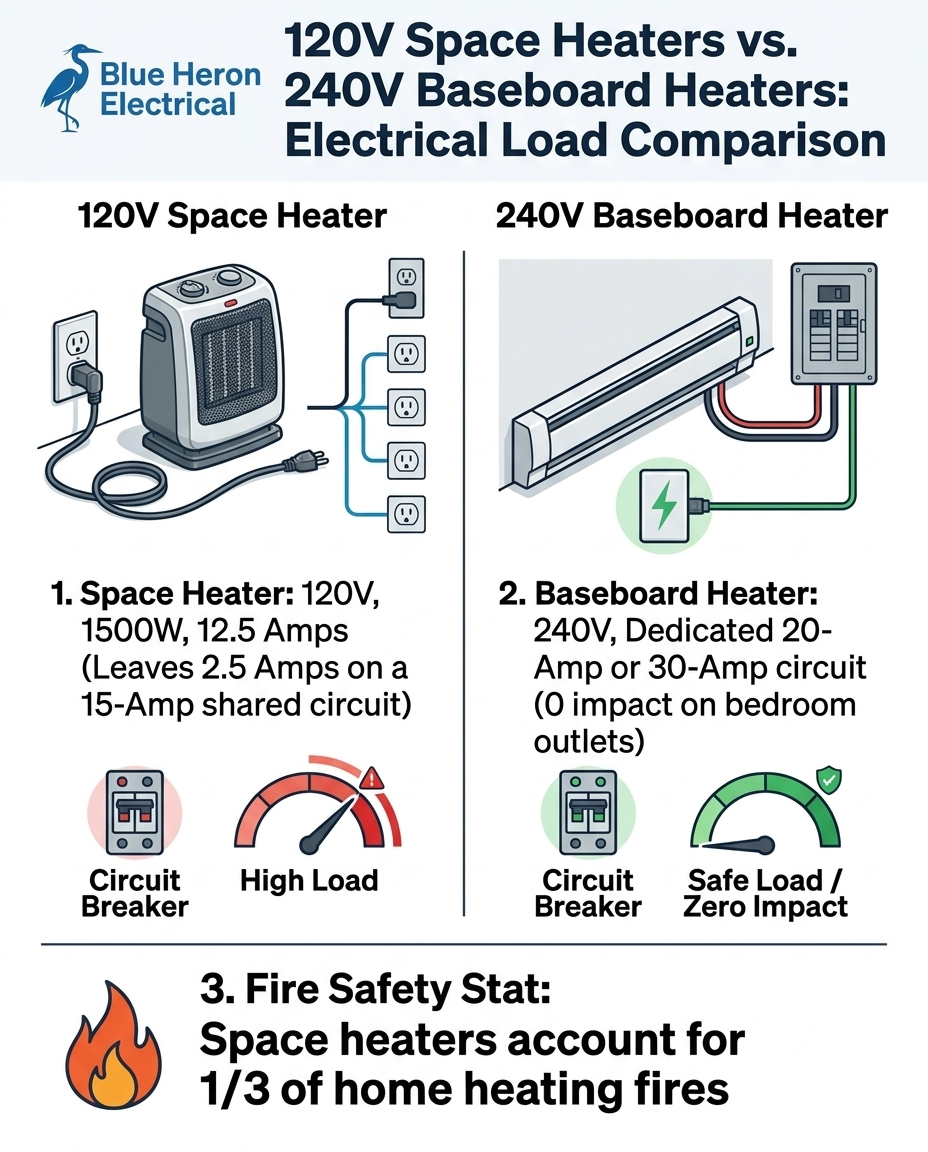
To understand why portable heating units cause so many electrical disruptions, you have to look at the math dictating 120V vs 240V circuit loads. A standard plug-in space heater sold at any hardware store typically draws 1,500 watts of power on its highest setting. In electrical terms, watts divided by volts equals amps. When you divide 1,500 watts by a standard 120-volt household outlet, the heater pulls exactly 12.5 amps of electrical current.
The Shared Circuit Problem: Most standard bedroom circuits are rated for a total of 15 amps. This means that a single portable heater consumes over 83% of the circuit's total available capacity the moment you turn it on. Bedrooms rarely have dedicated circuits for individual outlets; instead, all the outlets and overhead lights in the room—and sometimes the adjacent hallway or bathroom—are wired together on that same 15-amp loop.
If you have a television running, a few LED lamps turned on, and a smartphone charging, your circuit is already carrying a baseline load. The moment the portable heater cycles on, the total draw exceeds 15 amps. The immediate consequence is a tripped breaker, which is actually the safety mechanism working as intended to prevent the wires inside your walls from overheating.
However, running a circuit right at its absolute maximum capacity for hours on end causes sustained heat buildup at the receptacle. This leads to melting plastic, scorched outlets, and serious fire hazards. At Blue Heron Electrical, our focus on accurate load calculations helps prevent winter electrical fires, elevating the conversation from mere heating comfort to vital electrical integrity. If your panel is constantly shutting down power to your bedroom, professional circuit breaker services are the next logical step to assess the damage and correct the overload.
Why Hardwired 240V Baseboard Heaters Offer Superior Safety
Contrasting the limitations of shared 120V outlets, a hardwired 240V baseboard heating system operates on an entirely different level of infrastructure. These permanent installations do not plug into a wall; instead, they are wired directly into your home's main electrical panel on their own isolated lines.
Michigan's freezing mornings force supplemental heaters to run continuously on "high" just to maintain a tolerable room temperature. This sustained demand is exactly what standard outlets were never designed to handle. A hardwired baseboard system solves this by utilizing a dedicated circuit—typically rated at 20-amp or 30-amp—that serves absolutely nothing else in the home. Because 240V systems use two "hot" wires instead of one, they deliver heat more efficiently and safely, balancing the electrical load without straining your everyday lighting or entertainment circuits.
The Professional Installation Process:
1. Load Assessment: A licensed electrician evaluates your main panel to ensure it has the physical space and total amperage capacity to support a new 240V dedicated circuit.
2. Wire Routing: Heavy-gauge wire (typically 12-AWG or 10-AWG, depending on the heater's wattage) is routed safely through the walls or crawlspace directly to the installation site.
3. Hardwiring the Unit: The baseboard heater is permanently mounted and spliced directly into the new wiring, eliminating the weak point of a physical plug and a wall receptacle.
4. Thermostat Integration: A wall-mounted line-voltage thermostat is installed to provide precise, reliable temperature control.
Because analyzing 120V vs 240V circuit loads and working inside the main breaker box carries extreme risks of shock and property damage, this process strictly requires a licensed professional. Permanent installations provide decades of reliable, safe warmth without the constant fear of an overloaded wall outlet.
Older Homes and Electrical Capacity: A Metro Detroit Challenge
While the benefits of dedicated heating circuits are clear, implementing them in the region presents a specific set of hurdles. Many older homes in Sterling Heights, MI, and the surrounding Metro Detroit area were built long before modern electrical demands became the standard. It is incredibly common to find these mid-century homes still operating on original 100-amp electrical panels.
These legacy panels were designed to handle basic lighting, a refrigerator, and a few small appliances. They were not engineered to support the continuous, heavy load of modern electric space heaters running simultaneously in multiple bedrooms. When you introduce high-draw heating equipment to a 100-amp system, warning signs begin to appear rapidly. Homeowners often notice flickering overhead lights when a heater turns on, buzzing sounds emanating from the breaker box, or breakers that feel physically warm to the touch.
If your home lacks the capacity for safe supplemental heating, electrical panel upgrades provide the necessary foundation. Upgrading to a modern 150-amp or 200-amp service creates the bandwidth required to add dedicated 240V circuits safely.
The Risks of Outdated Fuse Panels
The situation becomes even more hazardous if your home still utilizes an outdated fuse box or a legacy Pushmatic panel. Many of these older systems completely lack proper grounding, meaning any electrical fault from a high-draw heater has nowhere safe to discharge. Running a 1,500-watt load continuously on an ungrounded, aging fuse system significantly elevates the risk of a thermal event inside the walls.
One local homeowner recently faced this exact hurdle when attempting to secure their home for the winter. Their old fuse panel desperately needed replacement, and the house itself lacked proper grounding. A professional crew swapped out the outdated fuse panel for a modern system and fully grounded the house with very little interruption. With the new panel installed, the home finally had the capacity and safety mechanisms in place to handle modern heating demands.
Side-by-Side Comparison: Electrical Requirements and Fire Safety
To clearly illustrate the differences in infrastructure and safety, evaluating 120V vs 240V circuit loads side-by-side reveals why permanent solutions outperform temporary fixes. If you have ever experienced overloaded panels causing electrical problems, this breakdown highlights exactly where the vulnerabilities lie.
• Power Source — 120V Plug-In Space Heater: Standard 120V wall receptacle. — 240V Hardwired Baseboard Heater: Directly wired to the main electrical panel.
• Circuit Type — 120V Plug-In Space Heater: Shared 15-amp loop (competes with lights/TVs). — 240V Hardwired Baseboard Heater: Dedicated 20-amp or 30-amp isolated circuit.
• Amperage Draw — 120V Plug-In Space Heater: Pulls 12.5 amps, leaving only 2.5 amps for the rest of the room. — 240V Hardwired Baseboard Heater: Draws power exclusively from its own high-capacity breaker.
• Fire Risk Profile — 120V Plug-In Space Heater: High. Cords and outlets can melt under continuous load. — 240V Hardwired Baseboard Heater: Low. Permanent wiring eliminates plug/receptacle failure points.
• Long-Term Reliability — 120V Plug-In Space Heater: Temporary, seasonal fix requiring constant monitoring. — 240V Hardwired Baseboard Heater: Permanent home addition with reliable, set-and-forget operation.
Recognizing the Warning Signs of an Overloaded Circuit
If you are currently relying on portable units to combat the chill in Sterling Heights, MI, knowing how to identify an overloaded circuit before it fails is critical. Electrical systems provide distinct warning signs when they are pushed past their safe operating limits. Ignoring these symptoms can lead to severe receptacle damage or internal wall fires.
• Warm wall outlets or faceplates: Receptacles should never feel warm to the touch. Heat indicates significant electrical resistance, usually caused by a loose connection inside the wall or a load that exceeds the outlet's physical rating.
• Burning smells or ozone odors: A faint, acrid smell resembling burning plastic or fish is a major red flag. This means the insulation around your wiring or the plastic housing of the outlet is actively melting.
• Scorch marks or discoloration: Brown or black smudges around the plug slots indicate that micro-arcing is occurring. Electricity is jumping the gap between the plug prongs and the worn internal contacts of the receptacle.
• Breakers that repeatedly trip: The breaker in your panel is a thermal-magnetic device designed to cut power when the wires get too hot. If a breaker trips, it is doing its job. Simply resetting it without unplugging the heavy load forces the system to overheat again, which eventually degrades the breaker until it fails completely.
If you observe any of these warning signs during a cold morning, take immediate action. Turn off the heating unit, unplug it from the wall, and do not use that specific outlet again until it has been inspected. When physical damage like scorch marks or melting is present, bringing in an emergency electrician is the safest way to ensure the hidden wiring inside your walls has not been compromised.
Frequently Asked Questions About Supplemental Heating Safety
Why does my space heater keep tripping the breaker?
Your space heater keeps tripping the breaker because it is pulling more electrical current than the circuit is designed to handle. A standard 1,500-watt heater draws 12.5 amps, which consumes almost the entire capacity of a shared 15-amp bedroom circuit. When you turn on a TV or a lamp on that same circuit, the total load exceeds 15 amps, causing the breaker to trip to prevent the wires from overheating and causing a fire.
Are baseboard heaters safer than space heaters?
Yes, hardwired baseboard heaters are significantly safer than portable space heaters from an electrical standpoint. Because baseboard units are permanently wired to their own dedicated circuits, they do not compete for power with your everyday appliances. This eliminates the risk of melting wall receptacles, overloaded shared wires, and the physical tripping hazards associated with long extension cords.
Do I need a dedicated circuit for a baseboard heater?
Yes, a dedicated circuit is strictly required for a hardwired baseboard heater. Evaluating 120V vs 240V circuit loads shows that permanent heating systems draw substantial, continuous power that must be isolated from the rest of the home. A licensed electrician will install a specific 20-amp or 30-amp 240V line directly from your main electrical panel to serve only the baseboard unit.
Can I run a space heater all night safely?
Running a portable space heater all night is highly discouraged due to the continuous strain it places on standard wall outlets. Over several hours, a heavy electrical load can cause the receptacle to heat up, potentially melting the plastic components and starting a fire while you sleep. If you need overnight warmth, a permanently installed, thermostatically controlled baseboard heater on a dedicated circuit is the reliable choice.
How do I know if my older home's electrical panel can handle a new baseboard heater?
The only way to know definitively is to have a professional perform a comprehensive load calculation on your main panel. If your home still relies on an original 100-amp service or an outdated fuse box, it likely lacks the capacity to support new 240V dedicated heating circuits safely. An electrician will assess your total current usage and determine if a panel upgrade is necessary before installation.
Secure Your Home's Electrical System Before Winter Arrives
As part of your September early fall prep, evaluating how you intend to heat the colder rooms in your house is a critical step in home maintenance. While portable units offer a fast burst of warmth, relying on them continuously places a dangerous level of strain on shared bedroom circuits. The math is undeniable: standard 15-amp loops simply cannot sustain the heavy load of portable heating without risking melted outlets and tripped breakers.
Choosing a hardwired 240V baseboard system provides the peace of mind that comes with dedicated infrastructure. By isolating the electrical draw to its own circuit, you eliminate the fire hazards associated with overburdened wall receptacles. Before the freezing temperatures set in permanently, take the time to have your home's electrical capacity professionally evaluated. Scheduling comprehensive circuit breaker services ensures your electrical panel is fully prepared to keep you safe and comfortable all winter long.
Customer Testimonials

Service Areas