
The Importance of AFCI Breakers for Bedroom Fire Prevention
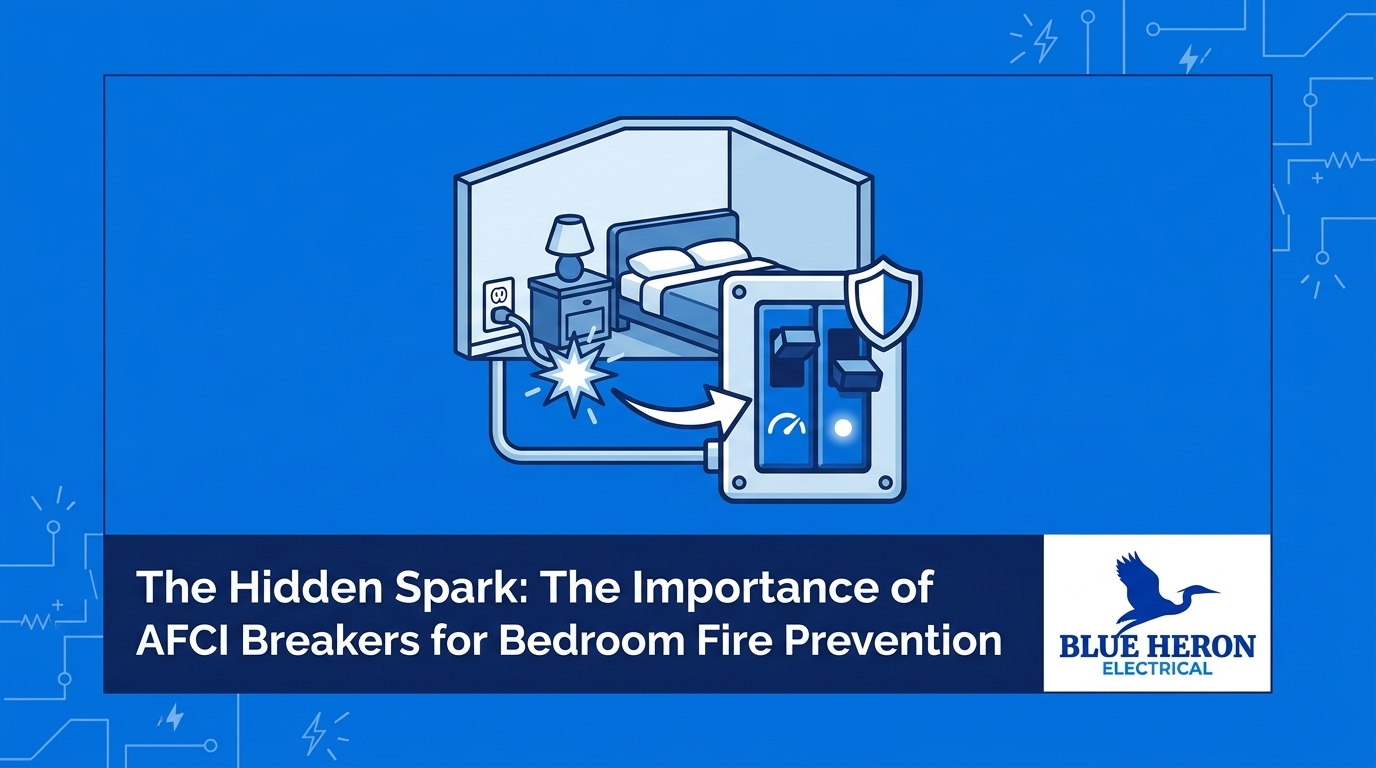
The Invisible Danger Behind Bedroom Walls
Understanding the importance of AFCI breakers for bedroom fire prevention is essential because when you flip a switch or plug in a charger, a silent hazard might be developing behind your drywall that standard panels simply cannot detect. Many homeowners rely on standard circuit breakers, mistakenly believing they are fully protected from all types of electrical fires. The truth is, traditional breakers are designed to catch large power overloads, but they completely ignore the erratic "spark signature" of a hidden arc fault. Recognizing this invisible danger is the first step in closing a critical safety gap in your home.
If you are concerned about aging electrical systems, exploring comprehensive residential electrical services and professional circuit breaker services in Sterling Heights can help protect your property.
Electrical arcing occurs silently behind drywall, making bedroom fires particularly dangerous. A stray nail from hanging a picture, a wire pinched by a bed frame, or simply aging insulation can create a tiny gap in your electrical wiring. When electricity jumps across that gap, it creates a miniature lightning bolt—an arc. Because this arc doesn't necessarily draw a massive amount of power, a standard breaker will not trip. It simply lets the spark continue burning.
According to the National Fire Protection Association (NFPA), electrical failures or malfunctions cause an average of 46,700 home fires annually. A significant portion of these originate in hidden spaces like bedroom walls. The purpose of this guide is to clarify the mechanical differences between traditional and modern breakers, and to explain why upgrading your panel is a critical safety decision that protects your home while you sleep.
Understanding the Mechanics: Overload vs. Arc Fault
To truly grasp why standard breakers leave your home vulnerable, you have to look at how they are built. Circuit breakers are mechanical gatekeepers. Their job is to monitor the flow of electricity and shut off the power when they detect a problem. However, the type of problem they are looking for makes all the difference.
The Anatomy of a Standard Breaker
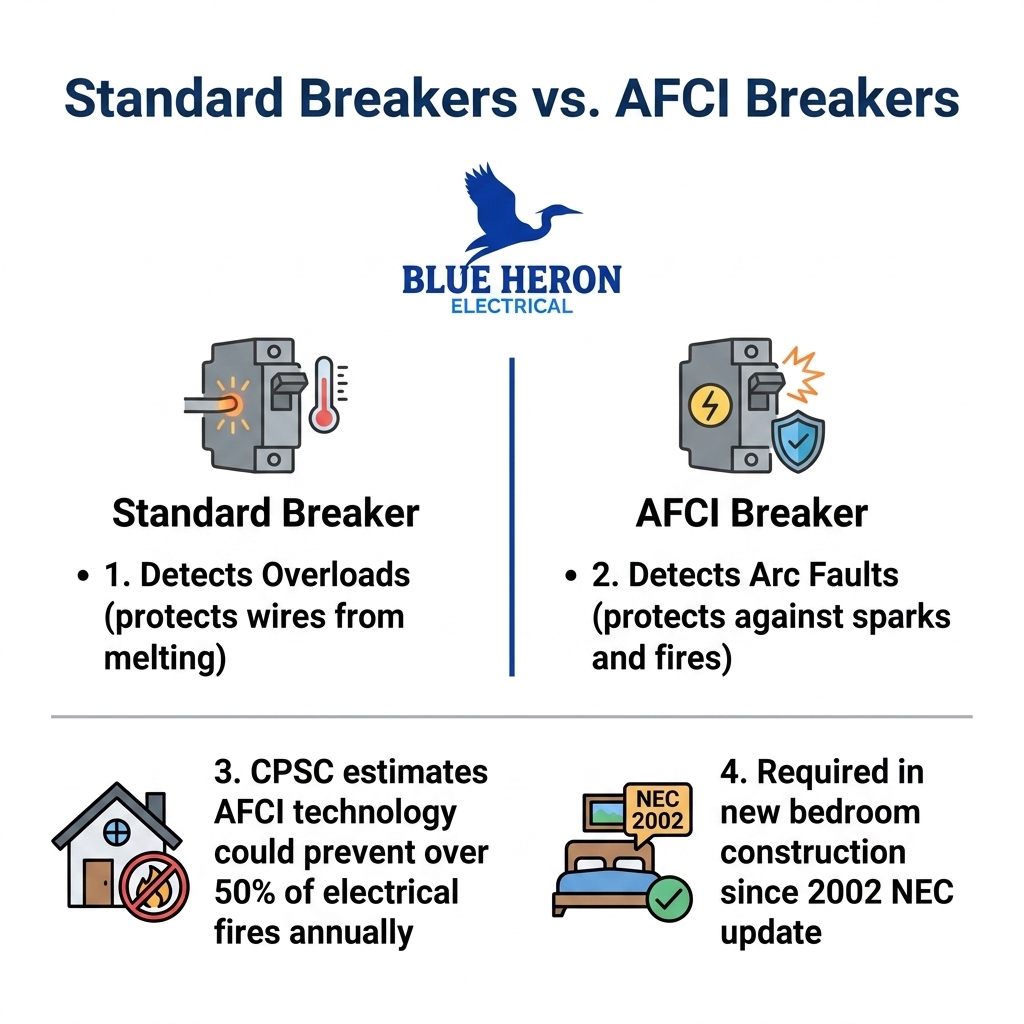
A standard circuit breaker provides overload protection. It uses a thermal-magnetic tripping mechanism to monitor the volume of electricity flowing through a wire. If you plug in a space heater, a vacuum cleaner, and a hair dryer on the same circuit, the wire will start to heat up because it is carrying more electrical current than it was designed to handle. The standard breaker detects this excessive heat or magnetic pull and trips, cutting the power before the wire melts.
At Blue Heron Electrical, we frequently remind homeowners that standard breakers miss low-amperage sparks. An arc fault might only draw a few amps of power—well below the threshold that would cause a standard 15-amp or 20-amp breaker to trip. The standard breaker assumes everything is fine, even as the spark generates intense heat inside your wall.
How AFCI Microprocessors Read the Circuit
An AFCI (Arc Fault Circuit Interrupter) breaker is fundamentally different. Instead of just measuring the volume of electricity, it analyzes the quality of the electrical current. An arc fault is an unintentional electrical discharge across a gap in a circuit, and it generates intense heat that often exceeds 10,000 degrees Fahrenheit.
AFCI breakers contain advanced microprocessors that constantly monitor the electrical waveform. They are looking for the specific "spark signature"—the erratic, jagged electrical pattern that occurs when electricity jumps a gap. Upon detecting this unique arc signature, the microprocessor triggers an instantaneous disconnection, shutting off the power before the 10,000-degree spark can ignite surrounding wood or drywall.
• Standard Breaker — Primary Function: Monitors electrical volume — What It Detects: Overloads and short circuits — What It Prevents: Wires melting from too much power
• AFCI Breaker — Primary Function: Monitors electrical waveforms — What It Detects: Dangerous sparking (arc faults) — What It Prevents: Electrical fires behind walls
• GFCI Breaker — Primary Function: Monitors current balance — What It Detects: Ground faults (water exposure) — What It Prevents: Electrical shocks to people
It is helpful to remember the distinction: AFCI technology prevents fires, while GFCI technology prevents shocks. Both are required for a fully protected home, but they serve entirely different purposes.
Why Bedroom Circuits Are Highly Vulnerable
Bedrooms present a unique set of electrical hazards that our electricians won't typically find in a kitchen or a hallway. The way we arrange furniture and use devices in sleeping areas creates the perfect storm for hidden arc faults.
Consider the most common bedroom hazards our team encounters. Beds and heavy dressers are frequently pushed tight against walls, pinching electrical cords plugged into low outlets. Over time, this constant pressure damages the protective casing around the cord, exposing the wiring. Additionally, bedrooms are prime locations for hanging pictures and mirrors, increasing the risk of a nail accidentally piercing a wire hidden behind the drywall.
The risk profile shifts significantly as the seasons change. The transition from summer cooling to late-summer back-to-school routines shifts electrical strain directly into bedrooms as families plug in more electronics. This late-summer back-to-school transition brings a massive surge in bedroom power consumption.
Here are the high-risk devices that increase the likelihood of arc faults in bedrooms:
1. Laptops and tablets: Often left charging on beds or pillows, where heat cannot dissipate properly.
2. Gaming systems: High-draw devices that are frequently left running for hours, often plugged into older power strips.
3. Multiple chargers: Daisy-chained extension cords used to power phones, smartwatches, and lamps from a single outlet.
4. Space heaters: Sometimes pulled out of storage on chilly late-summer nights, drawing massive continuous power through aging wall wires.
These specific loads increase the likelihood of arc faults because they combine high power demands with frequently moved, potentially damaged cords. Because bedrooms are where we sleep, a fire starting inside the wall at 2:00 AM is incredibly dangerous. This makes AFCI protection an absolute necessity in these spaces.
The Hidden Risks in Older Subdivisions
If you live in a newer build, your home likely already has AFCI protection. But for homeowners in older properties that predate modern electrical codes, the baseline risk of hidden arcing is significantly higher.
The National Electrical Code (NEC) is updated every three years to reflect new safety technologies. AFCI protection for bedrooms wasn't widely required by the NEC until the 2002 update. In our years of upgrading electrical systems across Macomb County, we've found that many older Sterling Heights subdivisions, built in the 1970s, 80s, and 90s, still operate on outdated panels that completely lack this modern safety feature.
Age plays a massive role in electrical safety. The wire insulation in older homes naturally degrades over decades of expanding and contracting with seasonal temperature changes. As the plastic sheathing becomes brittle and cracks, the exposed copper wires are much more likely to arc. When you combine aging wires with the heavy electronic loads of modern life, the risk multiplies.
One local homeowner realized the importance of modernizing their system during a winter renovation. They needed their older electrical panels updated to handle modern loads safely. Our professional team at Blue Heron Electrical updated the electrical panels, and the homeowner noted that the work went smoothly, leaving the home much safer and fully protected against unseen hazards.
Upgrading is a straightforward professional process, not a reason for panic. Understanding the common code violations in older Sterling Heights homes can help you make informed decisions about your property's safety without feeling overwhelmed.
Spotting the Warning Signs of an Arc Fault
Because arc faults happen behind walls or inside damaged cords, you cannot always see them. However, your electrical system will usually give you warning signs before a fire breaks out. Knowing what to look for allows you to call a professional before the situation becomes dangerous.
If you already have an AFCI breaker and it keeps tripping, do not assume the breaker is broken. In our field experience, an AFCI breaker that keeps tripping is usually doing its exact job by detecting a hazard. Attempting to swap a tripping AFCI breaker out with a standard breaker to "fix the nuisance" is extremely dangerous, as it removes the only line of defense against an active fire hazard.
Watch for these common signs of arcing in your bedroom circuits:
• Buzzing or crackling sounds: If you hear a faint buzzing coming from a wall outlet or light switch, that is the sound of electricity physically jumping a gap.
• Slight burning odors: A persistent, fishy, or metallic burning smell near an outlet means wire insulation is melting behind the wall cover.
• Flickering or dimming lights: If your bedroom lights flicker when a specific device (like a vacuum or gaming PC) is plugged in, the circuit is struggling to maintain a stable connection.
• Discolored wall plates: Brown or yellow scorch marks on outlet covers are a clear indicator that heat is building up inside the receptacle.
Diagnosing the exact source of an arc fault requires professional diagnostic tools. A licensed electrician can trace the circuit, locate the hidden damage, and repair the wiring safely. If you notice any of these symptoms, scheduling breaker repair in Royal Oak or your surrounding area is the safest next step.
Upgrading Your Panel for Proactive Safety
Transitioning from an outdated electrical system to a modern, AFCI-protected setup is one of the most impactful investments you can make in your home's safety. The process of updating an outdated panel involves removing the old breakers and bus bars, assessing the main service lines, and installing a modern panel equipped with advanced microprocessor breakers.
Blue Heron Electrical's commitment to proactive home safety and up-to-date code compliance ensures that families in older homes receive the highest standard of protection. Knowing your home's electrical system meets current safety codes provides immense peace of mind, especially when your family is asleep.
Another local homeowner we worked with dealt with outdated infrastructure recently. Their property still relied on an obsolete Pushmatic fuse panel and lacked proper house grounding. Our professional team swapped the fuse panel for a new one and grounded the house. The new panel was installed quickly with minimal home interruption, instantly bringing the property up to modern safety standards.
It is critical to note that panel upgrades and breaker replacements are strict professional-only jobs. The main service lines entering your panel carry enough raw amperage to cause severe injury or death. This is never a DIY project. Furthermore, a professional electrical panel safety upgrade often resolves multiple hidden issues in older homes at once—from ungrounded circuits and double-tapped breakers to insufficient capacity for modern appliances.
Frequently Asked Questions About AFCI Protection
Are AFCI breakers required in bedrooms?
Yes, modern National Electrical Code (NEC) requires AFCI protection for bedroom circuits to prevent fires. This requirement was first introduced in 2002 because bedrooms are high-risk areas for undetected electrical fires. If you are building a new home, adding an addition, or performing a major bedroom remodel, local building codes will legally require you to install AFCI breakers.
What is the difference between a regular breaker and an AFCI?
Regular breakers protect against overloads, while AFCI breakers detect dangerous sparking and arcing. A standard breaker shuts off power when too much electricity flows through a wire, preventing the wire from melting. An AFCI uses a microprocessor to monitor the electrical waveform, instantly shutting off power if it detects the jagged "spark signature" of electricity jumping a gap.
Why does my AFCI breaker keep tripping?
It is likely detecting a genuine arc fault, such as a damaged cord or loose connection, and should be inspected by a professional. While older generations of AFCI breakers occasionally experienced "nuisance tripping" from certain appliances, modern units are highly accurate. If it trips repeatedly, it is doing its job by protecting you from a hidden fire hazard.
Can I replace a standard breaker with an AFCI myself?
No, panel work requires a licensed electrician to ensure code compliance and safety. Working inside an electrical panel exposes you to the main service bus, which remains energized even if the main breaker is turned off. A professional has the diagnostic tools to install the breaker safely and verify that the circuit is functioning correctly.
Do older homes need AFCI breakers?
While not always legally mandated unless remodeling, upgrading is highly recommended due to aging wire insulation. The Consumer Product Safety Commission (CPSC) estimates that AFCI technology could prevent more than 50% of the electrical fires that occur every year. Adding them to an older home is a proactive safety measure that protects against decades of unseen wire degradation.
Taking the Next Step Toward a Safer Home
AFCI technology serves as a vital, active line of defense against invisible electrical fires. While standard breakers do an excellent job of preventing your wires from melting under heavy loads, they simply cannot see the sparks that start fires behind your drywall. Understanding the "spark signature" and how modern microprocessors detect it empowers you to make informed, proactive safety upgrades.
A clear, jargon-free understanding of how AFCI technology detects hidden wall sparks validates the necessity of a professional upgrade. You don't have to wait for a breaker to fail or a burning smell to appear before taking action. We encourage you to consult with a local expert to evaluate your current panel, assess the age of your wiring, and explore protective options. Upgrading to AFCI breakers is a straightforward process that delivers lasting peace of mind, ensuring your home remains a safe environment for your family night after night.
Customer Testimonials

Service Areas