

Why Holiday Lights Melt Timer Switches: The Hidden Dangers of Continuous Loads
The Hidden Fire Hazard in Your Holiday Lighting Display
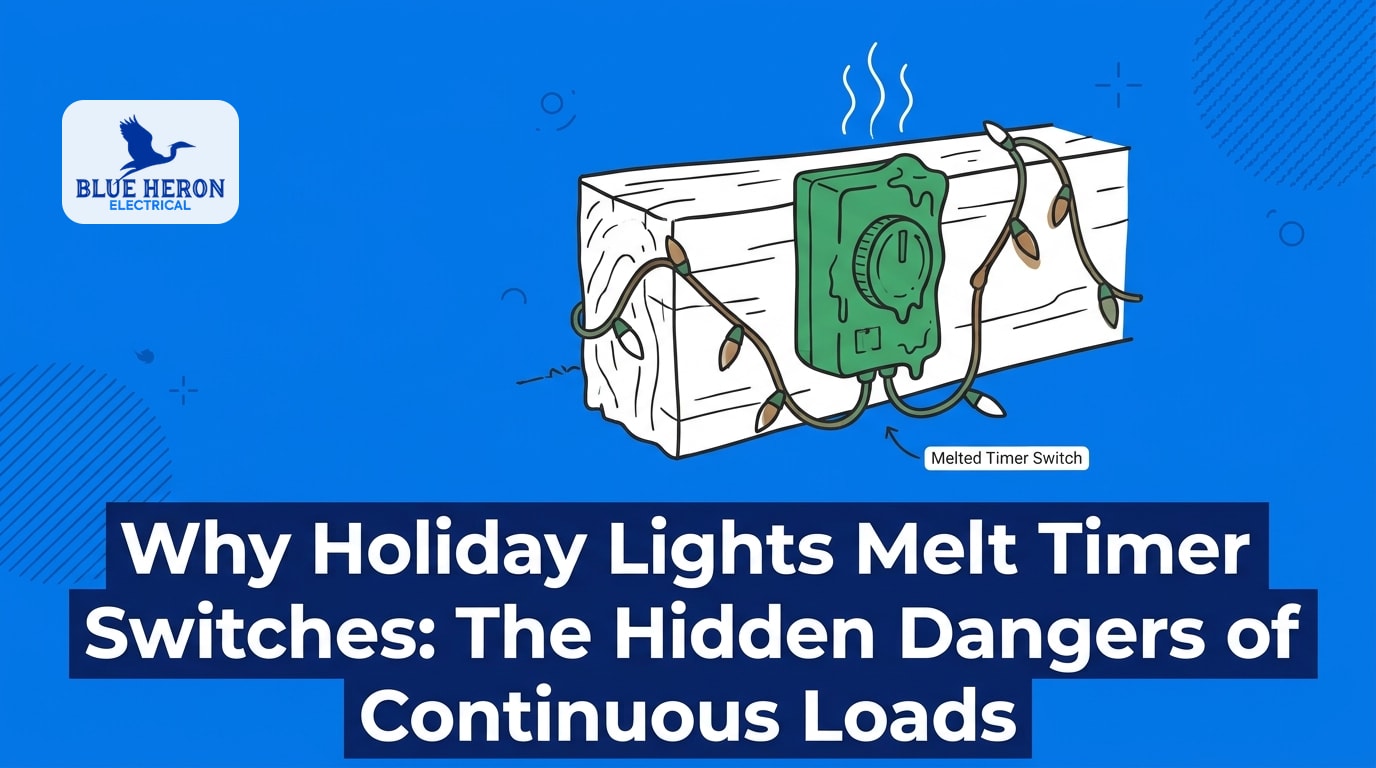
If you are wondering why holiday lights melt timer switches just as the first frost of the season settles in, you are not alone. November holiday prep is in full swing across neighborhoods, and you spend hours stringing up hundreds of bulbs, carefully arranging displays, and running extension cords to make sure everything looks perfect. But a few weeks later, you walk outside to a terrifying sight: the plastic housing on your outdoor timer is warped, scorched, or completely melted. This is not just a case of a defective piece of plastic; it is a symptom of a severe, underlying electrical overload.
Finding a distorted timer switch is a clear warning sign that your temporary exterior setup has reached a dangerous limit. While it is easy to assume that any timer bought at a hardware store can handle whatever you plug into it, the reality is much more complex. When you connect massive strings of lights, inflatable decorations, and illuminated figures into a single mechanical timer, you are pushing consumer-grade electronics to their absolute breaking point.
To keep your home safe, you need to recognize when standard temporary setups are no longer adequate. Upgrading to professional lighting solutions is often the best way to prevent these hidden fire hazards from threatening your property. Understanding the electrical forces at play is the first step in making the right decision for your exterior displays.
How Electrical Resistance Turns Timers into Fire Hazards
To understand why a timer melts, you have to look at the physics of electrical resistance. Whenever electricity flows through a material, it encounters resistance, and that resistance generates heat. In a perfectly wired, heavy-duty circuit, this heat is negligible and safely dissipates. However, cheap mechanical timers are built with lightweight internal contacts that are not designed to handle heavy, continuous power draws.
The problem of micro-arcing: Inside your timer switch, small metal contacts physically open and close to control the flow of electricity. Over time, or when overloaded, these connections can become slightly loose or corroded. When electricity jumps across a microscopic gap in a loose connection, it creates a phenomenon known as micro-arcing. This arcing generates an immense amount of localized heat, far more than the surrounding materials are designed to withstand.
Why the breaker doesn't trip: One of the most dangerous aspects of a melting timer is that it often happens without tripping your home's circuit breaker. Circuit breakers are designed to trip during a sudden short circuit or a massive overcurrent (like pulling 25 amps on a 15-amp circuit). However, a loose connection inside a timer might only be pulling 14 amps. Because this is technically under the breaker's absolute limit, the breaker stays on, allowing the timer to slowly overheat over several hours until it catches fire. If you ever smell burning plastic near an outlet, you should disconnect the power immediately and look into emergency electrical services to ensure the receptacle itself hasn't been permanently damaged.
The Breaking Point of Thermoplastics
Most consumer-grade timers are housed in standard thermoplastics. These materials are cost-effective and easy to manufacture, but they have relatively low melting points. When continuous load amperage limits are pushed to the maximum, the internal metal contacts heat up like the coils in a toaster.
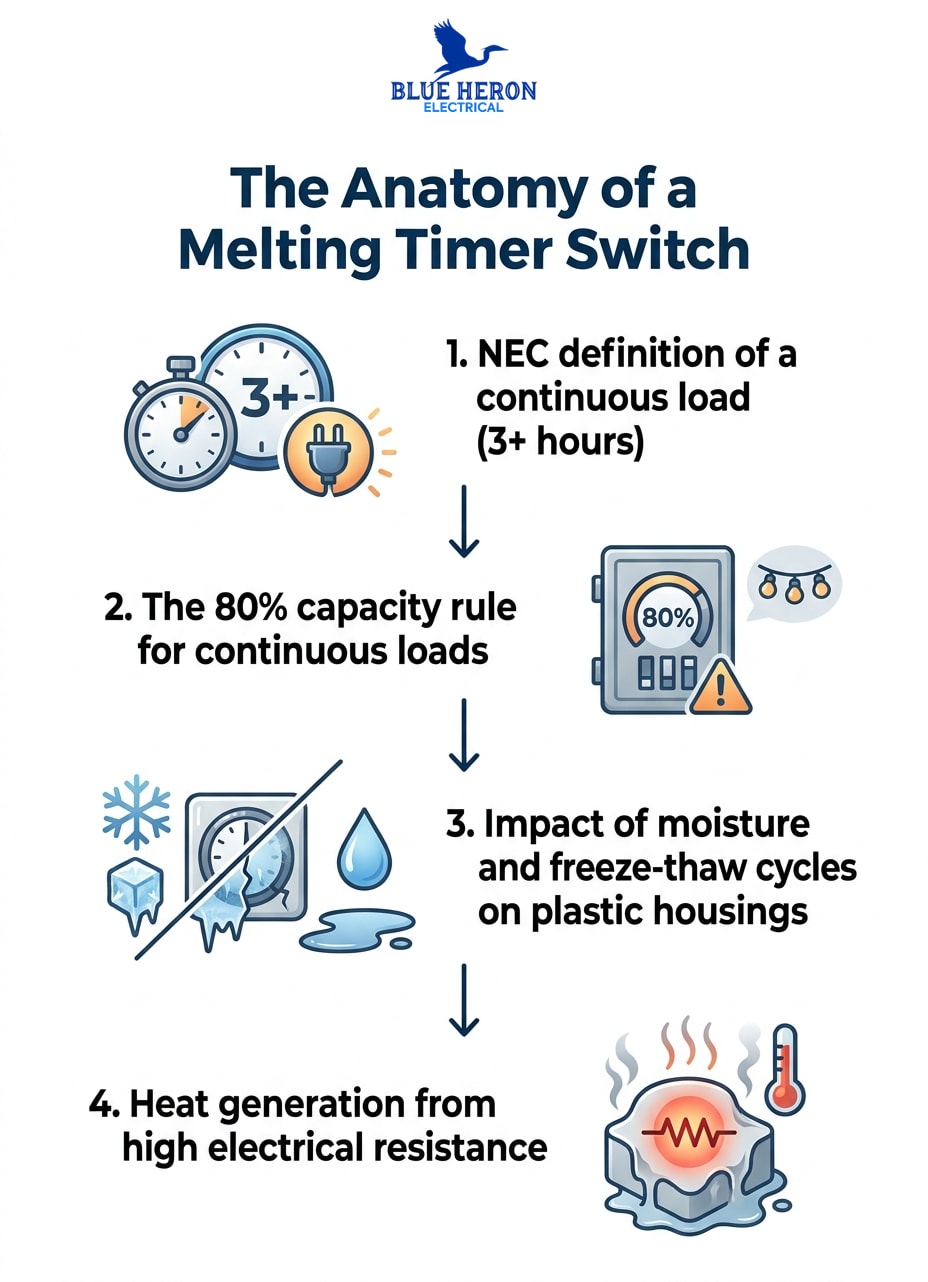
Once the temperature inside the timer exceeds the thermal limit of the plastic housing—often around 160°F to 200°F—the plastic begins to soften, warp, and eventually melt. As the housing loses its structural integrity, the internal components shift, making the loose connections even worse. This creates a dangerous feedback loop: more resistance creates more heat, which causes more melting, eventually leading to a complete electrical failure or a fire.
Understanding the 3-Hour Continuous Load Rule
The primary culprit behind melting timers is a misunderstanding of how electrical ratings work over long periods. The National Electrical Code (NEC) has specific guidelines to prevent exactly this type of thermal breakdown, and it all revolves around the concept of a "continuous load."
According to NEC Article 210.20(A), a continuous load is defined as any electrical load where the maximum current is expected to continue for three hours or more. Because almost all holiday lighting displays run from dusk until late into the night, they easily qualify as continuous loads. When dealing with continuous loads, you cannot safely use 100% of a device's rated capacity.
The 80% Rule in action:
1. Identify the rating: Look at the back of your outdoor timer. Most standard residential timers are rated for 15 amps.
2. Apply the continuous load limit: Because the lights will be on for more than three hours, the NEC dictates that you must restrict the load to 80% of the device's maximum rating.
3. Calculate the safe capacity: 80% of 15 amps is exactly 12 amps. Therefore, a 15-amp timer can only safely handle 12 amps of continuous holiday lighting.
4. Factor in the surge: Incandescent lights and certain LED drivers can pull a slight surge of power when first turned on. If your display is already hovering at 13 or 14 amps, this surge, combined with hours of runtime, guarantees that the timer will overheat.
It is incredibly easy for a large display of lights, motorized inflatables, and spotlights to surpass this hidden 12-amp limit. When you ignore continuous load amperage limits, the excess current generates the slow, sustained heat that eventually melts the timer switch into a puddle of plastic.
Why Freezing Rain and Snow Accelerate Electrical Failures
Electrical overloads are only half of the equation. The environment where these timers operate plays a massive role in their eventual failure. As you finalize your November holiday prep, it is crucial to account for the harsh realities of the upcoming season.
The impact of Michigan winter conditions: Here at Blue Heron Electrical, our team frequently responds to winter service calls across Sterling Heights where exterior electrical connections have taken a severe beating from the elements. Freezing rain, heavy snow accumulation, and brutal freeze-thaw cycles directly assault the integrity of temporary outdoor electrical setups. When a cheap plastic timer is left exposed to freezing temperatures, the housing becomes brittle. As the internal components heat up from the electrical load, the plastic expands. When the lights turn off and the timer rapidly cools in the freezing air, the plastic contracts. Over several weeks, this constant expansion and contraction causes microscopic cracks to form in the casing.
Moisture ingress and conductivity: Once those cracks form, melting snow and freezing rain seep into the timer's internal circuitry. Water is an excellent conductor of electricity. When moisture bridges the gap between the internal metal contacts, it creates high-resistance electrical faults. Instead of electricity flowing cleanly through the designated metal path, it struggles through the moisture, generating intense, localized heat.
Furthermore, water causes the internal copper and brass components to corrode rapidly. Corroded contacts have higher electrical resistance than clean metal. When you combine a continuous heavy electrical load with corroded, wet contacts subjected to freezing weather, the timer is practically guaranteed to overheat and melt.
The Danger of Using the Wrong Timer for Exterior Displays
One of the most common mistakes homeowners make is grabbing whatever timer they have in the garage and forcing it into outdoor service. Not all timers are created equal, and using an indoor-rated timer for an exterior display is a recipe for disaster.
Many consumers see a timer with a three-prong plug and assume it is safe for heavy-duty use. However, an "outdoor-rated" designation means something very specific. It is not just about having a slightly thicker plastic shell; it is about weatherproofing, grounding, and the ability to handle continuous load amperage limits safely.
• Weather Resistance — Indoor-Rated Timers: None. Casing is vented and vulnerable to moisture and dust. — Outdoor-Rated Timers: Sealed housings, often with protective covers for the outlets.
• Amperage Capacity — Indoor-Rated Timers: Typically 10 to 15 amps, designed for lamps and small electronics. — Outdoor-Rated Timers: Often rated for 15 to 20 amps, built with heavier internal contacts.
• Temperature Tolerance — Indoor-Rated Timers: Designed for climate-controlled rooms (60°F - 80°F). — Outdoor-Rated Timers: Engineered to withstand freezing temperatures and UV exposure.
• Typical Use Case — Indoor-Rated Timers: Living room lamps, indoor Christmas trees, small fans. — Outdoor-Rated Timers: Exterior holiday displays, block heaters, landscape lighting.
Relying on cheap, light-duty hardware store timers for extensive, high-amperage displays puts your property at risk. Always check the equipment ratings stamped on the back of the device before plugging anything in. If the timer does not explicitly state that it is rated for outdoor use and heavy-duty continuous loads, it does not belong in your yard.
Why Daisy-Chaining Extension Cords Overwhelms Your Equipment
Even if you purchase a high-quality, outdoor-rated timer, the way you connect your lights can still cause it to melt. The most hazardous practice in holiday decorating is daisy-chaining—plugging one extension cord into another, and then another, to reach the far corners of your property.
The physics of voltage drop: Extension cords have their own electrical resistance. The longer the cord, the higher the resistance. When you daisy-chain multiple cords together, the voltage traveling from the outlet to the final string of lights drops significantly. Because the lights and inflatables still require a specific amount of wattage to operate, a drop in voltage forces the equipment to pull more electrical current (amperage) to compensate.
Increased heat at the source: As the amperage draw increases due to voltage drop, all of that excess current must pass through the single timer switch plugged into the wall. This pushes the timer past its continuous load amperage limits, generating excessive heat at the plug and internal contacts.
The compounding risk of connections: Every time you plug two cords together, you introduce a new connection point that can loosen, corrode, or take on water. Adding more cords does not increase the safe capacity of the source timer; it actually makes the entire system more strained and volatile. Instead of relying on a web of dangerous cords spread across the freezing ground, many homeowners find that installing dedicated exterior soffit outlets for holiday lighting provides a much safer, cleaner, and more reliable way to power roofline displays.
Upgrading to Dedicated Exterior Circuits for Safe Displays
The ultimate solution to melting timers and overloaded extension cords is not to buy a slightly more expensive plastic timer. The safest approach is to upgrade your home's electrical infrastructure to handle the demand properly. As our experienced electricians at Blue Heron Electrical often remind our Sterling Heights customers, prioritizing safety-first, code-compliant exterior power solutions is always better than relying on risky DIY extension cord setups.
The benefits of dedicated circuits: A dedicated exterior circuit is an electrical line that runs directly from your main breaker panel to a specific outdoor location, without sharing power with your living room, garage, or kitchen. Because the circuit is dedicated, it is properly sized for continuous loads. It utilizes heavy-gauge copper wiring and commercial-grade receptacles that will not melt under the strain of a 12-hour lighting display.
Professionally installed soffit outlets: One of the most effective upgrades for holiday lighting is the installation of soffit outlets. These are receptacles installed securely under the eaves of your roof. They keep connections elevated, dry, and entirely protected from snow and freezing rain. Furthermore, these outlets can be hardwired to smart switches inside your home, completely eliminating the need for bulky, unreliable outdoor plug-in timers.
Attempting DIY electrical modifications to fix tripping breakers or melting timers is incredibly dangerous. When you are dealing with continuous load amperage limits and exterior weatherproofing, it is always best to consult a licensed professional for residential electrical upgrades. A professional can ensure your new circuits meet all NEC requirements and are perfectly sized for your specific lighting ambitions.
Frequently Asked Questions About Holiday Lighting Safety
Why is my outdoor timer melting?
Your outdoor timer is melting because it is being subjected to an electrical load that exceeds its safe continuous capacity, creating high internal resistance. When a timer operates at maximum capacity for several hours, the internal metal contacts heat up significantly. If moisture from rain or snow has also compromised the unit, this resistance increases, generating enough heat to melt the thermoplastic housing.
How many holiday lights can you safely plug into a timer?
You can safely plug in a number of lights that draws no more than 80% of the timer's total amperage rating. For a standard 15-amp timer, this means your total load should not exceed 12 amps for continuous use. You must check the wattage or amperage tags on your specific light strings and add them together to ensure they stay below this threshold.
Can a timer switch catch fire?
Yes, a timer switch can absolutely catch fire if it is overloaded, damaged by weather, or suffering from loose internal connections. The heat generated by micro-arcing inside the switch can easily exceed the ignition point of the surrounding plastic and nearby dry debris. This is why it is critical to use properly rated outdoor equipment and avoid daisy-chaining cords.
Are outdoor timers safe in the snow and rain?
Outdoor-rated timers are designed to resist moisture, but they are not entirely waterproof or immune to severe weather degradation. Over time, freeze-thaw cycles can crack the plastic housing, allowing snow and rain to seep into the electrical contacts. To maximize safety, outdoor timers should be kept elevated off the ground and shielded from direct precipitation whenever possible.
What is the 80% continuous load rule for holiday lights?
The 80% continuous load rule is an electrical code standard stating that any load running for three hours or more should only utilize 80% of a circuit's or device's maximum capacity. Because holiday lights are typically left on for many hours at a time, they generate sustained heat. Restricting the load to 80% prevents the wiring and timer switches from overheating and failing.
How do I know if my holiday lights are overloading the circuit?
Signs of an overloaded circuit include tripping breakers, flickering lights, warm extension cords, and a burning plastic smell near your outlets or timers. If you touch your outdoor timer and it feels hot to the touch, or if you notice the plastic beginning to warp, you are pulling too much current. You should immediately disconnect the lights and redistribute the load to other circuits.
Ensure Your Holiday Display Shines Safely This Season
Finding a melted timer switch in your yard is a serious warning sign that your current electrical setup is overloaded and vulnerable to the elements. The combination of heavy continuous electrical loads and harsh winter weather creates the perfect storm for equipment failure and fire hazards. Standard plastic timers are simply not built to handle the strain of massive, daisy-chained exterior displays.
As you finalize your November holiday prep, take the time to evaluate your power situation before the peak of the freezing season hits. Proactive safety measures are essential to protecting your home. Do not wait for a melted timer to cause a larger electrical emergency; reach out for professional guidance to install safe, dedicated outdoor power solutions so your display can shine safely all season long.
Customer Testimonials

Service Areas