
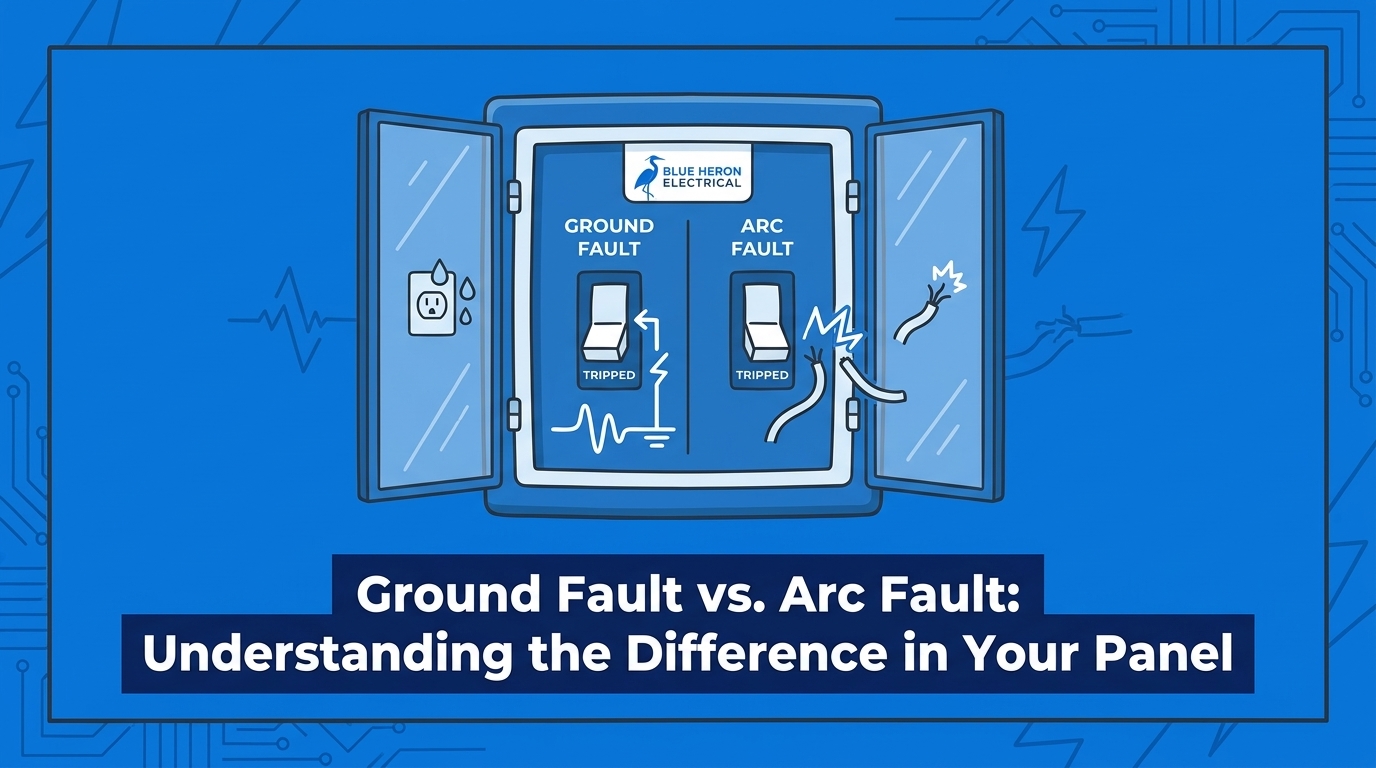
Ground Fault vs. Arc Fault: Understanding the Difference in Your Panel
Decoding the Mystery of Tripping 'Test' Breakers
Ground Fault vs. Arc Fault: Understanding the Difference in Your Panel is the first step to take when you open your electrical box and find a tripped breaker with a mysterious "test" button. At Blue Heron Electrical, we know how frustrating it is to deal with a breaker that keeps tripping, leaving you in the dark and wondering if your home has a serious electrical problem or just a sensitive switch.
Most standard circuit breakers are designed with one simple goal: protecting your home's wiring from overheating. If you plug too many heavy appliances into a single circuit, the standard breaker trips to prevent the wires inside your walls from melting. However, breakers equipped with "test" buttons are entirely different. These are specialized safety devices engineered specifically to protect human life and property from catastrophic hazards.
As the weather shifts into the early fall pre-heating season, households typically begin plugging in more devices, testing out space heaters, and turning on additional indoor lighting. During this transition, our service technicians notice these highly sensitive safety breakers may trip more frequently. This is not necessarily a malfunction; it is often the breaker doing exactly what it was designed to do.
To make sense of your home's safety infrastructure, you need to know how these devices operate. Upgrading or maintaining electrical panels requires a clear understanding of the life-safety differences between Ground Fault Circuit Interrupters (GFCI) and Arc Fault Circuit Interrupters (AFCI). We will break down these two vital technologies without getting bogged down in confusing engineering jargon, so you can make informed decisions about your family's safety.
GFCI Breakers: Your First Line of Defense Against Electrical Shock
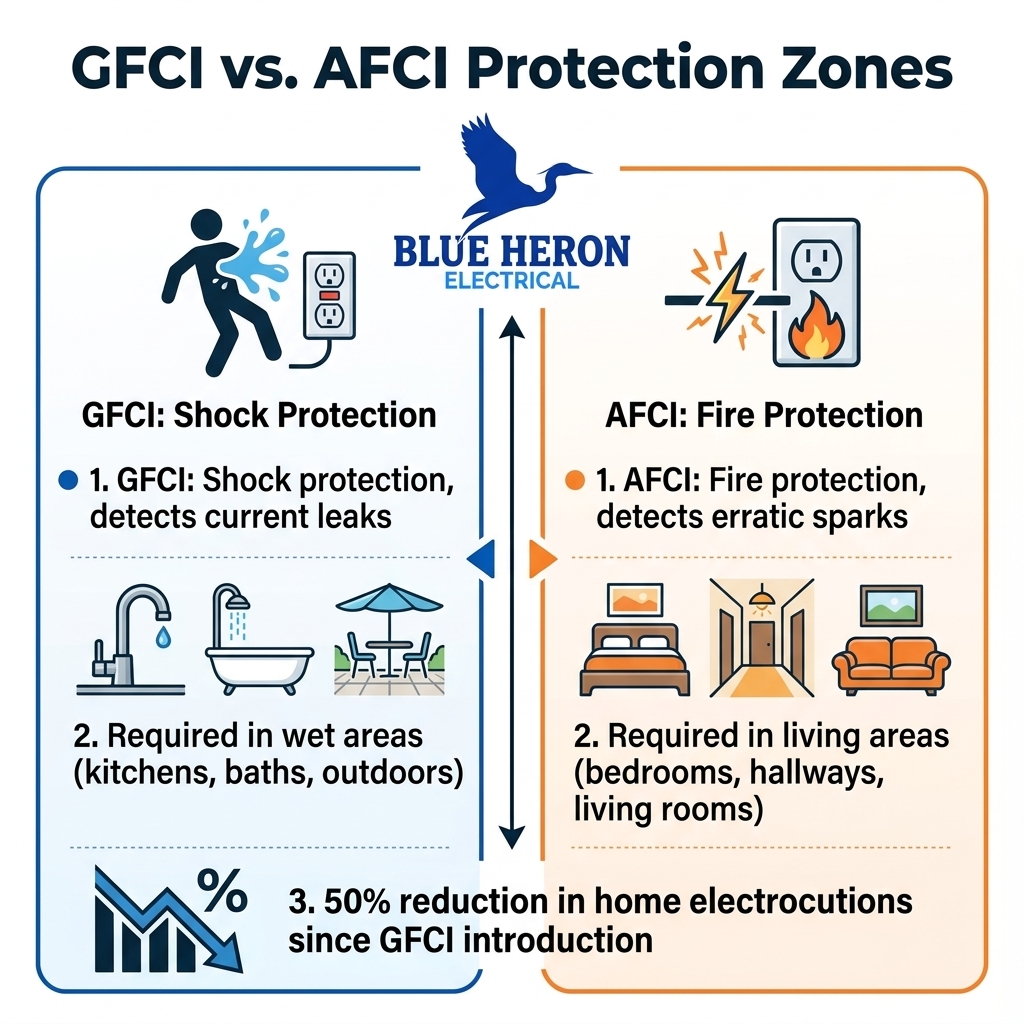
A Ground Fault Circuit Interrupter (GFCI) is a high-tech safety device designed to detect minute imbalances in electrical current. Under normal conditions, the electricity flowing out to an appliance should perfectly match the electricity flowing back. If a GFCI breaker detects even a tiny fraction of a difference—as little as four to five milliamps—it assumes that the missing current is leaking somewhere dangerous, such as through water or, worst of all, through a person.
The primary purpose of a GFCI is strict shock protection. By shutting off the power in a fraction of a second, a GFCI prevents severe injuries and electrocutions in environments where water and electricity frequently mix. The Consumer Product Safety Commission (CPSC) estimates that GFCIs have successfully reduced home electrocutions by roughly 50 percent since their widespread introduction.
Because their job is to prevent water-related shocks, GFCI protection is strictly required in specific zones around your home. You will typically find GFCI breakers protecting the following areas:
• Kitchens: Any outlet serving the countertop areas near the sink requires protection.
• Bathrooms: All receptacles near sinks, tubs, and showers must be on a GFCI circuit.
• Garages and unfinished basements: These areas are prone to dampness and concrete floors, which act as a direct path to ground.
• Outdoor receptacles: Our electricians at Blue Heron Electrical know firsthand that Sterling Heights MI experiences wet, humid summers and wet falls. We constantly remind our customers that the integrity of outdoor GFCI outlets is critical for year-round safety against the elements.
While you might be familiar with the GFCI outlets that have built-in reset buttons on the wall, many modern homes utilize GFCI breakers installed directly inside the main electrical panel. This provides blanket shock protection for the entire circuit from the source, rather than just at a single outlet.
AFCI Breakers: Guarding Your Home Against Hidden Electrical Fires
While GFCIs protect people from shock, an Arc Fault Circuit Interrupter (AFCI) protects the physical structure of your home from hidden fires. An AFCI is an advanced device that constantly monitors the electrical waveform on a circuit, looking for the erratic, chaotic sparking patterns associated with dangerous electrical arcs.
An electrical arc occurs when electricity jumps across a gap in a damaged wire or a loose connection. This sparking generates immense heat—often exceeding 10,000 degrees Fahrenheit—which can easily ignite surrounding wood framing or insulation inside your walls. According to the National Fire Protection Association (NFPA), electrical failures or malfunctions are a leading cause of home electrical fires. AFCIs are engineered specifically to detect these hidden hazards and cut the power before a fire can start.
Because arcs usually occur in damaged cords or compromised wiring, AFCI protection is targeted at living spaces where cords might be pinched by furniture or where wiring might be accidentally pierced by a nail. Common zones for AFCI protection include:
• Bedrooms: The most critical area for fire protection, as residents are asleep and vulnerable.
• Living rooms and family rooms: Areas with high concentrations of entertainment systems, lamps, and extension cords.
• Hallways and dining rooms: General living areas where electrical cords are frequently routed behind furniture.
Seasonal shifts dramatically increase the risk of arc faults. Freezing winters drive the use of portable space heaters, which pull heavy continuous loads. Pushing these heavy loads through aging or compromised wiring can expose hidden electrical arcs in living spaces. During the early fall pre-heating season, as families pull these heating appliances out of storage, our service calls for tripped breakers often spike. We have seen exactly how AFCI protection becomes absolutely vital in these moments for preventing catastrophic home fires.
Ground Fault vs. Arc Fault: A Direct Comparison
Understanding the distinction between these two safety devices is crucial for troubleshooting your panel. While both breakers feature a "test" button and look similar at first glance, their internal mechanisms and primary goals are entirely different.
Here is a direct breakdown of how these essential safety devices compare:
• Primary hazard prevented: A GFCI stops electrical shocks; an AFCI stops electrical fires.
• Trigger mechanism: A GFCI trips when it detects current leaking to the ground; an AFCI trips when it detects erratic, high-heat sparking patterns.
• Typical locations: GFCIs are installed in wet and damp areas; AFCIs are installed in dry living and sleeping areas.
• Historical context: The National Electrical Code (NEC) has required GFCIs since 1971 for outdoor areas, while AFCIs were first required in 1999 specifically for bedrooms.
To make the differences even clearer for homeowners in Sterling Heights MI, reference the comparison table below:
• Core Purpose — GFCI (Ground Fault): Life safety (Shock prevention) — AFCI (Arc Fault): Property safety (Fire prevention)
• What It Detects — GFCI (Ground Fault): Current leaking out of the intended path — AFCI (Arc Fault): Sparking or arcing from damaged wires
• Where It Is Required — GFCI (Ground Fault): Kitchens, baths, outdoors, garages — AFCI (Arc Fault): Bedrooms, living rooms, hallways
• Common Triggers — GFCI (Ground Fault): Water exposure, damaged appliances — AFCI (Arc Fault): Pinched cords, loose wall connections
Why Is My Safety Breaker Tripping?
One of the most common frustrations homeowners face is a safety breaker that refuses to stay on. When an AFCI or GFCI breaker trips, it is important to differentiate between a breaker doing its job (tripping due to a real, dangerous fault) and a failing breaker that needs replacement.
Repeatedly resetting a tripping safety breaker is incredibly dangerous. If the breaker is tripping because of an active electrical arc or a ground fault, forcing it back on simply ignores the underlying hazard and re-energizes a dangerous situation. Instead of forcing the breaker, you should follow a safe troubleshooting baseline. Start by unplugging every single device on the affected circuit. Once everything is unplugged, try resetting the breaker one time. If it stays on, begin plugging your devices back in one by one. If the breaker trips immediately when you plug in a specific lamp or vacuum, you have likely found the culprit—the appliance itself is faulty, not your electrical system.
A pattern we see often at Blue Heron Electrical involves unexplained breaker tripping as homeowners prepare for the cooler months. Recently, our team responded to a local homeowner dealing with this exact frustration. We focused on educating the customer on all their options, completing the necessary diagnostic work efficiently so they understood exactly how their system was protecting them. We emphasize a strict commitment to up-to-date code compliance and life-safety, prioritizing thorough education on electrical issues so our customers never feel left in the dark.
If the elimination method does not solve the problem, it is time to stop troubleshooting. Opening the electrical panel or attempting to replace a breaker yourself is strictly a job for a licensed professional. Professional circuit breaker services ensure the root cause is diagnosed safely and accurately.
When to Call a Licensed Electrician
You should immediately stop troubleshooting and contact a professional if you experience any of the following warning signs:
• Immediate tripping: If the breaker trips immediately upon reset with absolutely nothing plugged into the circuit, you likely have a wiring fault hidden inside your walls.
• Heat and odor: If the breaker itself feels hot to the touch, looks scorched, or emits a faint burning odor, leave it off and call for help immediately.
• Failed test button: If you press the "test" button on the breaker and it fails to trip, the internal safety mechanism has broken down, and the breaker must be replaced by a professional.
Updating Older Electrical Panels for Modern Code Compliance
Understanding safety breakers naturally leads to a common realization: many older homes completely lack these crucial safety features. If your home was built before the late 1990s, it likely lacks AFCI protection entirely, as the technology was not yet mandated. Furthermore, older homes may have very limited GFCI protection, leaving critical wet areas vulnerable to shock hazards.
For example, our crew recently worked with a homeowner in an older Sterling Heights property who needed a new breaker panel and a generator hook-up. We provided multiple compliance options and completed all tasks efficiently, ensuring the older home was brought up to modern safety standards. Upgrading an older panel not only improves your daily safety but ensures the home meets current National Electrical Code (NEC) standards, which is vital for both peace of mind and future property sales.
Modern electrical advancements also offer dual-function breakers. These innovative devices provide both AFCI and GFCI protection in a single unit. Dual-function breakers are incredibly useful for circuits that require both types of protection, such as a dishwasher circuit in a kitchen, where you need to guard against water-related shocks and hidden motor arcs simultaneously.
Any panel modification, whether adding a few safety breakers or performing comprehensive panel changes, requires professional assessment. An electrician must evaluate your system's total load capacity, verify that your home's neutral wiring is compatible with sensitive safety breakers, and ensure everything is installed to code. Homeowners often wonder, does a panel upgrade require an inspection and permit in Michigan? The answer is always yes, because strict oversight guarantees that your family's life-safety devices will function flawlessly when an emergency strikes.
Securing Your Home's Electrical Infrastructure
Ultimately, GFCI and AFCI breakers are non-negotiable life-safety devices. They stand between your family and the very real dangers of electrical fires and severe shocks. Understanding the basic differences in your panel is the first step in protecting your property as you head into the early fall pre-heating season.
If you live in an older home, or if you simply are not sure what kind of protection is currently installed in your electrical box, do not wait for a breaker to start tripping to find out. Our team at Blue Heron Electrical encourages homeowners to have their panels professionally inspected to verify their current protection levels. Investing in professional residential electrical services ensures that your home remains a safe, comfortable, and fully protected environment for years to come.
Frequently Asked Questions
What is the exact difference between arc fault and ground fault breakers?
The exact difference lies in the hazard they prevent. Ground fault (GFCI) breakers protect people from fatal electrical shocks by detecting current leaking to the ground, usually near water. Arc fault (AFCI) breakers protect your property from electrical fires by detecting erratic sparking behind walls or at loose connections.
Do I really need both AFCI and GFCI protection in my home?
Yes, both types of protection are essential and required by modern electrical codes. They serve entirely different life-safety purposes and protect different areas of your home. You need GFCIs in wet areas to prevent shocks, and AFCIs in living areas to prevent hidden fires.
Why does my arc fault breaker keep tripping when I plug in the vacuum?
An arc fault breaker may trip when you plug in a vacuum because the internal motor of the vacuum creates natural sparking as it runs. If the vacuum is older or the motor is wearing out, the AFCI breaker interprets those sparks as a dangerous electrical arc and shuts off the power to prevent a fire.
Can I replace a tripping arc fault breaker with a standard breaker?
No, you should never replace a tripping arc fault breaker with a standard breaker. Doing so removes critical fire protection from that circuit and violates the National Electrical Code. If an AFCI breaker is tripping, it is either detecting a real fire hazard or the breaker itself has failed and needs professional replacement.
How often should I press the test button on my safety breakers?
You should press the test button on your safety breakers once a month to ensure their internal mechanisms are still functioning. When you press the button, the breaker should immediately trip and cut the power. If it does not trip, the safety feature has failed and requires immediate professional attention.
Are dual-function AFCI/GFCI breakers required by the NEC?
Dual-function AFCI/GFCI breakers are heavily utilized to meet NEC requirements in specific areas that demand both fire and shock protection. For example, modern codes often require both types of protection for kitchen dishwasher circuits and laundry areas. Using a dual-function breaker is the most efficient way to achieve full compliance in these zones.
Customer Testimonials

Service Areas