

Dimmer Switch Buzzing: Causes and Compatibility Fixes
Preparing for Shorter Days: The Sudden Annoyance of a Buzzing Dimmer
If you are tired of your lighting fixtures making noise as the days grow shorter, understanding Dimmer Switch Buzzing: Causes and Compatibility Fixes is likely exactly what you need. At Blue Heron Electrical, our team fields a surge of calls about this very issue every September, as Michigan loses approximately two to three minutes of daylight every single day. As we approach these shorter days and the transition into long winters, early sunsets drastically increase our reliance on artificial lighting. Upgrading your home's bulbs to energy-efficient LEDs is a smart, proactive move—they use up to 90% less energy and last significantly longer than traditional bulbs. However, this common early-fall upgrade frequently results in a loud, frustrating hum coming directly from the wall switch.
You screw in the new bulbs, flip the switch to enjoy your brightened living room, and instead of a quiet evening, you are greeted by an irritating electrical buzz. This leaves many homeowners wondering if they bought defective bulbs or if something is seriously wrong behind the drywall. Understanding why this buzzing happens is the first step in deciding when to call for professional indoor lighting upgrades rather than simply returning the bulbs to the hardware store.
The core problem: A modern lighting upgrade often clashes with outdated electrical hardware. When you mix new digital lighting technology with older analog wall switches, the resulting electrical mismatch creates physical vibrations that you hear as a hum. As you prepare your home for the darker months ahead, resolving this noise is about more than just peace and quiet—it is about ensuring your electrical system is operating safely and efficiently.
The Primary Cause: Incompatible LED Bulbs and Legacy Dimmers
The fundamental reason your newly upgraded lighting is making noise comes down to a clash of generations. To understand the root cause of the buzzing, you have to look at how different types of light bulbs consume electricity. Traditional incandescent bulbs rely on simple, raw resistance, which older dimmers were specifically designed to handle. Modern LED bulbs, on the other hand, contain complex digital drivers that require a completely different type of electrical current delivery.
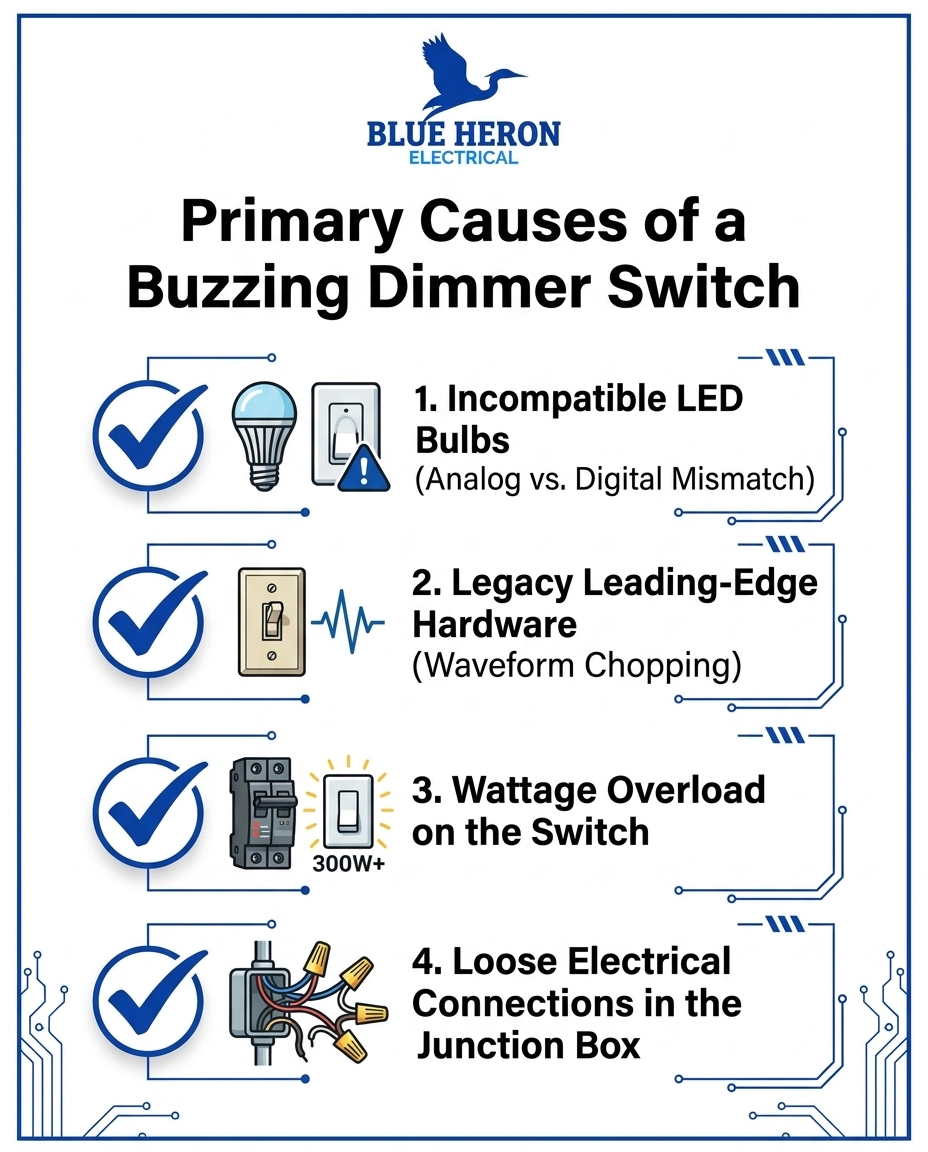
When an older, analog dimmer tries to control a modern, digital LED driver, the electrical mismatch causes physical vibration within the switch or the bulb itself. Especially in Sterling Heights older housing stock, original legacy switches are still incredibly common, making this a widespread issue for homeowners trying to modernize their spaces.
Why Did My Old Bulbs Never Buzz?
Your old incandescent bulbs never buzzed because they lacked complex circuitry. An incandescent bulb is essentially just a glowing wire inside a glass vacuum. When you lower the power using a legacy dimmer, the wire simply gets less hot and emits less light. Legacy dimmers were designed specifically for this high-wattage, simple, steady load.
LEDs do not have a glowing filament. Instead, they use a built-in electronic driver—essentially a miniature computer—that converts your home's alternating current (AC) into direct current (DC). When an old dimmer switch tries to restrict the power flowing to this digital driver using outdated methods, the internal magnetic components of the LED driver begin to rapidly vibrate. That high-frequency vibration is the exact buzzing sound you hear echoing through your hallway or living room.
Understanding the Hum: Leading-Edge vs. Trailing-Edge Dimmers
To truly fix the problem, it helps to understand the technical mechanics of dimmer compatibility. Electricity in your home runs on an alternating current (AC) waveform, meaning the voltage naturally rises and falls in a smooth wave pattern 60 times per second. Dimmer switches work by "chopping" this waveform to reduce the total amount of energy reaching the bulb.
Leading-Edge Dimmers (The Old Standard)
Legacy dimmers use a "leading-edge" chopping method. This means they cut off the front portion of the electrical waveform as the voltage rises, and then suddenly snap the power back on. For a simple incandescent filament, this sudden surge of power is perfectly fine. But for a modern LED driver, this harsh, abrupt jolt of electricity is chaotic. The sudden spike in voltage forces the magnetic components inside the LED to physically rattle, creating the audible buzz. If you are upgrading your lighting in September or early fall, this is almost always the culprit behind the sudden noise.
Trailing-Edge Dimmers (The Modern Solution)
Modern LED-compatible dimmers use a "trailing-edge" method. Instead of chopping the front of the wave, they allow the voltage to rise naturally and smoothly, and then chop the back end of the waveform as it falls. This provides a much smoother, gentler current delivery that digital LED drivers can easily process without any physical vibration.
• Leading-Edge (Legacy) — Waveform Impact: Chops the front (abrupt voltage spikes) — Bulb Compatibility: Incandescent & Halogen — Buzzing Risk: High risk of buzzing with LEDs
• Trailing-Edge (Modern) — Waveform Impact: Chops the back (smooth voltage fade) — Bulb Compatibility: LED & CFL — Buzzing Risk: Low risk; quiet operation
By simply looking at the outside of a switch on your wall, it is almost impossible to tell which technology it uses. However, if your home was built more than a decade ago and the switches have never been updated, they are almost certainly leading-edge models.
Nuisance vs. Danger: Is a Buzzing Dimmer a Fire Hazard?
One of the most common questions homeowners ask is whether that annoying sound is actually a warning sign of an impending electrical fire. The short answer is: it depends on the exact nature of the sound and the physical condition of the switch plate.
A mild, steady hum coming from the bulb or the switch due to leading-edge chopping is usually just a nuisance. While it is not immediately dangerous, this electrical mismatch is highly inefficient. The harsh voltage spikes force the LED driver to work overtime, which can significantly reduce the lifespan of your expensive new energy-efficient bulbs.
However, a loud buzz accompanied by other physical symptoms indicates a serious, immediate hazard. In many Sterling Heights older housing stock properties, what sounds like a simple hum might actually be electrical arcing caused by an overloaded circuit or deteriorating wire connections.
Signs You Need Immediate Professional Help
• The switch plate feels abnormally hot: While a slight warmth is normal for some older dimmers, a switch cover that is hot to the touch indicates severe resistance and a major fire risk.
• You hear a crackling or popping sound: A steady hum is a vibration issue; a crackling, sizzling, or popping sound is electrical arcing, meaning electricity is jumping through the air between loose connections.
• Lights flicker inconsistently: If your lights strobe or flicker regardless of where the dimmer slider is positioned, the internal components of the switch are failing.
• You notice a burning or ozone smell: Any faint smell of burning plastic near a wall switch requires immediate attention.
If you notice multiple switches buzzing simultaneously, or if you hear a similar humming noise originating from your main breaker box, the issue extends far beyond a single incompatible light bulb. In these cases, broader electrical panel inspections are absolutely vital to rule out systemic voltage issues or failing breakers.
Legacy Hardware: Why Older Homes Struggle with New Lighting Tech
The transition to modern lighting is rarely as simple as twisting in a new bulb, especially in established neighborhoods. Mid-century and late-20th-century homes frequently still contain their original, legacy incandescent dimmer switches. These older wiring configurations complicate what should be a simple upgrade.
For example, a pattern our Blue Heron Electrical crew sees often in Sterling Heights involves homeowners reaching out to add modern lights and update several switches as part of a larger interior upgrade. When our team safely wires in new fixtures and installs compatible switches, we ensure everything works seamlessly without any electrical humming or flickering. This is a common situation we encounter: upgrading the visible lighting fixtures often uncovers outdated wiring configurations hidden inside the walls.
One of the biggest hurdles with older homes is the absence of a neutral wire inside the switch box. Many modern smart dimmers and high-end LED dimmers require a dedicated neutral wire to power their internal electronics, even when the lights are turned off. Homes built before the late 1980s often utilized "switch loop" wiring, where only the hot wires were brought down to the wall switch, leaving the neutral wire up in the ceiling fixture.
When modernizing an older home's lighting, we highly recommend consulting Sterling Heights electricians who understand local legacy wiring. Blue Heron Electrical has extensive experience ensuring safe, code-compliant lighting upgrades in older Metro Detroit homes. Having a professional evaluate the junction box ensures that the new hardware is fully compatible with the existing wiring infrastructure, preventing dangerous electrical faults down the road.
The Professional Fix: Installing ELV Dimmers for LED Lights
If you have confirmed that your bulbs are dimmable LEDs but the buzzing persists, the most effective and permanent fix is removing the legacy switch entirely. It must be replaced with an Electronic Low Voltage (ELV) or LED-compatible trailing-edge dimmer. Because of the inherent risks of electrical shock, code violations, and fire hazards, this upgrade requires professional installation by a licensed electrician. You should never attempt a DIY dimmer swap if you are unfamiliar with local building codes and load calculations.
Here is an overview of the process a professional electrician follows to safely resolve a buzzing dimmer:
1. Circuit Evaluation and Safety Disconnect: The electrician begins by identifying the correct circuit at the main panel, safely disconnecting the power, and verifying with a multimeter that zero voltage is present at the switch box.
2. Wiring Verification: Once the old switch is removed, the junction box is inspected. The electrician checks for the presence of a neutral wire, verifies the condition of the insulation, and ensures the box has adequate physical space (cubic capacity) to house a bulkier modern ELV dimmer safely.
3. Load Calculation: The total wattage of all LED bulbs controlled by the switch is calculated. Even though LEDs use less power, modern dimmers have strict maximum load ratings for LEDs that are much lower than their incandescent ratings. The electrician ensures the new dimmer is perfectly sized for the circuit's demand.
4. Switch Installation and Testing: The new ELV trailing-edge dimmer is wired into place using secure, code-compliant connections. Power is restored, and the system is tested across the entire dimming range to ensure the buzzing is completely eliminated and no flickering occurs at low levels.
By having an expert handle this installation in September or early fall, you guarantee that your home's lighting will be safe, reliable, and completely silent long before the shortest days of the year arrive.
Other Electrical Culprits Behind Humming Switches
While an incompatible analog dimmer and digital LED driver is the most frequent cause of buzzing, it is not the only possibility. If a professional installs a brand-new ELV dimmer and a hum still persists, other electrical edge cases within the home's wiring must be investigated.
Loose Wire Connections
Over decades of use, the constant expansion and contraction of copper wires due to temperature changes can cause wire nuts to loosen. A poorly secured connection inside the junction box can physically vibrate as alternating current flows through it. This vibration creates a mechanical hum that sounds remarkably similar to a compatibility buzz, but it carries a much higher risk of arcing and fire.
Wattage Overloads
Even with highly efficient LEDs, putting too many fixtures on a single switch can stress the hardware. If a homeowner replaces a single ceiling light with a massive array of recessed can lights, the combined inrush current (the initial surge of power when the switch is flipped) can overload the dimmer's internal components, causing them to strain and hum.
Panel Voltage Drops
Sometimes, the issue originates far away from the switch itself. Voltage drops caused by high-draw appliances on the exact same circuit can cause lighting instability. This is the same underlying principle behind why bathroom lights flicker when a hair dryer is running. If a heavy appliance kicks on and starves the circuit of voltage, the LED driver struggles to compensate, which can result in temporary buzzing or flickering.
Frequently Asked Questions About Dimmer Switch Buzzing
Why is my dimmer switch buzzing with LED bulbs?
It is caused by the electrical mismatch between the digital LED driver inside the bulb and the analog chopping action of a legacy leading-edge dimmer. The older switch sends harsh spikes of voltage that cause the magnetic components inside the modern LED to physically vibrate, creating the buzzing sound.
Is a buzzing dimmer switch dangerous?
A mild, steady hum is usually not dangerous, though it can shorten the lifespan of your bulbs. However, if the buzzing is accompanied by a switch plate that is hot to the touch, erratic flickering, crackling sounds, or a burning smell, it is a severe fire hazard that requires immediate professional attention.
How do I stop my dimmer switch from buzzing?
The permanent solution is having a professional electrician remove the outdated legacy switch and install an ELV (Electronic Low Voltage) or LED-compatible trailing-edge dimmer. This ensures the electrical current is delivered smoothly to the bulbs, completely eliminating the vibration.
Do I need a special dimmer for LED lights?
Yes, LEDs require trailing-edge or ELV dimmers that are specifically rated for the lower wattage and digital circuitry of modern lighting. Standard incandescent dimmers cannot properly regulate the power flow to an LED driver.
Can a buzzing dimmer switch increase my energy bill?
While the buzzing sound itself does not consume a significant amount of extra power, an incompatible setup can cause the LED driver to operate highly inefficiently. This strain forces the bulb to work harder, reducing its lifespan and negating some of the energy-saving benefits you expected from the upgrade.
Ensure Safe, Quiet Lighting for the Darker Months Ahead
Do not let a loud, buzzing switch ruin the comfort of your freshly upgraded indoor lighting. As September brings shorter days and we rely more heavily on our indoor fixtures, a quiet, well-lit home becomes essential. Understanding the compatibility issue between old switches and new bulbs is the first step; having the right hardware safely installed is the final solution.
If your switches are humming, crackling, or feeling warm to the touch, it is time to bring your home's wiring up to modern standards. Reach out to local professionals to evaluate your home's switches and ensure your residential electrical services are fully up to code for the fall and winter. With the right dimmer installed, you can finally enjoy the energy savings of your new LEDs in total peace and quiet.
Customer Testimonials

Service Areas