
Upgrading Exterior Motion Lights to Deter Fall Wildlife
Outsmarting Foraging Wildlife as Daylight Dwindles
Before the first frost even hits, the September transition to darker evenings rapidly changes the rhythm of your neighborhood. You might notice that upgrading exterior motion lights to deter fall wildlife becomes a pressing priority when you start losing two to three minutes of daylight every single day. This rapid shift pushes the active foraging hours of nocturnal animals—like raccoons and deer—directly into the early evening, right when you are still awake and using your property.
If you need help securing your home's perimeter against these seasonal intrusions, professional residential electrical services can provide the permanent, hardwired upgrades required to keep your yard safe and well-lit.
Many homeowners rely on outdated, dim, or slow-to-illuminate halogen floodlights to protect their property. The problem is that these older fixtures simply fail to startle encroaching animals. A raccoon digging through your trash or a deer grazing on your late-season garden will barely flinch at a light that takes several seconds to reach full brightness. To effectively reclaim your perimeter, you need the immediate, high-intensity shock of modern, strategically placed LED upgrades.
The Shift in Autumn Wildlife Behavior
As the days get shorter, wildlife behavior shifts into high gear. Animals are instinctively driven to consume as many calories as possible before winter sets in. This means they become bolder, venturing closer to homes, patios, and driveways in search of easy food sources. When your exterior lighting is inadequate, your yard transforms into a safe haven for this accelerated foraging.
The quick fix: Replacing those sluggish, energy-draining halogen bulbs with instant-on LED fixtures. However, simply screwing in a new bulb isn't always enough. Positioning professional installation as the safest route for permanent outdoor electrical upgrades ensures that your new lights are wired correctly, weather-sealed, and aimed exactly where they will have the greatest impact on skittish wildlife.
The Science of the Startle: Why Instant-On LEDs Outperform Halogens
Understanding why some lights scare animals away while others are completely ignored comes down to the mechanics of the lighting technology itself. There is a distinct biological reaction that you are trying to trigger, and older lighting technologies simply cannot deliver the necessary speed.
The Warm-Up Delay of Traditional Bulbs
Traditional halogens and compact fluorescent lamps (CFLs) rely on heat and gas to produce light. When a motion sensor is triggered, these bulbs have a brief but noticeable warm-up period before they reach full brightness. To a human, a two-second delay might just seem like a minor annoyance. To a skittish deer or a hyper-aware raccoon, that gradual increase in light is a gentle warning, not a threat. It gives them time to assess the situation and realize there is no immediate danger, allowing them to continue foraging without fear.
The Microsecond Speed of LED Technology
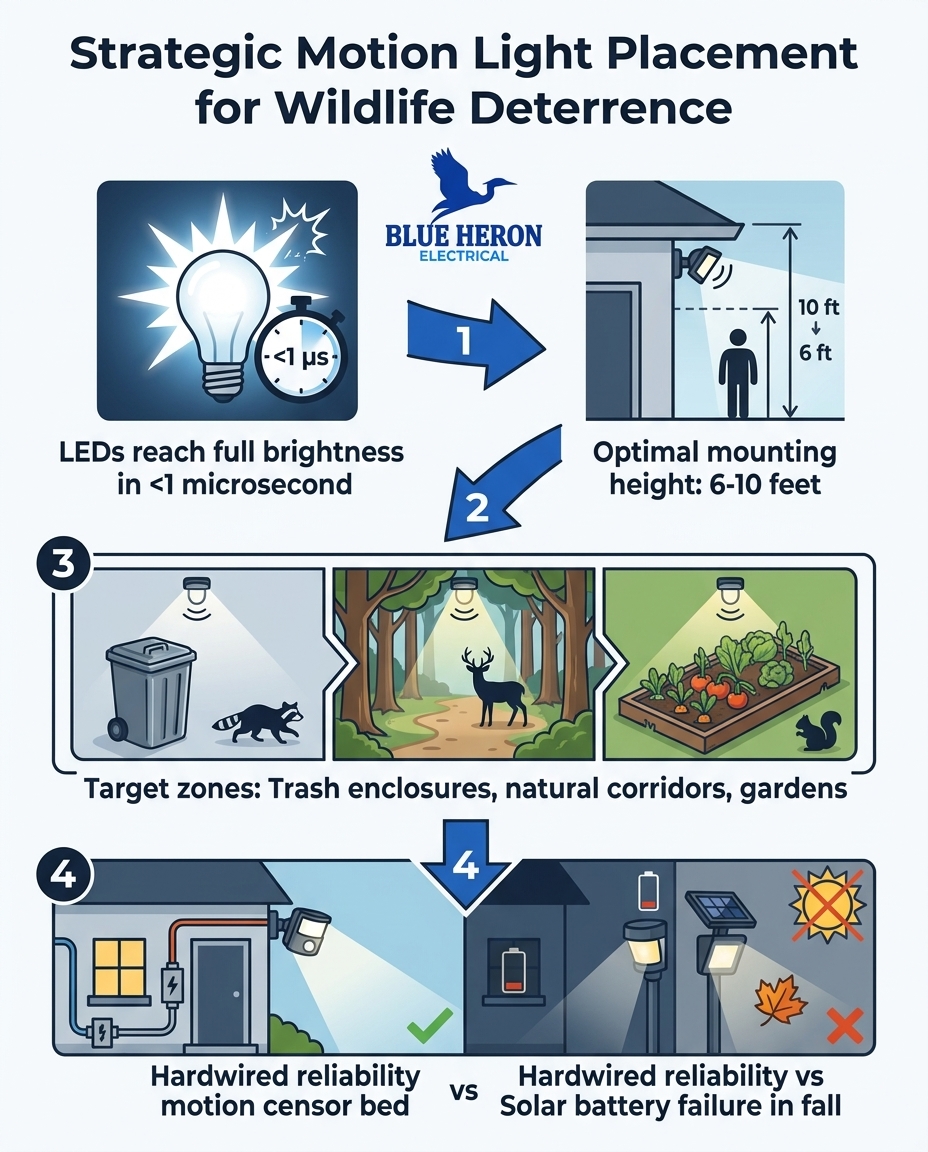
Modern light-emitting diodes (LEDs) operate on an entirely different principle. Instead of heating a filament, they pass an electrical current through a microchip, illuminating the tiny light sources instantly. In fact, LEDs reach full brightness in under a microsecond.
This microsecond illumination is the key to the "startle effect." When an animal steps into a sensor zone, the area goes from pitch black to blindingly bright instantly. This sudden, aggressive change in the environment triggers a natural flight response. The animal perceives the instant flash as a direct threat and scatters immediately.
Comparing Lighting Technologies for Wildlife Deterrence
• Halogen Floodlights — Time to Full Brightness: 1 to 3 seconds — Startle Effect on Wildlife: Low (gradual fade-in allows animals to adjust) — Energy Efficiency: Poor (generates excessive heat)
• CFL Bulbs — Time to Full Brightness: 30 seconds to 3 minutes — Startle Effect on Wildlife: Very Low (too slow to trigger flight response) — Energy Efficiency: Moderate
• Instant-On LEDs — Time to Full Brightness: Less than 1 microsecond — Startle Effect on Wildlife: High (instant flash triggers immediate panic) — Energy Efficiency: Excellent (ideal for long winter nights)
Beyond the startle effect, the energy efficiency of LEDs is a massive advantage during the longer fall and winter nights. Because they draw a fraction of the power required by halogens, you can install brighter lights with wider coverage areas without overloading your existing electrical circuits.
Mapping High-Risk Zones for Motion Sensor Placement
Having the right technology is only half the battle. If your motion sensors are pointed at the wrong areas, wildlife will simply walk around them. Strategic placement is required to intercept animals at their natural entry points before they reach their targets.
Identifying Natural Corridors
Wildlife doesn't wander randomly; animals follow paths of least resistance. In places like Sterling Heights residential areas bordering wooded or park spaces, these paths often form natural corridors. Animals will use tree lines, privacy fences, and the edges of local riverways to navigate quietly into your yard.
By mapping out these specific high-risk targets, you can position your motion sensors to catch movement exactly where the animals break cover. Overlapping sensor zones are crucial here. If you only have one light pointing at the driveway, a raccoon can easily sneak through the unlit gaps along the side of the house to reach your trash cans.
Strategic Placement Zones for Maximum Effectiveness
To completely secure your property's perimeter, focus your lighting upgrades on these specific vulnerabilities:
• Trash can enclosures: The primary target for raccoons and opossums. Aim a dedicated, high-lumen LED directly at the bins with a narrow sensor field to catch them the moment they approach.
• Late-season vegetable gardens: Deer are notorious for stripping autumn gardens bare. Mount lights higher up and angle them downward to create a wide, blinding wash of light over the vegetation.
• Ornamental shrubs and dense landscaping: These areas provide cover for skunks and rodents. Low-level motion lighting can startle them out of the brush.
• Blind corners and alleyways: Any narrow passage between your home and a fence is a natural highway for wildlife. Place sensors at both ends of the corridor.
When overlapping these zones, ensure that the outer edge of one sensor's range bleeds into the beginning of the next. This creates an unbroken wall of security that animals cannot bypass without triggering a response.
Eliminating Blind Spots in Older Properties
Retrofitting comprehensive security lighting onto an existing home presents unique challenges. Older properties were rarely designed with modern, 360-degree security in mind, meaning they often lack sufficient exterior junction boxes for optimal light placement.
Overcoming Architectural Limitations
Adding modern security zones to an aging electrical system isn't always straightforward. One homeowner discovered this during a spring renovation while looking to add lights and additional switches to an older home. Because the property lacked the necessary exterior junction boxes in the right locations, the electrical crew had to carefully map out new circuits and provide multiple layout options to ensure comprehensive coverage. Ultimately, the new installations resulted in a fully modernized exterior that completely eliminated previous blind spots.
When you are trying to cover the side of a garage or a deep backyard corner, you can't just attach a heavy fixture to vinyl siding and hope for the best. The process involves safely routing new wiring through attics or crawlspaces, installing weatherproof junction boxes, and adding new dedicated circuits to accommodate the expanded lighting zones.
Calibrating Sensitivity to Avoid Nuisance Tripping
Once the blind spots are eliminated and the new fixtures are mounted, the sensors must be carefully calibrated. If the sensitivity is set too high, every blowing leaf or stray cat will trigger the lights, annoying you and your neighbors. If it's set too low, a large deer might slip by unnoticed.
What we check during calibration:
• Range distance: Adjusting how far out the sensor "sees" to keep it within your property lines.
• Field of view (FOV): Narrowing the angle so passing cars on the street don't trigger the yard lights.
• Size threshold: Ensuring pets don't trigger the lights, but larger wildlife does.
A professional assessment is invaluable here. An experienced electrician can identify unique structural blind spots caused by roof overhangs, mature trees, or outbuildings, ensuring your new lights are positioned for maximum deterrence.
Why Hardwired Systems Defeat DIY Solar Lights Every Fall
It is tempting to grab a multi-pack of cheap solar motion lights from a big-box store and stick them in the ground. However, these DIY solutions almost always fail precisely when they are needed most: during the dark, wet months of autumn.
The Problem with Diminishing Daylight
The core issue with solar lighting in the fall is basic math. As the days grow shorter and the angle of the sun drops lower in the sky, solar panels receive significantly less direct sunlight. By the time November rolls around, diminishing daylight hours prevent solar batteries from fully charging. When a raccoon triggers a solar light at 2:00 AM, the depleted battery can only produce a dim, weak glow—hardly enough to startle a determined animal.
Moisture, Freezing, and Seal Failure
Beyond the battery issues, the physical construction of cheap solar lights cannot withstand the elements. Michigan's harsh, wet fall weather and impending winter freezes destroy poorly sealed DIY solar lighting setups. Water seeps into the plastic housing during heavy autumn rains. When the temperature drops below freezing overnight, that trapped moisture expands, cracking the casing and shorting out the cheap internal circuitry. This causes them to fail completely when wildlife activity peaks.
The Unwavering Reliability of Hardwired Circuits
Contrast this constant cycle of failure with the unwavering reliability of hardwired electrical connections on a dedicated circuit. A hardwired LED floodlight draws power directly from your home's electrical panel. It does not care if it has been raining for three days straight, or if the sun set at 4:30 PM.
Hardwired lights guarantee full-power illumination regardless of overcast autumn days. When the sensor is tripped, you get the exact same blinding, microsecond flash of light in the dead of winter as you would in the middle of summer. If you are serious about deterring wildlife, hardwiring is the only permanent solution.
Ensuring Code-Compliant Outdoor Electrical Safety
Any time you introduce electricity to the exterior of your home, safety must be the primary focus. Outdoor electrical work carries significant risks, and improper wiring can lead to disastrous consequences.
The Risks of Improper Outdoor Wiring
Water and electricity are a dangerous combination. If exterior fixtures are not properly sealed and grounded, water ingress from fall storms or melting snow can easily cause short circuits. At best, a short circuit will trip your breaker and leave you in the dark. At worst, it can energize the metal casing of the light fixture or cause an electrical fire inside your walls.
This is why emphasizing professional, code-compliant hardwiring of instant-on LEDs over flimsy, unreliable DIY lights is so important. A licensed electrician ensures reliable performance through harsh weather by following strict safety protocols.
Key Safety Components for Exterior Upgrades
When upgrading exterior motion lights, several code-compliant components must be utilized:
1. Weather-Resistant (WR) Receptacles: All outdoor connections must be housed in boxes specifically rated for wet locations.
2. Proper Grounding: Exterior fixtures must be bonded to the home's grounding system to safely direct stray voltage into the earth.
3. GFCI Protection: Ground Fault Circuit Interrupters monitor the flow of electricity and instantly cut power if they detect a leak, preventing severe shocks.
4. Proper Wire Gauge: Ensuring the new circuits can handle the electrical load without overheating.
Modifying exterior electrical loads often requires pulling permits to ensure safety. Local municipalities have strict rules about how outdoor wiring must be trenched, secured, and connected. If you are unsure about the local rules, you can review the permit requirements for outdoor lighting to understand what is involved.
Ultimately, licensed electricians guarantee the system will withstand severe weather without posing a fire or shock hazard, giving you peace of mind all winter long.
Frequently Asked Questions About Wildlife Deterrent Lighting
Do motion sensor lights scare away raccoons?
Yes, sudden, bright light startles nocturnal foragers like raccoons. Because they rely on the cover of darkness to stay safe from predators, an unexpected flash of high-intensity light triggers their flight instinct. The effectiveness depends heavily on using instant-on LEDs rather than slow-warming bulbs, as the rapid change in environment is what actually causes the panic.
Are deer afraid of motion lights?
Deer are skittish and generally avoid sudden changes in their environment. While they might grow accustomed to a porch light that stays on all night, a motion-activated blast of light will usually send them running. Properly aimed, high-lumen motion lights can effectively deter them from grazing on expensive landscaping and late-season gardens.
How high should I mount outdoor motion lights?
Mounting heights typically range between 6 to 10 feet to provide a wide coverage area. If you mount them too low, the sensors might be blocked by shrubs or easily tampered with. The exact height depends on the fixture's sensor range and the specific blind spots being targeted around your property's perimeter.
Why are my motion lights not deterring animals?
Common reasons include slow bulb illumination, dead solar batteries, or poorly calibrated sensor sensitivity. If your lights take too long to warm up, animals realize there is no immediate threat. Furthermore, improper placement that leaves dark corridors also allows wildlife to bypass the sensors entirely without ever triggering the light.
Can I install hardwired exterior lighting myself?
Outdoor electrical work carries significant safety and weatherproofing risks. From ensuring watertight seals to properly grounding the fixtures against severe weather, the margin for error is incredibly small. It is strongly recommended to hire a licensed professional to ensure code compliance and long-term safety.
Secure Your Property's Perimeter Before Winter Arrives
Waiting until the darkest part of the year leaves your property vulnerable to foraging damage. As the days continue to shorten, nocturnal animals will only become more aggressive in their search for food. Upgrading exterior motion lights to deter fall wildlife is a proactive step that protects your landscaping, secures your trash enclosures, and eliminates the dark corners where pests love to hide.
The true value of this upgrade lies in the combination of instant-on LED technology and strategic, professional installation for optimal coverage and safety. A licensed electrician can map out your blind spots, ensure your wiring is completely weatherproof, and install a system that won't fail when the temperatures drop. Don't let outdated halogens or flimsy solar lights leave your yard unprotected. Schedule an assessment of your exterior lighting solutions today, and rest easy knowing your home is secure through the long winter nights ahead.
Customer Testimonials

Service Areas