
How to Safely Remove Abandoned Wiring During a Fall Renovation
Discovering Mystery Wires During Your Fall Renovation
You pull down a section of drywall for your kitchen update, and right behind the studs sits a cluster of unidentified, cut wires—perhaps an old 12-gauge Romex cable. Figuring out how to safely remove abandoned wiring during a fall renovation is a critical hurdle for any homeowner. As you prep your house for the colder months, the temptation to just tuck those wires back into the wall cavity and hang the new drywall is incredibly strong. However, making assumptions about electrical safety can turn a simple home improvement project into a hidden hazard.
For comprehensive support during your project, explore our residential electrical services.
When you are deep into early fall remodeling this September, pushing to finish before the late-October frost arrives, your timeline is usually tight. You want to get the walls closed, the paint dry, and the house put back together before the holiday season. Finding a mystery wire brings that momentum to a sudden halt. You are immediately faced with a critical decision point: do you bury the wire and hope for the best, or do you pause the project to bring in a professional?
The Hidden Risks of Covering Up Wires
Burying an unverified wire is one of the most dangerous mistakes you can make during a remodel. Legacy electrical systems often contain modifications made by previous owners, and what looks like a harmless, disconnected cable could actually be a live circuit waiting to arc.
• Fire hazards: Live wires tucked behind drywall can spark, igniting nearby wood framing, dust, or insulation.
• Shock risks: Anyone driving a nail or screw into that wall later to hang a picture could inadvertently tap into a live 120-volt current.
• Code violations: Building codes strictly prohibit concealing live, improperly terminated wires inside closed wall cavities.
• Future complications: If a circuit fails later, hidden wiring makes troubleshooting nearly impossible without tearing the walls back open.
The urgency to finish your renovation should never override the safety of your home. Taking the time to properly identify and handle discovered wiring is the only way to ensure your updated space is as safe as it is beautiful.
Why You Can Never Assume a Cut Wire is Dead
One homeowner recently reached out when they realized their property needed significant electrical upgrades, including a new panel, updated lights, and a generator hook-up. The crew had to provide multiple options to untangle the complex legacy wiring, ultimately completing all tasks smoothly. This scenario highlights a typical pattern we see in older Sterling Heights residential areas—particularly in tract homes built between 1970 and 1990: previous homeowners often make undocumented, DIY changes to the electrical system over the decades. Because of this history, you can never look at a cut wire and safely assume it carries no current.
If you uncover a mess of old cables, consulting with experienced Sterling Heights electricians is the smartest move you can make. A wire that appears completely severed might still be connected to a live breaker at the main panel. In some cases, it might act as a hidden load, meaning it only becomes energized when a specific switch in another room is flipped.
Visual Signs That Spell Danger
While only a professional can verify if a wire is truly dead, there are several visual indicators that the wiring you found is highly problematic and requires immediate expert attention.
• Exposed copper ends — What It Could Actually Mean: The wire was cut hastily without being capped, creating an immediate arcing and shock hazard if the circuit is live.
• Blackened or melted insulation — What It Could Actually Mean: The wire has previously overheated or short-circuited, indicating a severe, unresolved problem on that circuit.
• Cloth-wrapped insulation — What It Could Actually Mean: You have uncovered legacy wiring (like knob-and-tube or early non-metallic sheathed cable) that lacks modern grounding.
• Wires taped together with duct tape — What It Could Actually Mean: A previous DIYer attempted an illegal splice outside of a junction box, which is a major fire risk.
Even if none of these visual warning signs are present, the danger remains. Comprehensive upgrades and professional tracing are often necessary when renovating older properties to ensure that every part of the electrical system meets modern safety standards.
The Dangers of Burying Wires Before Winter Insulation
The timeline of an early fall remodeling before winter adds a specific layer of urgency to your project. In Michigan, the window to comfortably open up exterior walls and close them back up is short. Freezing temperatures arrive quickly, bringing a rush to install dense, new insulation and seal the home against the cold. While high-quality insulation is great for your energy bills, it creates a highly dangerous environment for unverified electrical wires.
How Insulation Exacerbates Electrical Fire Risks
Electrical current naturally generates a small amount of heat as it travels through a wire. When wires are properly installed, sized, and terminated, this heat safely dissipates into the surrounding air cavity. However, if a live, cut wire is left improperly terminated and then buried, the dynamics change entirely.
When you pack dense R-15 or R-21 fiberglass batts, blown-in cellulose, or closed-cell spray foam insulation tightly around a compromised wire, you are essentially wrapping a heat source in a thick, thermal blanket.
• Trapped Heat: Dense insulation prevents normal heat dissipation, causing the temperature around the wire to rise steadily.
• Increased Load: During the winter, as temperatures drop well below freezing, your home's heating systems, space heaters, and holiday lighting increase the overall electrical load, which can push more current through shared circuits.
• Insulation Degradation: Prolonged exposure to trapped heat can melt the wire's protective plastic casing, exposing the bare copper underneath.
• Combustion: Once the bare copper is exposed and arcs, the surrounding paper backing on the drywall or the wood studs can quickly catch fire inside the wall.
Because these fires start deep inside the wall cavity, they often go unnoticed until they have grown significantly. This is why resolving all electrical mysteries before the drywall goes up is absolutely critical. Once the walls are sealed tight against the freezing Michigan winter, you lose all visibility into what is happening behind them.
How Professionals Trace and Verify Abandoned Wiring
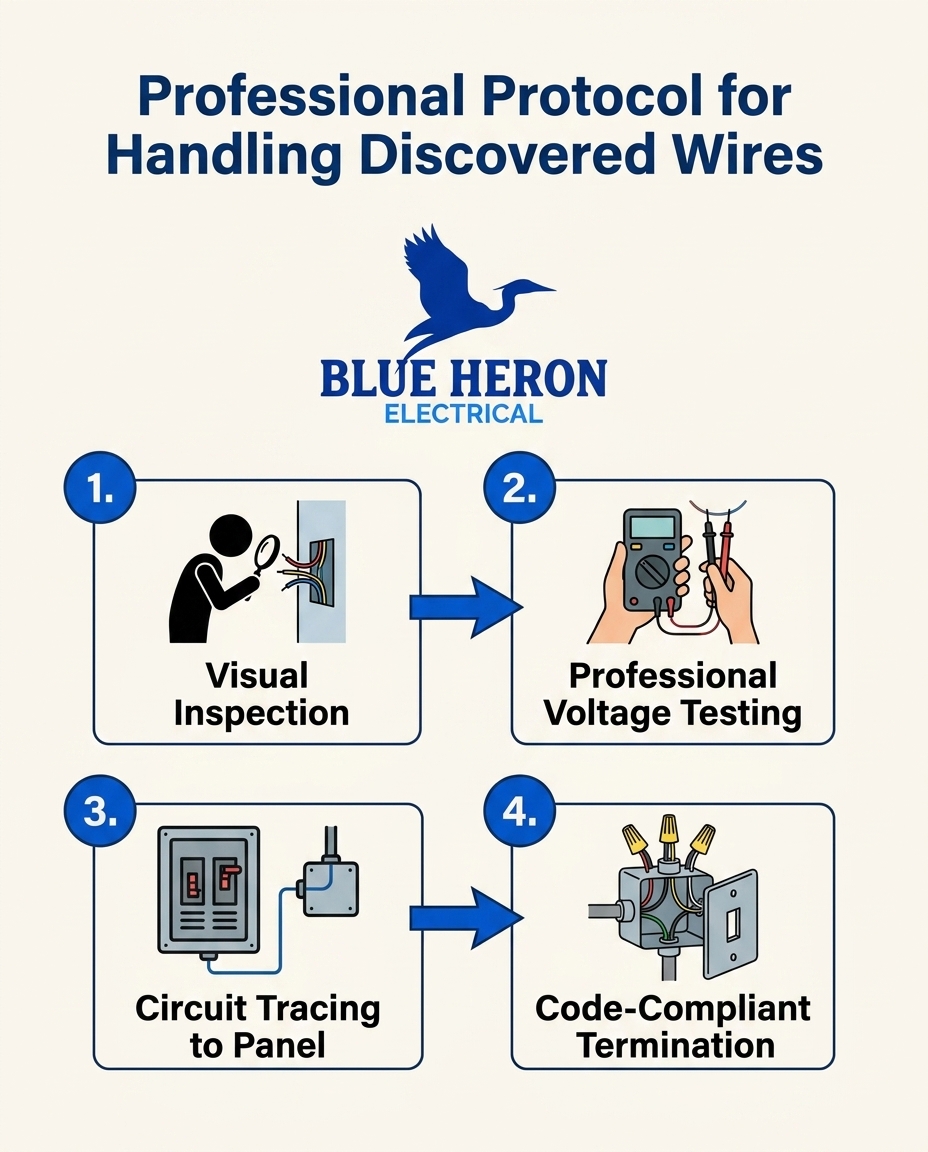
Handling unknown electrical components is never a DIY project. Working with licensed professionals ensures that unknown wires are properly traced and safely terminated, preventing hidden fire hazards from lingering in your walls. Here is the rigorous protocol an electrician follows to resolve the mystery safely.
1. Initial Visual Inspection: The electrician begins by examining the discovered wire, looking for identifying marks on the sheathing, gauge size, and the direction it travels through the framing. This helps determine if it was likely part of a lighting circuit, an old appliance line, or a low-voltage system.
2. Advanced Voltage Testing: Using professional-grade, CAT III-rated multimeters and non-contact voltage testers, the electrician checks the wire for active 120V or 240V current. They will test the wire under various conditions, ensuring it doesn't suddenly become live when a seemingly unrelated switch is flipped elsewhere in the house.
3. Circuit Tracing to the Panel: If the wire is live, or if its origin is unknown, the electrician uses a circuit tracer to send a signal down the line. This allows them to track the wire's path through the walls all the way back to the main electrical panel, identifying exactly which breaker controls it.
4. Verifying Hidden Loads: Before removing anything, the professional verifies that cutting or capping this wire will not disrupt other hidden loads. In older Sterling Heights residential areas, it is common to find multiple rooms daisy-chained together on a single, convoluted circuit.
5. Code-Compliant Termination: Once the wire is fully understood, the electrician takes action. If the wire is completely obsolete, the safest route is disconnecting it at the breaker and pulling it out of the wall entirely. If removal isn't possible, they will terminate the live ends safely inside an approved, accessible junction box.
Code Requirements for Terminating Cut Wires
When you are tackling early fall remodeling before winter, ensuring that your project passes municipal inspections is just as important as the aesthetic upgrades. The National Electrical Code (NEC), including specific guidelines under Article 314, sets strict rules regarding how abandoned wires must be handled. These regulations exist specifically to prevent the types of hidden fires that occur when DIYers take shortcuts.
Understanding these rules is especially important if you are planning electrical for kitchen, bathroom, and basement remodels, where water and heavy appliance loads make safety even more critical.
No Buried Splices or Live Caps
The NEC explicitly prohibits burying live splices or capped live wires behind a finished wall. You cannot simply twist a wire nut onto the end of a live cable, wrap it in electrical tape, and cover it with drywall. Over time, seasonal temperature changes, slight vibrations in the home, or degrading adhesive on the tape can cause that cap to fall off, exposing the live copper directly to the wood framing.
The Accessible Junction Box Rule
If a wire cannot be completely removed from the wall cavity and must remain live for other parts of the circuit to function, the code requires a specific solution. The wire must be safely terminated inside a hard plastic or metal junction box. Furthermore, that junction box must remain permanently accessible. This usually means installing a blank faceplate on the wall over the box. It cannot be mudded over, painted shut, or hidden behind permanent cabinetry. This ensures that future electricians can easily locate and inspect the splice without destroying the building finish.
The Best Practice: Complete Removal
While an accessible junction box is code-compliant, the ultimate best practice for abandoned wiring is complete removal. A professional electrician will trace the wire back to the preceding junction box or all the way to the main electrical panel and disconnect it there. By entirely removing the dead leg of wiring from the circuit, you eliminate any future confusion, free up space in your wall cavities, and guarantee that the cut wire can never accidentally become re-energized.
Frequently Asked Questions About Abandoned Wires
Finding unexpected electrical issues often brings up a lot of questions, especially when you are on a tight remodeling schedule. If you run into trouble, reaching out to an emergency electrician is always the safest path forward. Here are the answers to the most common questions homeowners have about mystery wires.
Can I bury a cut wire in the wall?
No, burying an unverified or live cut wire is a severe fire hazard and violates the National Electrical Code. You should never cover up a wire with drywall, insulation, or paneling unless a licensed professional has verified it is entirely disconnected from the power source at the panel. If it is live, it must be terminated in an accessible junction box.
What does an electrician do with abandoned wires?
An electrician traces the wire to its source, verifies it is dead, and either removes it entirely or terminates it safely in an accessible junction box. They use specialized tracing tools to follow the cable through the walls to determine if it carries a hidden load. Once identified, they disconnect it at the breaker to ensure it can never pose a threat.
Are dead wires dangerous?
Even truly dead wires can become dangerous if they are accidentally re-energized at the panel; they must be properly traced and removed or safely capped. In older Sterling Heights residential areas, especially those containing original 1960s or 1970s wiring, a dead wire left in a wall might be mistakenly hooked back up to a new 15-amp or 20-amp circuit during a future renovation. Proper termination ensures it stays safe permanently.
Is it illegal to bury a junction box in drywall?
Yes, the NEC requires all junction boxes to remain accessible without damaging the building finish. You cannot apply drywall mud or plaster over a junction box cover. It must have a removable faceplate so that anyone working on the electrical system in the future can easily access the wires inside for testing or repairs.
What happens if you accidentally cut a live wire during a remodel?
It can cause immediate sparking, tripped breakers, and poses a severe shock hazard; professional emergency electrical assistance is required immediately. Cutting a live wire shorts the circuit through your tool, which can cause burns or damage your home's electrical panel. You should turn off the main power immediately and wait for a professional to arrive.
Secure Your Home's Electrical Safety Before Winter
Ignoring a mystery wire during your September 2026 early fall remodeling before winter is a gamble you cannot afford to take. The visual signs of danger—from exposed copper to brittle insulation—are just the tip of the iceberg when dealing with legacy electrical systems. As you prepare to insulate and seal your home against the freezing temperatures, ensuring that your wall cavities are free of hidden fire hazards is paramount.
Don't let a cut wire derail your renovation or put your property at risk. Schedule a professional inspection to verify your wiring is safe, code-compliant, and ready to be closed up. If you need expert guidance to keep your project on track, reach out for our electrical remodeling services today.
Customer Testimonials

Service Areas