
Why We Use Copper Pigtails on Aluminum Wiring in Older Homes
The Hidden Fire Hazards in 1965–1973 Homes
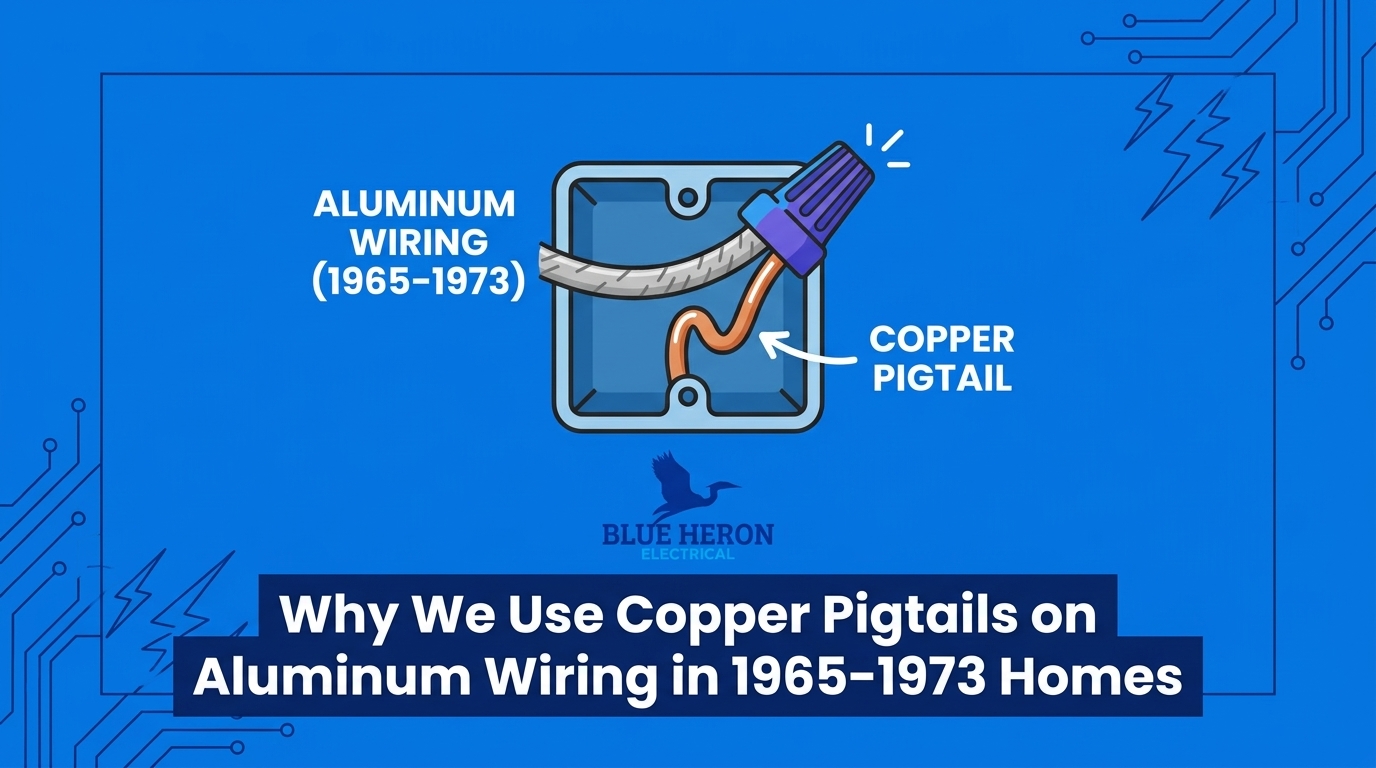
Flickering lights, faintly warm switch plates, and outlets that randomly stop working in a mid-century house are not just quirks of age; they are urgent warning signs. Here at Blue Heron Electrical, responding to these exact symptoms is why we use copper pigtails on aluminum wiring in older homes throughout our community. Between 1965 and 1973, a severe national copper shortage—driven by wartime demands and a booming housing market—led builders across the country to substitute aluminum wiring in millions of new residential properties. While the aluminum metal itself conducts electricity effectively through the long runs inside your walls, the way it behaves at the actual connection points creates a significant, hidden fire hazard.
Every time an aluminum wire connects to an outlet, a light switch, or a breaker panel, it is subjected to mechanical pressure and environmental changes. Over the decades, our electricians have seen how these specific connection points degrade, leading to microscopic gaps, intense electrical resistance, and dangerous heat buildup. Addressing these hazards requires far more than simply tightening a screw or twisting a few wires together; it demands a specific, permanent professional solution. If you are concerned about the safety of your home's aging infrastructure, reaching out for residential electrical services and specialized aluminum wiring replacement in Sterling Heights is the critical first step. The industry-standard method our team relies on for neutralizing these risks without tearing open every wall is a process known as copper pigtailing, which permanently bridges the gap between dangerous older wiring and modern, safe connections.
Understanding the Mechanics of Aluminum Wire Failure
To understand why your 1965-1973 era home is at risk, you have to look closely at the specific metallurgy of aluminum and how it behaves under mechanical stress. When our crew opens up junction boxes in these older properties, the degradation is often invisible to the naked eye, occurring behind drywall and beneath old electrical tape.
The Problem: The Physics of Cold Flow
Unlike copper, which holds its shape exceptionally well under pressure, aluminum is a softer, more malleable metal. When an electrician tightens a screw terminal over an aluminum wire, the metal begins to slowly deform and flatten out over time—a process engineers call "cold flow." As the wire changes shape, the tight mechanical grip of the screw begins to loosen. This creates a microscopic gap between the wire and the terminal. Even a fraction of a millimeter of space is enough to cause electrical arcing, where electricity physically jumps through the air, generating intense, localized heat.
The Cause: Dangerous Oxidation Patterns
All metals oxidize when exposed to air, but the resulting chemical compounds behave very differently. When copper oxidizes, the resulting copper oxide remains electrically conductive. Electricity continues to flow smoothly with minimal resistance. Aluminum, however, reacts differently. When aluminum oxidizes, it creates a layer of aluminum oxide—a material that acts as a powerful electrical insulator. This insulating layer significantly increases the electrical resistance at the connection point. As electricity struggles to push through this resistance, it generates dangerous amounts of heat, often enough to melt surrounding plastic insulation or ignite nearby combustible materials.
The Solution: Professional Evaluation and Mitigation
Because these complex physical and chemical changes happen internally, a visual glance at a switch plate will not reveal the danger. These hidden structural changes are exactly why our team strongly recommends routine, thorough inspections for any property built during this era. If you suspect your home has these older circuits, learning more about identifying aluminum wiring risks is an essential step toward protecting your property.
How Thermal Cycling Accelerates Connection Loosening
The inherent physical vulnerabilities of aluminum wiring are severely compounded by environmental factors, particularly the extreme seasonal shifts we experience in Michigan. From hot, humid summers to freezing, bitter winters, our homes are subjected to massive swings in temperature and humidity. These external changes directly impact the hidden electrical connections inside your walls through a process known as thermal cycling.
Every material expands when heated and contracts when cooled, but aluminum has a significantly higher rate of thermal expansion and contraction than copper. When you turn on a high-draw appliance—like a space heater or a high-capacity vacuum cleaner—the electrical current flowing through the circuit generates internal heat. The aluminum wire expands inside its connection point. When the appliance is turned off, the wire cools and shrinks.
This continuous, microscopic movement forces the wire to work itself loose from standard terminals over time. Because the metal is also subject to the "cold flow" deformation mentioned earlier, it never shrinks back to its exact original shape. Each cycle of expansion and contraction leaves the connection slightly looser than it was before.
A pattern we see often is that this constant movement becomes especially dangerous during early fall temperature fluctuations. As the weather cools in September and heating systems, space heaters, and heavier lighting loads are suddenly turned on, the electrical system undergoes rapid, frequent thermal cycling. Our licensed professionals always warn homeowners that these pre-heating-season fluctuations accelerate the degradation of the connections, making immediate professional mitigation necessary before the heavy, sustained winter heating loads begin. Waiting until the dead of winter to address these loose connections dramatically increases the risk of a thermal event or electrical fire hidden within the wall cavities.
The Danger of Galvanic Corrosion When Mixing Metals
When homeowners or inexperienced handymen attempt to fix loose aluminum wiring, our technicians often discover a fatal error: directly connecting a new copper wire to the old aluminum wire. This creates an entirely new, highly dangerous chemical reaction known as galvanic corrosion, which is exactly why our team strictly requires specialized AlumiConn lug connectors for all mitigation work.
Galvanic corrosion is an electrochemical process that occurs when two dissimilar metals are placed in direct physical contact in the presence of an electrolyte, such as ambient moisture or humidity in the air. Copper and aluminum are far apart on the galvanic scale. When they touch, the copper acts as a cathode and the aluminum acts as an anode. The aluminum begins to rapidly sacrifice itself to the copper, corroding and deteriorating at an alarming rate.
Twisting a copper wire directly to an aluminum wire using standard methods accelerates this corrosion exponentially. When we inspect a failed DIY connection, the evidence of this reaction is obvious. The exposed aluminum wire will be covered in a white, crusty powder. This is the oxidized byproduct of the galvanic reaction. As this powdery buildup thickens, it physically pushes the wires apart, destroying the mechanical integrity of the splice. The connection becomes brittle and highly resistant to electrical flow.
As the resistance spikes, the connection point acts exactly like the heating element inside a toaster. The extreme heat leads to arcing, sparking, and melted wire insulation. This complex, destructive chemical reaction is why DIY repairs on older wiring are so dangerous. Specialized, professional-grade connectors that physically separate the two metals are absolutely required to prevent this galvanic reaction from occurring in your walls.
Why Standard Wire Nuts Are a Dangerous Temporary Fix
One of the most common and dangerous mistakes our crew encounters in older Sterling Heights homes is the use of standard wire nuts to join copper and aluminum wires. While a standard wire nut is perfectly safe for joining two copper wires, our team will be the first to tell you it is entirely inadequate and inherently unsafe for aluminum mitigation.
Inside a standard wire nut is a conical metal spring designed to bite into wires and hold them tightly together. However, because aluminum is much softer than copper, this metal spring easily crushes and scores the aluminum conductor. This scoring creates weak points where the wire can easily snap. Furthermore, standard wire nuts do absolutely nothing to prevent the physical contact between the copper and aluminum conductors. When twisted together inside the cap, the metals touch, allowing galvanic corrosion to begin immediately. The twisting action also exacerbates the cold flow of the aluminum wire, causing it to deform and eventually slip loose from the copper wire entirely.
Even specialized "purple" wire nuts, which are marketed specifically for aluminum-to-copper connections and contain an antioxidant paste, are widely considered a dangerous temporary fix. The antioxidant paste is designed to prevent oxidation, but it does not stop the metals from touching, nor does it secure the wires against thermal expansion and contraction. Because of their high failure rates, purple wire nuts are not considered a permanent repair by the Consumer Product Safety Commission (CPSC). Attempting to tighten, replace, or install these nuts as a DIY project is highly dangerous, violates current safety codes, and leaves your home at risk.
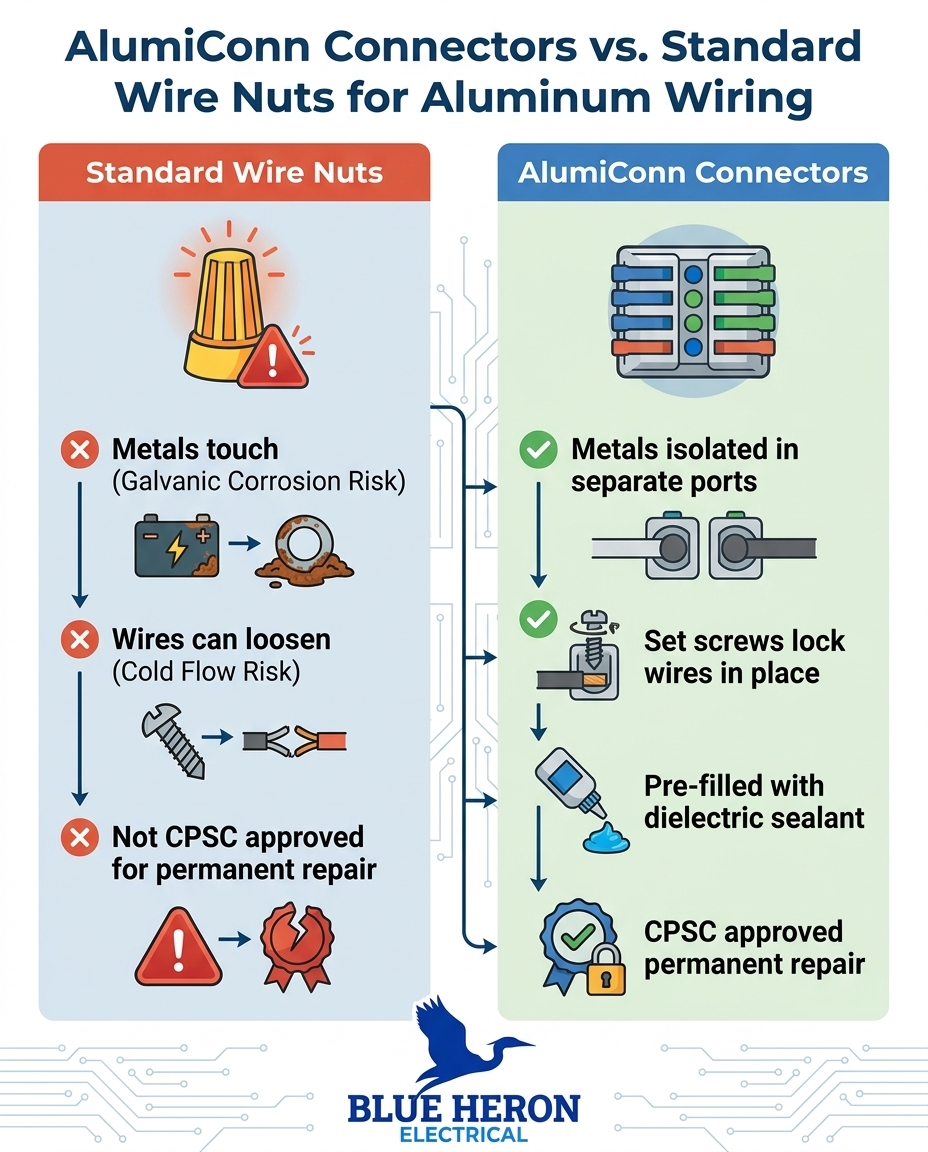
• Standard Wire Nuts — Prevents Metal Contact?: No - Allows Galvanic Corrosion — Resists Thermal Expansion?: No - Prone to loosening — CPSC Approved Permanent Repair?: No - Highly Dangerous
• Purple Wire Nuts — Prevents Metal Contact?: No - Relies on paste only — Resists Thermal Expansion?: No - High failure rate over time — CPSC Approved Permanent Repair?: No - Temporary fix only
• AlumiConn Lug Connectors — Prevents Metal Contact?: Yes - Separate isolated ports — Resists Thermal Expansion?: Yes - Mechanical set screws — CPSC Approved Permanent Repair?: Yes - Industry Standard
The Technical Superiority of AlumiConn Lug Connectors
To permanently neutralize the hazards of older aluminum wiring, the industry standard relies on specialized AlumiConn lug connectors. These devices are engineered specifically to overcome the physical and chemical vulnerabilities of aluminum. At Blue Heron Electrical, our team's commitment to permanent, code-compliant safety solutions means our licensed electricians strictly utilize these specialized AlumiConn connectors rather than cutting corners with unsafe standard wire nuts.
The design of these connectors addresses every point of failure associated with older wiring systems.
Mechanical Separation of Metals
1. Complete Isolation: The core feature of the AlumiConn connector is its internal design, which features separate, isolated ports for the copper wire and the aluminum wire.
2. Eliminating Galvanic Corrosion: Because the two dissimilar metals never physically touch one another, the electrochemical reaction required for galvanic corrosion is completely eliminated. The copper and aluminum remain safely separated by the conductive body of the lug itself.
Torque-Specific Set Screws
1. Resisting Thermal Expansion: Instead of relying on twisted friction, the wires in an AlumiConn connector are secured by mechanical set screws. When torqued to the exact specifications required by the manufacturer, these screws lock the wires firmly in place. This prevents the aluminum from backing out or loosening due to thermal expansion and cold flow.
2. Professional Calibration: Achieving the correct tightness requires professional calibration. If the screw is too loose, the connection will arc; if it is too tight, it will crush the soft aluminum wire. This precision is why our team insists that installation must be handled by licensed professionals.
Dielectric Sealant and CPSC Approval
In addition to mechanical security, each port inside the connector is pre-filled with a specialized dielectric silicone sealant. When the wire is inserted, this sealant coats the exposed metal, completely preventing oxygen and ambient moisture from reaching the aluminum. This stops oxidation in its tracks, ensuring that no insulating aluminum oxide layer can form. Because of this comprehensive, fail-safe design, the AlumiConn method we use is fully approved by the Consumer Product Safety Commission (CPSC) as a permanent, safe mitigation strategy for older residential properties.
Comprehensive Upgrades for Older Electrical Systems
Addressing aluminum wiring is often just the first step in modernizing a mid-century property. Homes built between 1965 and 1973 often have outdated electrical infrastructure that simply cannot handle the heavy loads demanded by modern appliances, home offices, and entertainment systems.
Many homes from this era are still operating with their original 60-amp or 100-amp electrical panels. These older breaker panels may pose their own distinct safety risks. Some historical panel designs from the 1960s are notorious for failing to trip during an overload, while others lack the proper grounding pathways required to protect today's sensitive smart appliances and home electronics. When our professionals mitigate aluminum wiring hazards throughout a house, it is often the ideal time to evaluate the entire electrical system for necessary modernization. Upgrading the main infrastructure ensures that your newly secured AlumiConn connections are supported by safe, reliable, and consistent power distribution from the source. Additionally, federal tax credits or utility incentive programs may apply to qualifying electrical and efficiency upgrades, so we always advise readers to verify current programs with their utility provider or a tax professional.
Our team sees these overlapping needs frequently when properties in the Sterling Heights area change hands or during early fall electrical tune-ups. For example, we recently worked with a homeowner who purchased an older property and quickly realized the electrical system needed significant upgrades, ranging from a new panel to modernized lights, switches, and a pre-winter generator hook-up. By providing multiple options and working diligently to accomplish all the tasks, we brought the entire electrical system up to modern safety standards efficiently.
If your older home is still running on its original infrastructure, exploring electrical panel upgrades alongside your wiring mitigation can provide long-lasting stability. Ensuring that every component—from the breaker box to the final outlet—is modernized guarantees that your property remains safe, functional, and fully code-compliant for decades to come.
Frequently Asked Questions
Is it safe to pigtail copper to aluminum wiring?
The short answer is yes, provided it is done correctly by a licensed professional. Safe pigtailing requires specialized, CPSC-approved connectors like AlumiConn lugs that physically separate the two metals. Our team strongly warns that using standard wire nuts or twisting the wires together is highly dangerous and violates safety codes.
What happens when you connect copper and aluminum wire directly?
Connecting these two dissimilar metals directly triggers a chemical reaction called galvanic corrosion. Moisture in the air acts as an electrolyte, causing the aluminum to rapidly degrade and form a white, powdery residue. We frequently see this corrosion destroy connections, leading to extreme electrical resistance, dangerous heat buildup, and a high risk of electrical fires.
Why are AlumiConn connectors recommended over standard wire nuts?
We recommend AlumiConn connectors because they feature separate ports that prevent the copper and aluminum from touching. They also utilize mechanical set screws to lock the wires in place, preventing them from loosening due to thermal expansion. Standard wire nuts offer neither of these protections, allowing the connection to degrade and overheat over time.
Can I use purple wire nuts for aluminum wiring?
While purple wire nuts contain an antioxidant paste, they are widely considered a dangerous temporary fix and are not approved by the CPSC for permanent repairs. They do not prevent the metals from touching or stop the aluminum wire from deforming and slipping loose. Our professional electricians rely strictly on specialized lug connectors for a permanent, safe solution.
How long do AlumiConn connectors last once installed?
When installed correctly by a licensed professional using the manufacturer's specific torque requirements, AlumiConn connectors are designed to be a permanent repair. Because they isolate the metals, lock the wires mechanically, and seal out oxygen with dielectric grease, they effectively neutralize the hazards of aluminum wiring for the remaining lifespan of the home's electrical system.
Understanding exactly why older wiring fails at connection points is the first step in protecting your property. By recognizing the dangers of galvanic corrosion and thermal expansion, you can see why specialized AlumiConn pigtailing is the correct, permanent professional solution. If you are ready to secure your 1965-1973 home this fall, reach out to our team at Blue Heron Electrical to discuss your options for aluminum wiring replacement in Sterling Heights today.
Customer Testimonials

Service Areas